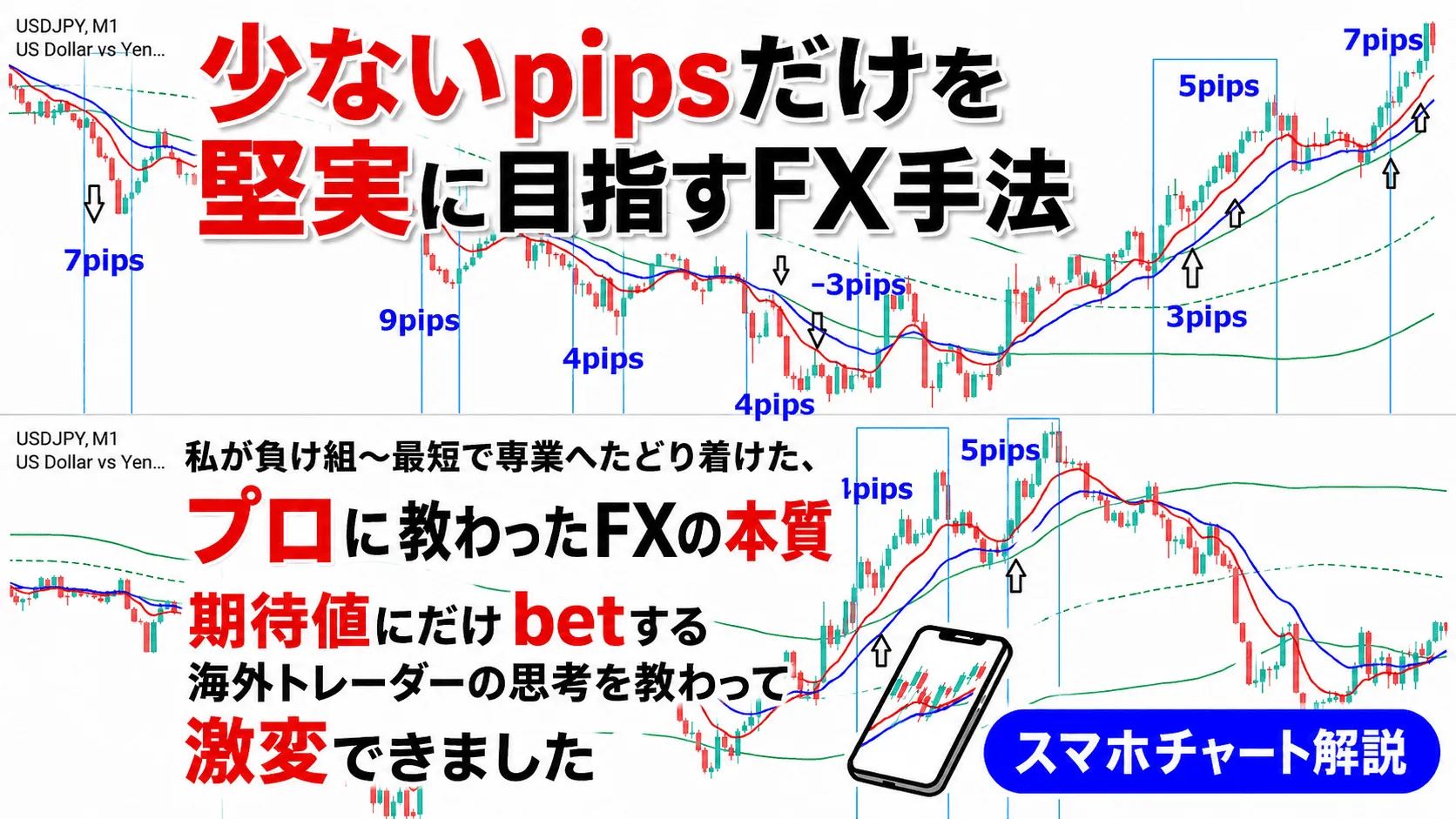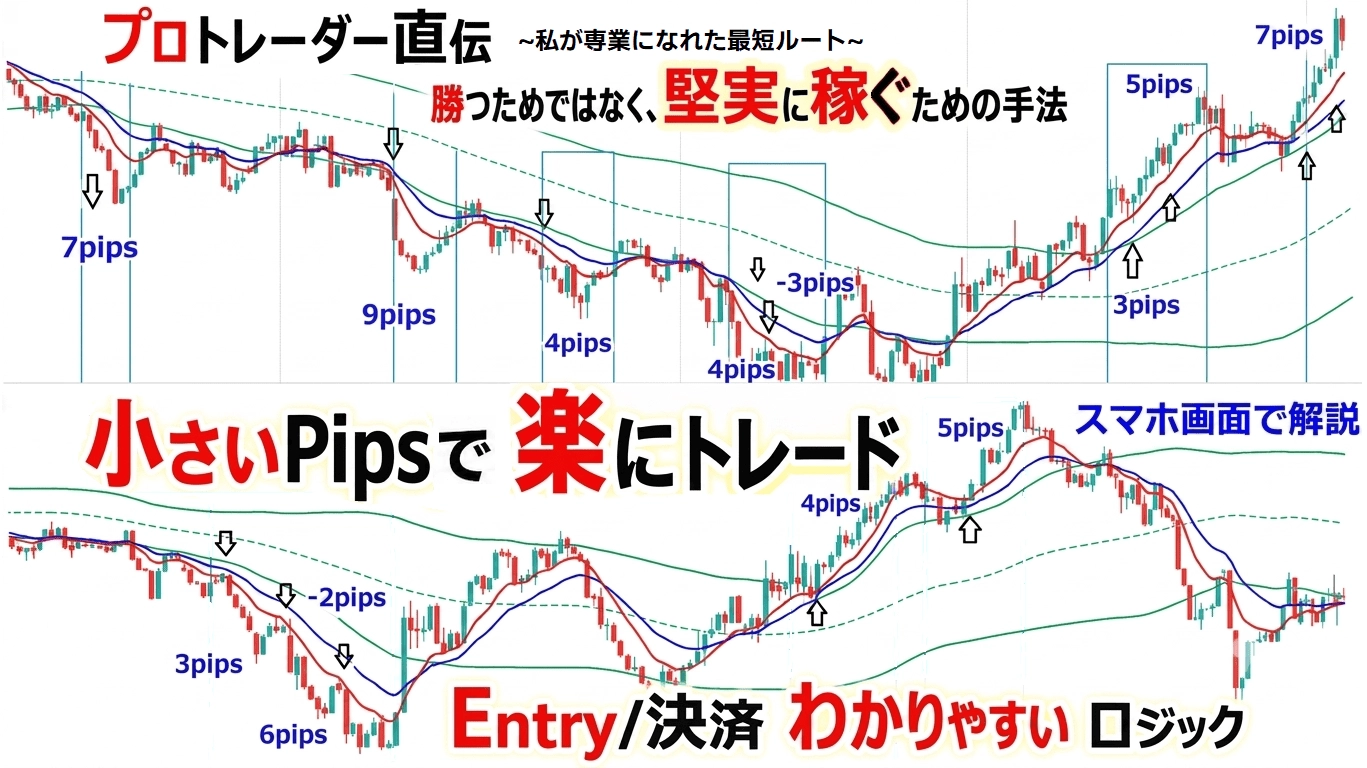
[Method Explanation ⑦] What the legendary traders consider most important: expected value is not "win rate" but "upward rate"
【Method Explanation ⑦】What legends of trading focus on as the most important thing, the expected value is not “win rate” but “rate of increase.”
【Trading with the same perspective as legendary traders】
Legendary traders like Buffett and Soros say
“Only trade calmly in places where the expected value is high and likely to win. Do not touch difficult markets.”
Just by following this, you can earn, yet more than 90% of traders cannot...
Words of a professional trader
“When you enter, you first want the position to show profit; I want to enter in such a place.”
As mentioned many times in articles,
In scalping, you want to enter in a place where it becomes positive immediately after entry.
Conversely, if you cannot take a position that becomes positive immediately after entry, it will be tough.
So how can we find such places as part of a method?
If you are obsessed with “win rate,” you will not see the essence.
Even if you leave a drawdown untreated, it can recover to a profit.
Then, in terms of win rate, that would be counted as a “win,” so
the statement
“I want to enter in places where the position immediately becomes profitable”
does not apply here.
I want to enter in places that become profitable immediately after entry, as a part of my method.
That said, of course, it does not mean we can always do it 100% of the time.
My method is
I want to enter in places that become profitable immediately after entry, but
even if that’s not possible, at least before hitting the stop loss
I aim to enter at a place where there is a high probability of at least one instance of unrealized profit
before the stop loss is reached.in order to
My mentor, a professional trader, shares the same approach, and I learned this mindset from him,
and I use a method that combines what I like about his two techniques.
The word “win rate”
may seem to be everything at first glance, but
the path to reaching a “win rate” is actually complex.
What the logic of the method is aiming for?
Even if the trade with the method does not align with the expected flow or decision,
a profitable outcome is still a “win,”
but if the trade follows the expected flow and then fails to extend and returns to a loss, it is a “loss.”
For example, what my method’s logic aims to capture is
to seize “momentum.”
To reiterate
Even if you cannot enter in places that become profitable immediately after entry,
at least before hitting the stop loss
enter in places with a high probability of profit at least once
before the stop loss is reached,is how it is built.
Regarding exits,
・Take profit if it runs
・If suspicious, exit (at break-even, small loss, small profit)
・Stop loss: -1 pips to -6 pips (do not take losses beyond -6 pips)
This is the general approach, but in the second part
if it is suspicious, exit
even if you are at break-even or small gain or small loss is acceptable
from the perspective of win rate,
small profit = win
small loss = loss
would be classified in the opposite way.
The results, relative to what the method’s logic aims for, show that
classifying by “win rate” is completely meaningless.
The statement “don’t chase win rate” arises from these reasons.
Rather than focusing on win rate, enter at places where there is a probability that unrealized profit will appear.
To do that,
you capture momentum and enter.
This advantage is especially present because it is a 1-minute chart.
For example, there are times when the market moves more easily in certain hours,
and by looking at multiple pairs, you can observe that the dollar is moving, the yen is moving, etc.
Also, consider what the inherent strength of indicators is,
which becomes clearer when thought about.
You cannot derive “win rate” from indicators.
However, by using indicators,
you can identify areas with high potential to rise or fall.
Rather than winning with indicators, win by using indicators.
Using indicators,
for example, use a chart that includes candlesticks, MACD, moving averages, etc., as a map of the chart
When the map looks like this, it is likely to rise
When the map looks like this, the win rate is…
Which is more ambiguous, which one?
In my mentor and my method’s logic,
the aim is to trade where there is a high probability that prices will move a little after entry
This logic makes the target of “+10 pips in one day” realistic.
Even in a non-trending, range-bound area,
in scalping, you can capture momentum bit by bit in a place with some momentum.
The method I am currently practicing is here
【Steadily +10 pips per day】
A 1-minute FX method taught by professional traders that helped me escape the losing group (2–5 hours a day)
Explained with smartphone chart images
【Entry points】【Exit points】are easy to understand in the logic
■ Thought of overseas pro traders (legendary investors Buffett and Soros)
A trading method for earning, not just for winning
Trade based on the expectation value of “long where the rate of increase is high,” not on “win rate.”
↓
https://www.gogojungle.co.jp/tools/ebooks/76385
#USDJPY #EURUSD #FXMethod #FXBeginner #FXHolyGrail #FXWinStrategy #RealTrade #Scalping #Indicator #ProTrader #FXTrade #DayTrading #DayTrader#DayTrade #WantToBeATrader
#Investment #SelfInvestment #InvestmentLife #WantToBeAnInvestor #Freelance #WantToBeFreelance #FreedomOfWork #DesireFreedom #SecondCareer #StockLife #JobChangeInProgress #HomeWork
#AssetFormation #FundRaising #AssetManagement #IndependentBusiness #SoleProprietor #WantToBeSOlEpreneur #Entrepreneur #WantToMakeMoney #HowToMakeMoney #WantToStartABusiness #LeaveCorporateLife #SideHustle #WantSideHustle #HouseholdHustle #EntrepreneurWoman #MomEntrepreneur