
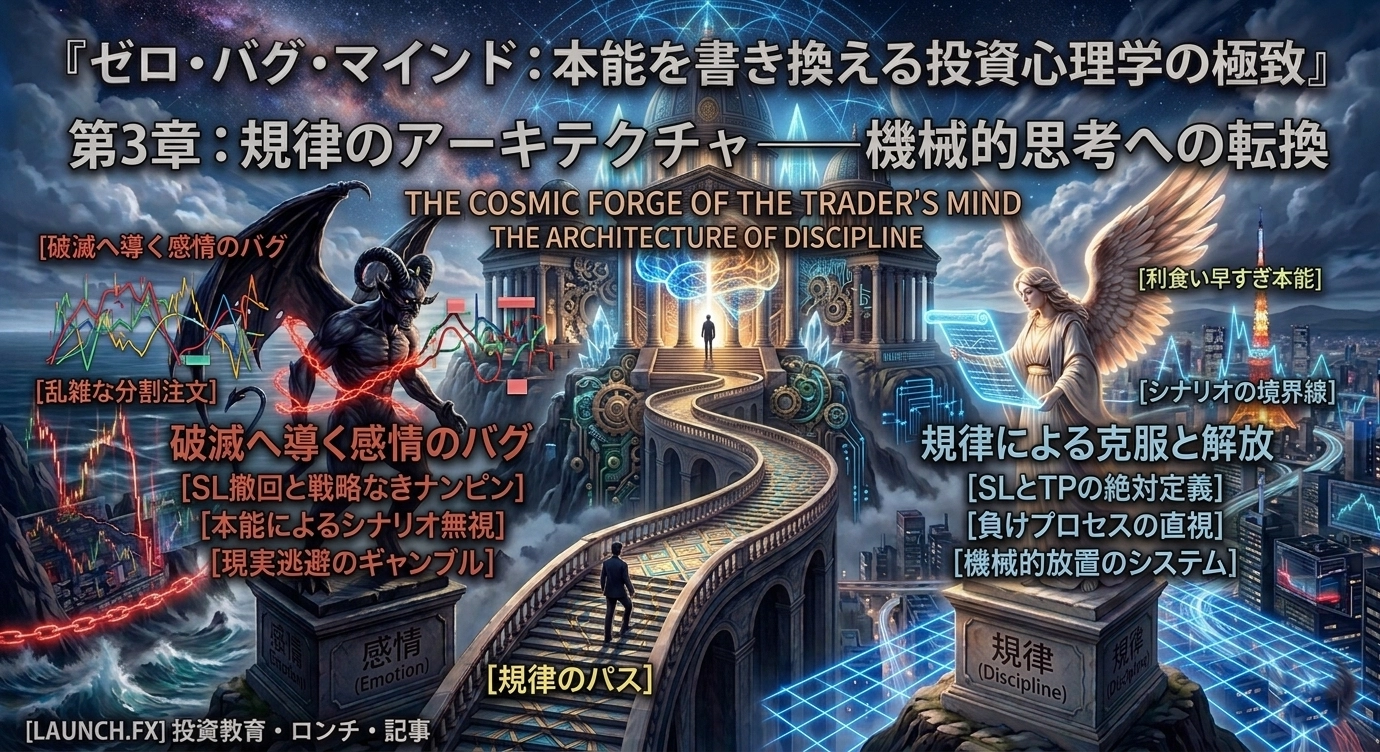
Chapter 3: Architecture of Regularities — Transformation into Mechanical Thinking
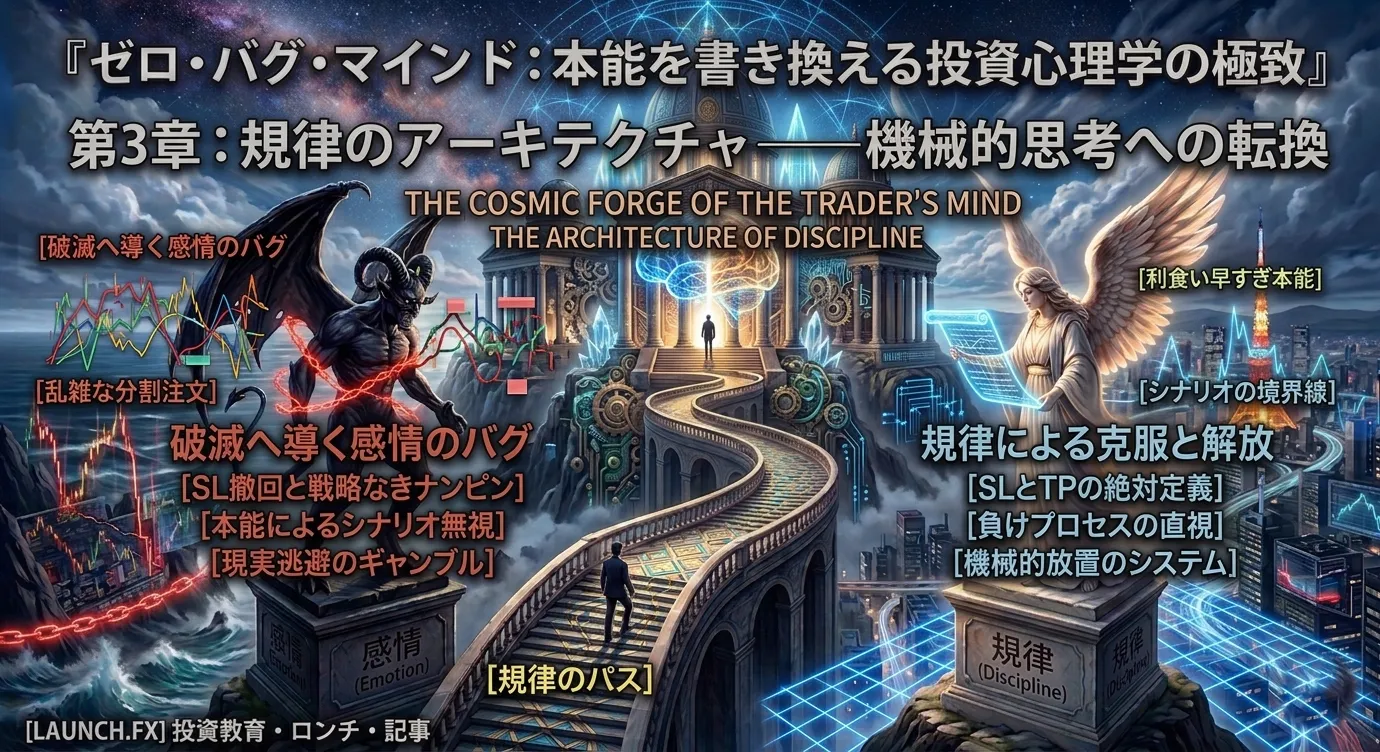
Chapter 3: Architecture of Rules—Turning to Mechanical Thinking
Do not rely on willpower; let the surrounding environment dominate
Many losers vow, “We’ll definitely follow the rules next time,” only to self-destruct again. Their fatal mistake is trusting their own willpower.
I affirm this: the moment your rate swings wildly and your money goes up and down, your brain is filled with adrenaline and fear, leaving almost no room for rational judgment. Before you even fight, the outcome is already decided.
Professionals can cut losses coldly not because their mental strength is superior, but because they are completely enclosed within a “discipline architecture (structure)” that eliminates room for emotion. To win, you don’t need a rock-solid mind; you need a system that preempts instinctual eruptions.
Putting into words “why there”—Absolute definitions of SL and TP
In building the architecture of discipline, the most important thing is Stop Loss (SL) and Take Profit (TP) settings in advance.
Many losing traders decide SL and TP by vague sensations like, “it seems likely to rebound around here” or “below the recent low.”
This is the biggest cause of brain bias harming you.
In the concept I propose, the ‘Zero-Bug Mind,’ SL and TP must be your“proof of the market scenario”.
-
The essence of Stop Loss (SL) is the “point of scenario collapse”
Before entering, the physical boundary line: “If this line is broken, I must admit that my rising scenario was 100% wrong.” That is SL. Simply moving SL or not setting it just because you don’t want to lose money is evidence of a brain bug (Prospect Theory) failing you. -
The essence of Take Profit (TP) is the “point where the scenario is achieved”
TP is the initial resistance band that the market is likely to reach if it moves as you expected. Fearful manual closure at small profits (early take) or greedily raising TP only to get a reversal—all of this is not about the scenario but about the current profit (emotion).
At the moment you press the entry button, if you cannot logically explain why SL is there and why TP is there, that trade is not trading—it is naked instinct and gambling.
[Destruction Pattern] Retracting SL and Pinning without a Strategy
In the trading world, can you guess what is the worst and most unattractive folly?
It is,“cancelling the SL the moment a drawdown hits it, and, without a plan, doubling down with no strategy”..
This is no longer trading. It is surrendering to the reality that your scenario was wrong, and inflating positions simply to “stay alive”—the fate of a brain hacked by instinct. Strategic, planned averaging (split entries) might be acceptable, but unplanned averaging to escape SL will sometimes temporarily save you as the market returns; in the long run it will cause“blowing up your entire account with one loss”.
Closing the screen is an escape. The most important is “seeing the loss through”
Many investment books advocate, “If you’ve set SL, close the screen.” Let me be clear:That is practically impossible.
When your own money is moving, no one can close the screen and walk away. Trying to avert your eyes will make you panic the moment you open your smartphone, impulsively removing the SL. What is truly needed is not running away.“To witness your own losing process with bleeding rigor, head-on.”.
The most painful yet most valuable ability in the market is the single matter of how you acknowledge your own loss (mistake). The fear as the rate heads toward the SL and the moment the loss is realized; by not averting your eyes and watching, you train your brain to recognize the cold reality that “your scenario was wrong,” down to the bone.
Acceptance of pain is the only trigger to rewrite your instincts
Only after repeatedly facing the loss directly in front of the screen will the brain’s bias (Prospect Theory) begin to quiet.
Gaze at the moment the SL is hit as proof of your mistake
Teach your brain that “loss = normal end of the scenario,” not “loss = failure.”
Instead of manually fiddling with orders to escape, you must see through to the end the reality where your drawn scenario is ruthlessly crushed. No matter how painful, accept that pain head-on and acknowledge your mistake. This posture of facing reality is the only path to dismantling the survival-instinct spell and transforming you into a professional trader.
Chapter 3 Summary and Foreshadowing for Chapter 4
Trading is not a game to seek the Holy Grail; it is a contest of how honestly and mechanically you can admit your own mistakes. Face SL and TP scenarios squarely, and watch the outcome no matter how your emotions rage. Once this mind architecture is complete, the market becomes a place that merely drains profits mechanically.
However, even with this resolve, many traders still fall into the “capital management trap” and blow up their accounts with a single trade. Why do they take such reckless risks with all their money on one trade?
Next time, Chapter 4 “Destruction of Lot Management—The Greatest Illusion of a One-Hit Kill”.
We will reveal the mathematical truths behind the madness of leverage and capital management—the cause of instant expulsion of novices from the market.
To continue delivering valuable essence,
at the top-left of the screen,【Follow】【Like】【Heart】your support is greatly appreciated.
If you found this helpful or want to read the next chapter, please consider a one-click support.
Refine market intuition and receive the latest information
Join the YouTube channelNote: Signal live streams are also conducted. Don’t forget to subscribe!