

Dollar/yen breaks through 162 yen! Yen depreciation shows no signs of stopping; markets warn of government intervention
USD/JPY Breaks Through 162 Yen! Yen's Decline Continues; Market Watches for Government Intervention
Today's Featured News
The USD/JPY rose to the 162 yen level, marking a historically weak yen not seen in about 40 years.
The Bank of Japan (BOJ) raised its policy rate to 1.0% last month, but the yen’s weakness shows no signs of slowing. In the market, attention is focused on when the government and the BOJ will take currency intervention action.
Why Isn’t the Yen Weakness Stopping?
① Even with BOJ rate hikes, the U.S.-Japan interest rate gap remains large
The BOJ’s rate hike this time was a historic event.
However, in the market, more than anything,the U.S.-Japan interest rate gapis being kept in mind.
Even now, the Fed's policy rate significantly exceeds the BOJ's, with a gap of about 2.75% (275 bp).
Against this backdrop of a wide rate gap, investors are selling the low-yielding yen to buy the high-yielding dollar through carry trades, supporting the rise in USD/JPY.
② The market views 160 yen as an “intervention line”
The Japanese government has not specified a concrete intervention level.
However, in the market,around 160 yenis increasingly seen as a trigger point for intervention.
USD/JPY has already risen to the 162 yen range, but while the Japanese government warns that it will take appropriate measures if necessary, it has not actually intervened.
Therefore the market sentiment is that “no intervention yet,” which is supporting dollar selling pressure.
“There hasn’t been any intervention yet”
is a view that continues to push the yen weaker.
③ Intervention alone cannot change the trend
Even if the government/BOJ conducts dollar-buying intervention, it may lead to a temporary rise in the yen.
However, the market’s view is that
“as long as the U.S.-Japan rate gap does not narrow, the yen’s downtrend will be hard to reverse.”
is prevailing.
In fact, in past interventions, rapid appreciation of the yen was often short-lived, with the yen weakening again afterward.
The Biggest Focus is the U.S. Jobs Report (NFP)
The next focal point is the U.S. employment data.
Market expectations are:
Nonfarm Payrolls (NFP):+110,000
Previous:+172,000
Unemployment Rate:4.3%
If the jobs data comes in below market expectations, U.S. long-term yields and the dollar may fall, and USD/JPY could adjust.
Conversely, if the data significantly surpasses expectations, expectations for a Fed rate hike could persist, potentially accelerating yen weakness.
Technical Analysis
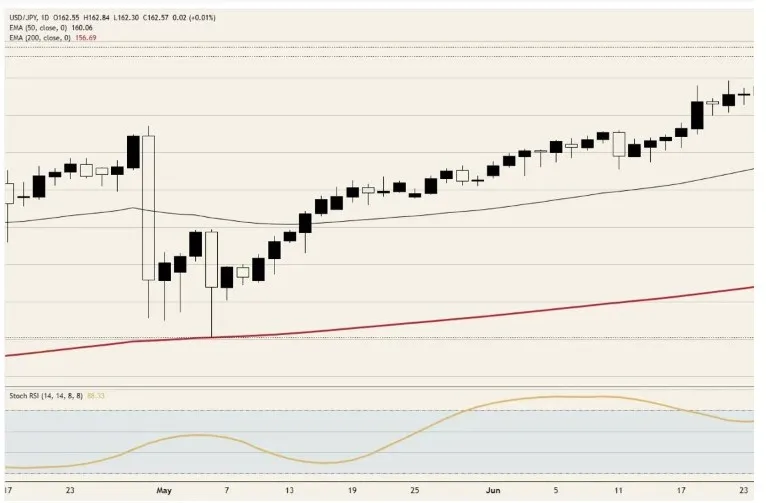
USD/JPY has risen tothe 162 yen rangeand the strong upward trend remains intact.
Both short-term and medium-term highs and lows continue to trend higher, with the market leaning toward dollar buying and yen selling.
However, the Stochastic RSI is in overbought territory, indicating short-term overheating.
Nevertheless, overheating alone does not signal a trend reversal, and currently dip-buying remains favored.
Key Price Range
Upper targets
・163.00
・164.00
※ If the yen weakness continues, market caution over currency intervention by the government/BOJ will rise.
Lower supports
・160.00
・50-day EMA (around 160)
・158.50
If there is a clear move below 160, it may indicate changes in market conditions such as intervention or narrowing of the U.S.-Japan rate gap.
Summary
✅ USD/JPY has risen to the 162 range
✅ Even after the BOJ rate hike, yen weakness persists
✅ The 275bp U.S.-Japan rate gap supports yen selling
✅ Markets view 160 as an intervention line
✅ The biggest focus is the U.S. jobs data (NFP)
The yen’s weakness is at a historically high level, but market dynamics still favor dollar buying driven by the U.S.-Japan rate gap.
Going forward, the U.S. jobs data results, the subsequent movement in U.S. interest rates, and when the Japanese government/BOJ will intervene will be major focal points for the USD/JPY pair.
