

Why is the yen bought? The true nature of the “risk-on/risk-off” that drives the USD/JPY market
Why is the yen bought? The true nature of “risk-on” and “risk-off” that steer the USD/JPY market
In the FX market,
“Today is a risk-off market.”
“USD/JPY rose on risk-on.”
We often hear these phrases.
However,
“What exactly is the difference between risk-on and risk-off?”
Have you ever wondered?
Actually, understanding this concept alone makes the price movements of the USD/JPY much easier to grasp.
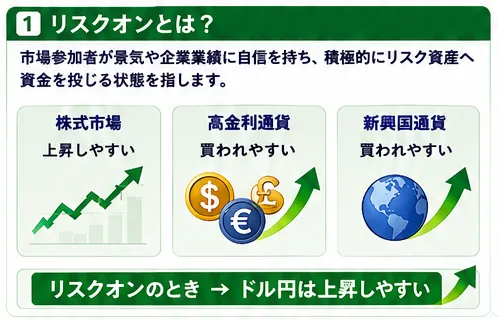
Risk-on refers to a state in which market participants have confidence in the economy and corporate earnings and actively allocate funds to risky assets.
This phase is characterized by rising stock markets and the tendency to buy high-yielding currencies and emerging market currencies.
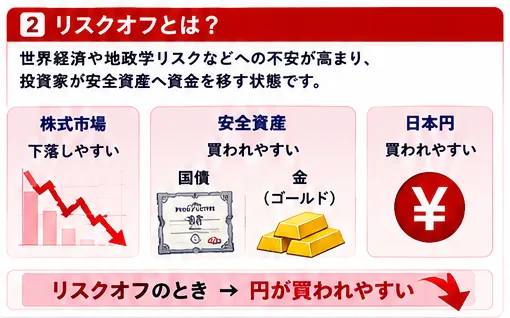
On the other hand, risk-off is a state where concerns about the world economy and geopolitical risks grow, and investors shift funds into safe assets.
Stock markets fall, and safe-haven assets such as government bonds, gold, and the Japanese yen tend to be bought.
Some of you may wonder here.
“Why the Japanese yen?”
Japan currently has ultra-low interest rates and is not a currency from which high yields can be expected.
Nevertheless, in global risk-off episodes, the yen often strengthens.
Behind this is a market structure that has been cultivated over many years, including Japan being one of the world’s largest net creditors and investors around the world using the yen as a funding currency.
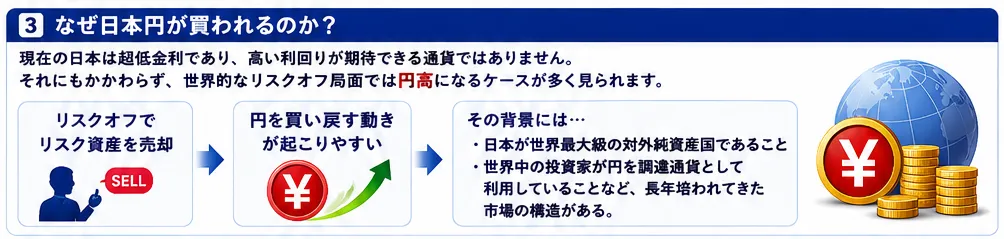
Therefore, when the market becomes unstable, investors tend to sell risky assets and buy back the yen.
In today’s USD/JPY market, this risk-on/risk-off movement is very important.
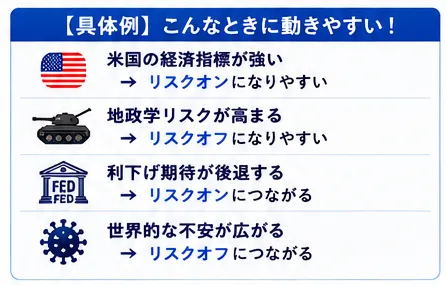
For example, if the U.S. economy remains solid and expectations for corporate earnings rise, the stock market tends to rise.
Then the whole market becomes risk-on, and the USD/JPY tends to rise as well.
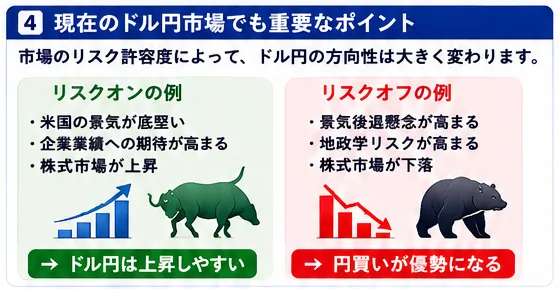
Conversely, when concerns about a recession and geopolitical risks increase, investors favor safe assets, and yen buying becomes dominant.
In other words, when looking at the USD/JPY, it is important not only to consider economic indicators but also to check the market’s overall “risk tolerance.”
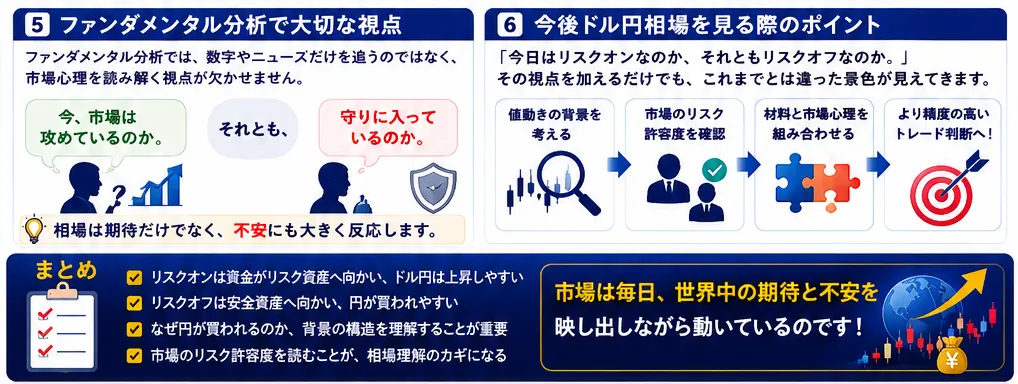
In fundamental analysis, it is not enough to chase numbers or news alone;
“Is the market attacking right now?”
or
“Is it entering a defensive posture?”
These perspectives for reading market psychology are indispensable.
The market reacts not only to expectations but also greatly to fears.
Therefore, by understanding the risk-on/risk-off concept, the underlying movements of the USD/JPY become clearer.
From now on when viewing markets,
“Is today risk-on or risk-off?”
Even adding this perspective should reveal a different landscape from before.
The market moves each day while reflecting the world’s hopes and anxieties.
★URL:https://www.gogojungle.co.jp/users/186761?via=indicators_detail_users