
[FX Beginner] Trading strategy using horizontal lines
A Beginner's Trading Strategy Using Horizontal Lines
~ Targeting the Transition from Range to Trend ~
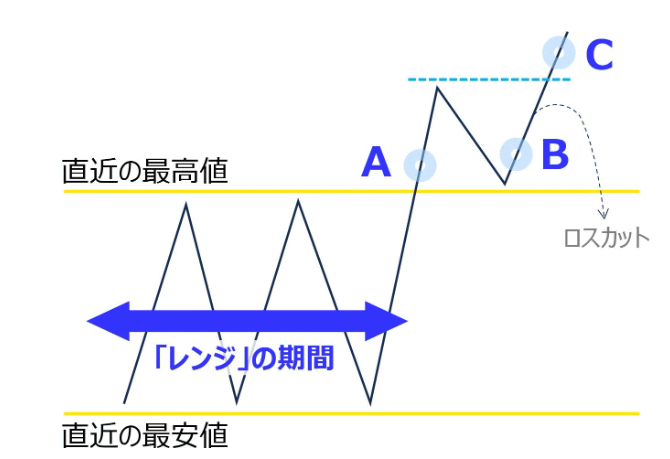
The market does not always move in a single direction. A range-bound market (consolidation) where prices move up and down within a certain range occurs for much of the time. This range is the condition in which prices are trapped between a resistance line that caps the upside and a support line that supports the downside.
During this period, the buying and selling forces are balanced, and the price range gradually narrows. Candlestick movements become smaller, and price volatility slows. Market participants' orders gradually accumulate, with many stop orders (loss-cut orders) clustering near the resistance and support lines. This state can be seen as a period when the market is “stocking up power” for the next big move.
Transition from Range to Trend
Range-bound markets do not last forever. Eventually, the balance of supply and demand is broken, and a breakout in one direction occurs. This often leads to orders that have been accumulated being filled in sequence, causing prices to move vigorously.
For example, if the price breaks above the resistance line, those who were selling begin to buy back, and new buying momentum judges that the price will continue higher, accelerating the rise. This movement is highly likely to mark the start of a new trend, but there are points to be cautious about.
Two Entry Points to Aim For
In trading using horizontal lines, particularly focus on the following two timings.
① Right after a Breakout Point (Breakout)
Immediately after breaking above the resistance line or breaking below the support line. This timing often has the strongest momentum, but it is also a place where “false breakouts” occur frequently. It may look like a break temporarily, then quickly revert back to the previous range, so instead of jumping in immediately, it is practical to combine the strength of the move, volume, and confirmation across multiple timeframes.
② Rebound Point After the Breakout (Role Reversal)
After an upward breakout, if the price drops back toward the vicinity of the pre-breakout resistance line and then this line functions as support and the price bounces from that level, this is called a “role reversal.”
The rebound here indicates market participants have reaffirmed that the breakout direction is correct, and there tend to be fewer false breakouts and relatively higher win rates than right after the breakout. It is a particularly approachable entry point for traders riding a trend, especially for beginners.
Opportunities Rotate… Trends and Ranges Enter in Alternation is alternating
The movement of “range (contraction)” followed by “trend (expansion)” is a fundamental mechanism of the market. Generally, the longer the range-bound period lasts or the more intense the compression, the larger the subsequent trend tends to be.
However, no one can predict exactly when the market will move or in which direction. What matters is to adhere to the following points.
- Enter based on clear rules
- Always set a stop loss (SL) (e.g., below the most recent low or above the high)
- Also decide your take profit (TP) in advance
- Do not risk too much capital on a single trade
In particular for beginners, it is important to prioritize point ② “role reversal” and wait for sufficient justification before acting. The FX market includes institutional and individual investors from around the world, and false moves happen frequently. Do not get swayed by a single win or loss; aim for a long-term balance of win rate and profit and loss.
Using horizontal lines for entry is simple, but with persistent observation it becomes a powerful tool. Start with demo trading to practice enough, and solidify your own rules before deploying real capital.
Horizontal Line Indicator: automatically draws resistance and support lines
→ Recommendation 1: displays other timeframes and currency pairs on the chart being viewed …Details here
→ Recommendation 2: show Bollinger Band expansion simultaneously …Details here