

Is the market looking at more than just economic indicators? The true nature of the “consensus” that moves the dollar/yen
What the market is watching isn't economic indicators? The true nature of the “consensus” moving the USD/JPY
In the FX market, important economic indicators are released almost every day.
U.S. employment statistics.
Consumer Price Index (CPI).
GDP growth rate.
Additionally, a lot of information flows to the market, including monetary policy from the Federal Reserve and the Bank of Japan.
When you look at such news,
“If the results are good, the dollar strengthens.”
“If the results are bad, the dollar weakens.”
It’s easy to think this way.
However, in actual markets, that isn’t always the case.
So why is that?
The answer lies in
the market consensus (market expectations)
Consensus refers to the results that many market participants anticipate in advance.
For example, regarding employment statistics,
the expectation that “employment will increase by 200,000”
is shared across the market.
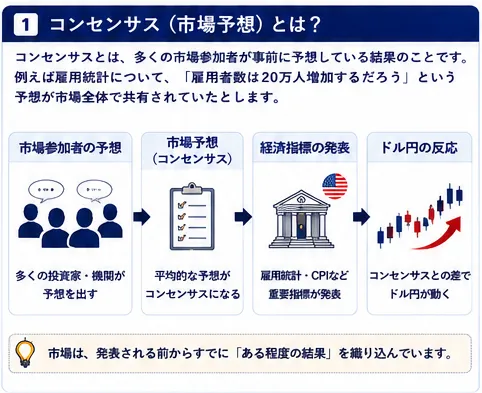
And if the actual result is also 200,000, at first glance it may seem like a positive factor.
But sometimes the market hardly moves.
That’s because
the market had already priced in that result.
On the other hand,
what if the forecast was for 200,000, but the actual figure was 280,000?
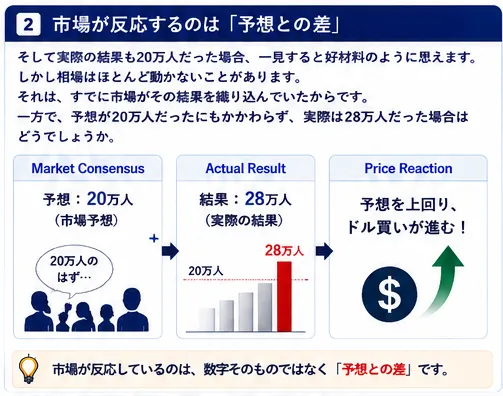
The market would
interpret it as “the economy is stronger than expected,”
and
be mindful that the timing of rate cuts by the Fed could be pushed back.
As a result, dollar buying may advance, pushing the USD/JPY higher.
In other words, what the market reacts to is not the numbers themselves, but the
difference from expectations
that matters.
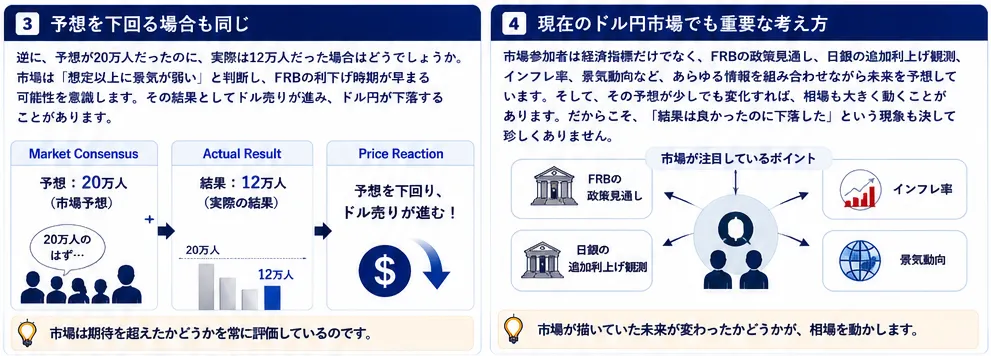
This way of thinking is also very important in the current USD/JPY market.
Market participants don’t just consider economic indicators; they combine
the outlook for Fed policy,
the possibility of additional rate hikes by the Bank of Japan,
inflation rates,
economic conditions,
and various other information to forecast the future.
And if that forecast shifts even slightly,
the market can move significantly.
That’s why
“the results were good but the price fell”
is by no means rare.
The market constantly evaluates whether expectations have been exceeded.
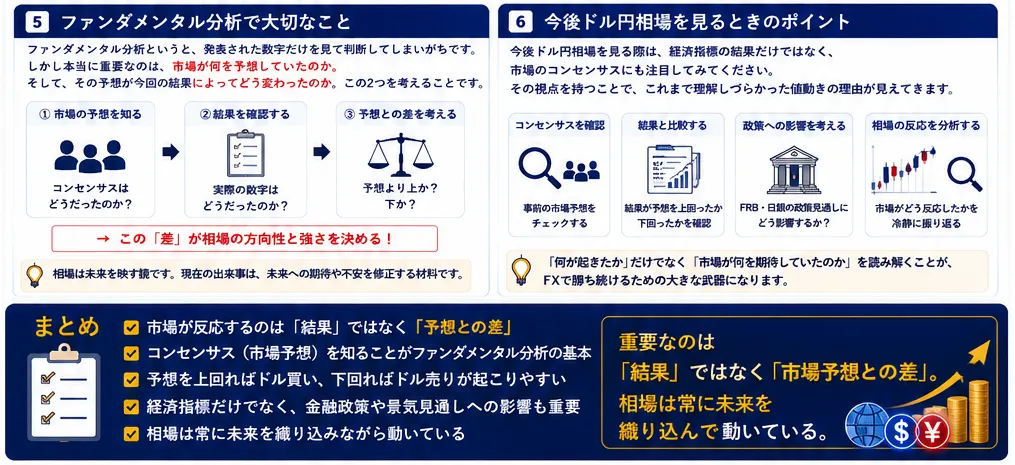
When people think of fundamental analysis,
they tend to judge based only on the released numbers.
But what’s truly important is
what the market was expecting.
And,
how that expectation has changed due to the current results.
Consider these two factors.
The market is a mirror that reflects the future.
Current events are only materials to adjust future expectations and anxieties.
Moving forward, when looking at the USD/JPY market,
pay attention not only to the results of economic indicators
but also to market consensus.
With that perspective, you should be able to understand reasons behind price movements that were previously hard to grasp.
To consistently win in the FX market, the key weapon will be the ability to interpret not only “what happened” but also “what the market was expecting.”
★URL:https://www.gogojungle.co.jp/users/186761?via=indicators_detail_users