
[Do not rush to confirm immediately after moving] Lessons from an 18-year trader
? After Move, Don’t Rush to Confirm — Lessons from an 18-Year Trader
To those who rush to enter right after stopping out or taking profits in GOLD trades. Why judgments go off after a “move,” the structural reasons, and a habit of checks you can start tomorrow, compiled from 18 years of experience.
Good evening!
This is Masashi^^
↓ A feature on GOLD’s antidote has been organized^^
Please participate now while you can.
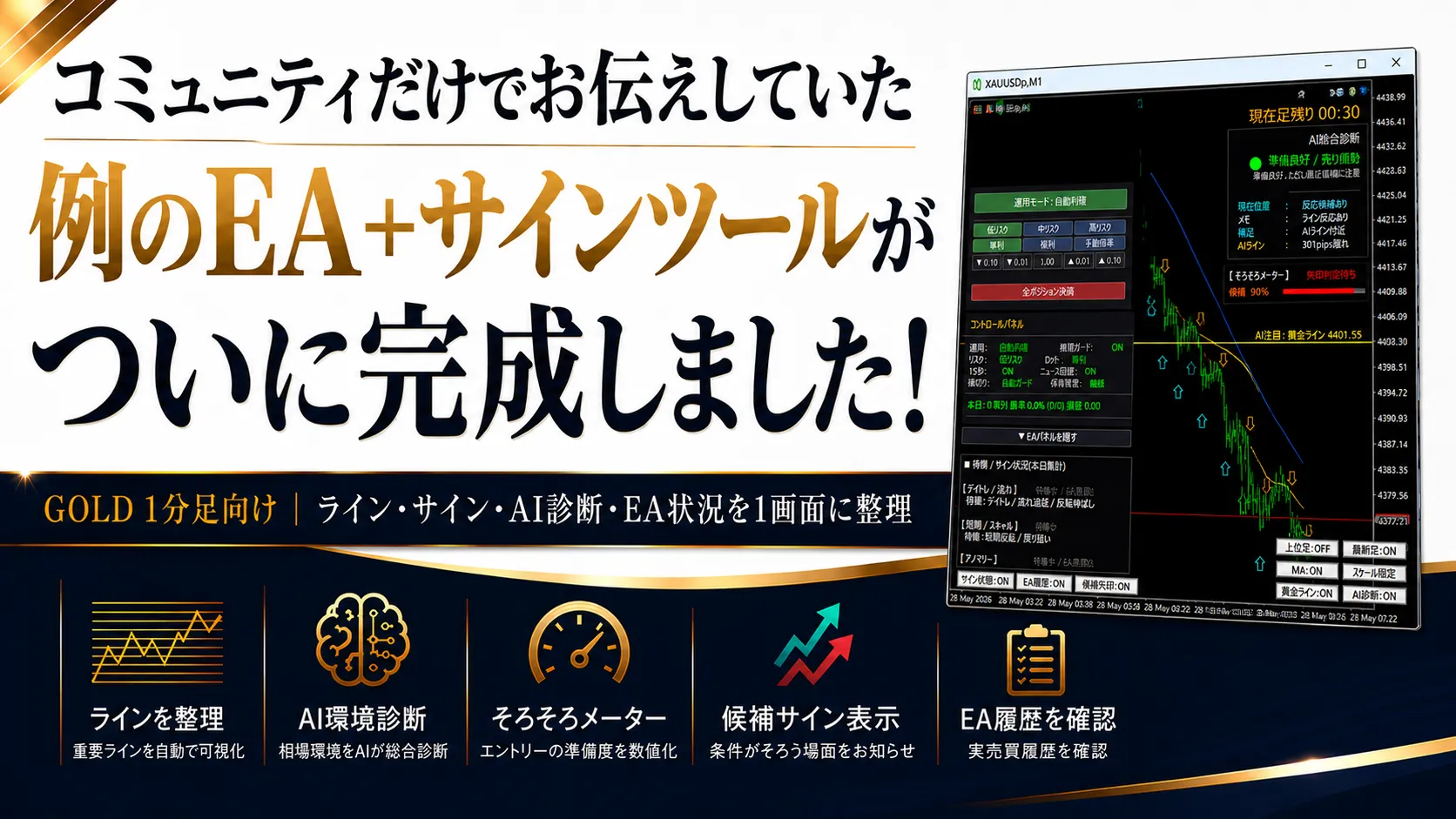
https://www.gogojungle.co.jp/tools/indicators/80000
This time I will write about the theme of “being thorough with confirmation after the move.”
In the past, after stopping out, I believed I could quickly recoup and kept watching the chart, only to add more losses (;'∀')
❌ After a stop-out, immediately entering again hoping to recoup
❌ After a big win, entering again with thin justification thinking “I can still go further”
❌ Even though I was "watching the chart," for some reason I still lost
What these have in common is not weak mentality, but a lack of a defined confirmation procedure— rather, the issue is the absence of a fixed verification processthat’s the reason.
❌ Things you do after the move
Right after you stop out, what are you doing?
Probably you haven’t closed the chart.
You keep looking at the screen and start searching for the next entry point.
The same after a big win.
You feel “If this momentum continues, I could take more,” and you enter one after another.
This is natural from a feeling perspective.
Humans tend to“continue the moving state”tendencies exist.
In trading, emotions swing strongly whether you gain or lose.
Those lingering emotions influence the next decision.
Let’s organize concretely what kind of actions arise.
❌ After a stop-out → “This is odd; there must be a way to recoup soon” while scanning the screen
❌ After a profit, → “There’s more I can go for” entering with weak justification
❌ After a winning streak → “I’m on a good run” and loosen standards
❌ After a losing streak → “I want to win once soon” so enter in places you wouldn’t normally
All of theseare states where emotions move first and checks come laterthan the other way around.
? Here’s a question for you.
What’s the win rate of entries made after a move?
Many traders feel it’s not good.
“Watching” and “being able to confirm” are completely different things.
Charts viewed with lingering post-move emotions tend to beonly what you want to seeseeing.
There’s a pre-made conclusion to enter here, and you look at the chart to justify it.
I’ve experienced this many times over the 18 years (;'∀')
By the time you notice it, it’s too late and you’re in a chain of stop-outs.
? “Move-after entries collapse” because of the quantity of confirmation, not its quality
First step is to put into words what you are doing after the move and recognize it.
? Why judgments go off after the move
Everyone understands that emotions influence decisions.
But if we understand it, why do we repeat it?
That’s because,it’s not an emotional problem, but a structural problem.
In trading, there is a necessity for “structural confirmation.”
Simply put,
✅ where is the market now (relation to the wall)
✅ what is the state of the wave right now (position on higher time frame)
✅ is this timing a place to trade (lower time frame state)
The proper flow is to confirm these three before deciding to enter.
However, in the “post-move” state, this confirmation gets“omitted”.
Why is it omitted?
When emotions are high, people try to “speed up processing.”
When the brain detects haste, it makes judgments by intuition rather than deep thinking.
As a result, people judge that “there is a place to get in” without first confirming “where the wall is” and “what the wave state is.”
? The scary part is“I think I’ve confirmed it”.
You watched the chart.
But you did not check the wall’s relation.
You did not confirm the higher-time-frame wave state.
Only the memory of “this shape resembles a past winner”entered into you.
Entering based on memory is completely different from confirming structure.
Furthermore, market after a move often changes state.
After a large move, the relation to the wall changes.
The wave state is entirely different before one move completes and after.
Therefore, “the judgments usable before moving” are not necessarily usable after moving.
Each time, you need toreconfirm the statenewly.
If you’ve thought, “Why did I lose even though the shape is the same as before?” this might be the cause.
⚖️ Post-move lack of confirmation isn’t laziness; haste causes you to skip structural checks
? What the winners do after moves
There are clear differences between winning traders and losing traders when comparing post-move actions.
What losing traders do after moves
❌ Immediately look for the next entry point
❌ Set a goal to recoup today (to gain back)
❌ Enter by looking for shapes that look similar on the chart
❌ Let the result of the immediately prior entry bias the judgment
What winning traders do after moves
✅ Stop consciously once
✅ Confirm whether the current state is the same as before moving
✅ If the structure has changed, wait for the next timing
✅ Don’t worry about “current P/L”; base decisions only on the current structure
This is the fundamental difference.
Losing traders operate within a continuity“continuation”of prior entries.
They move in the continuous narrative of “I just stopped out, so I must recoup.”
Winning traders operate with a sense of“independence”from prior entries.
They operate with a detached view: “the prior entry and the current entry are entirely different.”
Saying it aloud sounds obvious.
But whether you can actually do it is a different story.
There’s a big gap between “understood” and “done.”
Filling that gap isn’t about willpower.
Habit: perform confirmation in the same steps every time.
Winners look calm not because their minds are unusually strong, but because their structural confirmation is fixed.
Answering questions like “What is the current wall relation?” and “What is the current wave state?” is automated, so even when rushed you can perform the same confirmations.
Conversely, if this process isn’t fixed, your judgments will keep swinging after moves.
? Winners reset after moves. Independently rechecking the current structure, not tied to the previous entry
? The concept of “Reset Confirmations”
So, how should we think about it?
What I consciously use is“Reset Confirmation”as a concept.
After movement, before seeking the next entry, always insert a step to re-confirm the current structure.
That’s all.
However, what’s important is“what to confirm”.
First,confirm the current situation on the lower time frame.
Get a rough idea of what moves are occurring and where you are.
Next,confirm the wall position and wave state on the higher time frame.
After movement, has the relationship to the wall changed?
Has the wave settled or is it still ongoing?
Carefully confirm this on the higher time frame.
Then,return to the lower time frame.
Compare the wall and wave state confirmed on the higher time frame with the current lower time frame state to judge whether you are in a position to enter.
This back-and-forth of lower time frame → higher time frame → lower time frameis the basic flow of reset confirmation.
? A lot of people make a mistake here bylooking for a place to enter on the higher time frame.
The higher time frame is for grasping the larger structure.
It is not a frame to decide where to enter.
If you look for a place you can enter on the higher frame, when you return to the lower frame you will end up watching to justify what you decided on the higher frame.
That’s not confirmation; it’san act of justifying your own decision afterwards.
This tends to occur especially after moves.
In a state of haste, the impulse is to decide to enter the moment you confirm a higher-frame entry.
Reset confirmation isto separate roles and confirm in order.
Trying to rush to conclusions causes breakdowns.
⚖️ The higher time frame is where you confirm only the wall’s position and the wave state. The decision to enter comes after returning to the lower time frame. This separation of roles prevents post-move drift
✅ Three steps you can start tomorrow
So, what should you do starting tomorrow?
I’ll outline three concrete steps.
Step 1: Build a habit of recording “after a move”
First, after stop-outs or taking profits, record how many minutes passed until the next entry.
No special tools are needed. A notepad suffices.
When a record like “stop-out → next entry two minutes later” exists, it’s likely an entry made without emotional removal..
First step is to make visible, in numbers, how quickly you enter next.
Step 2: Use a confirmation checklist after moves
Before seeking the next entry, make it a rule to answer the following questions.
? “Is my current position close to the wall or far from it?”
? “Is the higher-time-frame wave settled or still in progress?”
? “Is the lower-time-frame state in a form that could enter?”
If you can’t answer these three in words, do not enter.
Step 3: Look at your post-move self with a different perspective
This actually works surprisingly well^^
The moment you consider entering, ask yourself once, “Am I feeling rushed now?”
If you answer “Yes,” wait 5 minutes.
If you still want to enter after 5 minutes, repeat Step 2’s confirmation.
In my rookie days, I also had a long period of “I know it, but can’t do it” (;'∀')
What resolved it wasn’t piling on mental strength, but“having set confirmation steps”.
If steps are fixed, you can act regardless of emotion.
If steps aren’t fixed, emotion dictates judgment.
✍️ Using a post-move confirmation list gradually reduces haste, because the act of confirming itself resets emotion
Try these three steps from your very first trade tomorrow.
If one run goes well, ingrain that pattern as the correct form.
Accumulation will erase post-move drift from its structural roots.
? Conclusion: What I’ve learned in 18 years
“Shortening confirmations after moves” isn’t a mental issue.
It’s because the confirmation steps aren’t fixed.
When movement occurs, stop briefly, check the lower frame, then confirm the wall and wave on the higher frame, then go back to the lower frame.
This back-and-forth forms the basis of decisions not swayed by emotions.
Whether right after stopping out or after big gains,the confirmation steps don’t change.
Following the same steps every time is the fastest way to reduce result drift.
After 18 years, I’ve come to understand this well.
If you chase flashy wins, the “move-after” move becomes fatal.
Conversely, those who have the habit of carefully confirming after moves tend to endure longer.
Stay calm, and build steadily^^
? The content this time“the answer of the market”is something that those who already have the answer will understand more deeply.
This summarizes in two years’ worth of narrowing down the roles of resistance, waves, lower time frames and higher time frames.
If you’re curious, please take a look.
✅ The market’s answer
https://www.gogojungle.co.jp/tools/ebooks/77829
? Free AI tool for trade analysis