Losers are the most obsessed with win rate
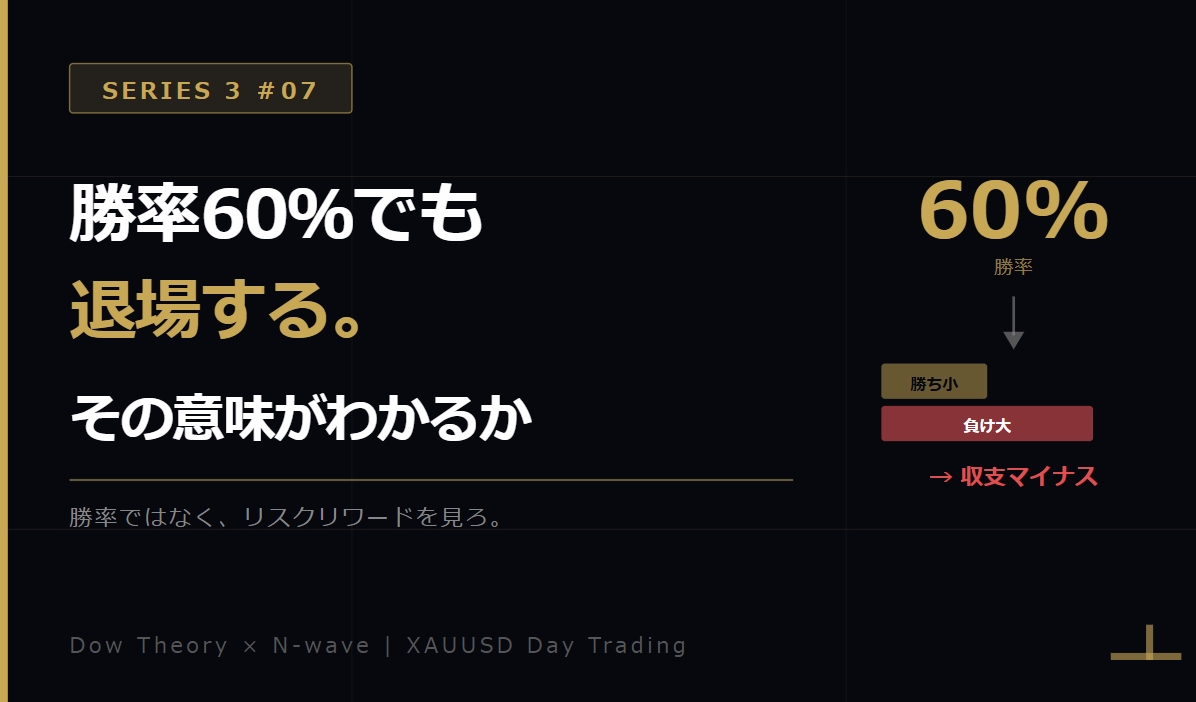
You Exit Even at a 60% Win Rate. Do You Understand What That Means?
you do not know the fact that you can lose capital even with a 60% win rate.
There are many traders who think, “If I improve my win rate, I will win.” Therefore they search for high-win-rate methods. Phrases like “a 70% win-rate method” or “an 80% win-rate logic” attract them.
But there is a big pitfall here.Even with a high win rate, if your risk management collapses, you will be wiped out.Even if the win rate is objectively excellent at 60%, if the balance of profits and losses is poor, your capital will decrease.
Win rate is only one aspect of trading. What really matters is the total expectancy, which combines the win rate and the size of each win/loss.
Concrete Example of Losing Despite a 60% Win Rate
Let’s consider a simple example. Suppose you have a method with a 60% win rate. If you trade 10 times, you win 6 and lose 4. On the surface, it seems you have an edge.
But what happens if each win is small and each loss is large? For example, wins yield 10,000 yen, losses yield 20,000 yen.
10 trades (60% win rate)
・Wins: 6 × +10,000 = +60,000
・Losses: 4 × −20,000 = −80,000
・Total =−20,000
Even with a 60% win rate, the total is negative.
This happens because wins are small and losses are large.
Even with a 60% win rate, if the balance of profits and losses is poor, the total can be negative like this.A high win rate does not guarantee profits.
The Illusion of “Slow and Steady Then a Big Blow”
A high win rate but shrinking capital is the typical losing pattern called “slow and steady then a big blast.”
You accumulate small profits steadily (high win rate). But occasionally you take a big loss (one loss is large). That one big hit can wipe out all the profits you built up gradually. This is the typical trader who has a high win rate but cannot win.
Why does this happen? You want profits realized quickly (hence small profits). You don’t want losses realized (hence you endure losses until they get large). This psychology creates the worst balance: small wins and big losses.
The more you chase win rate, the more you fall into this trap. The psychology of “I don’t want to lower my win rate” leads to premature take-profit and overly delayed stop-loss.