
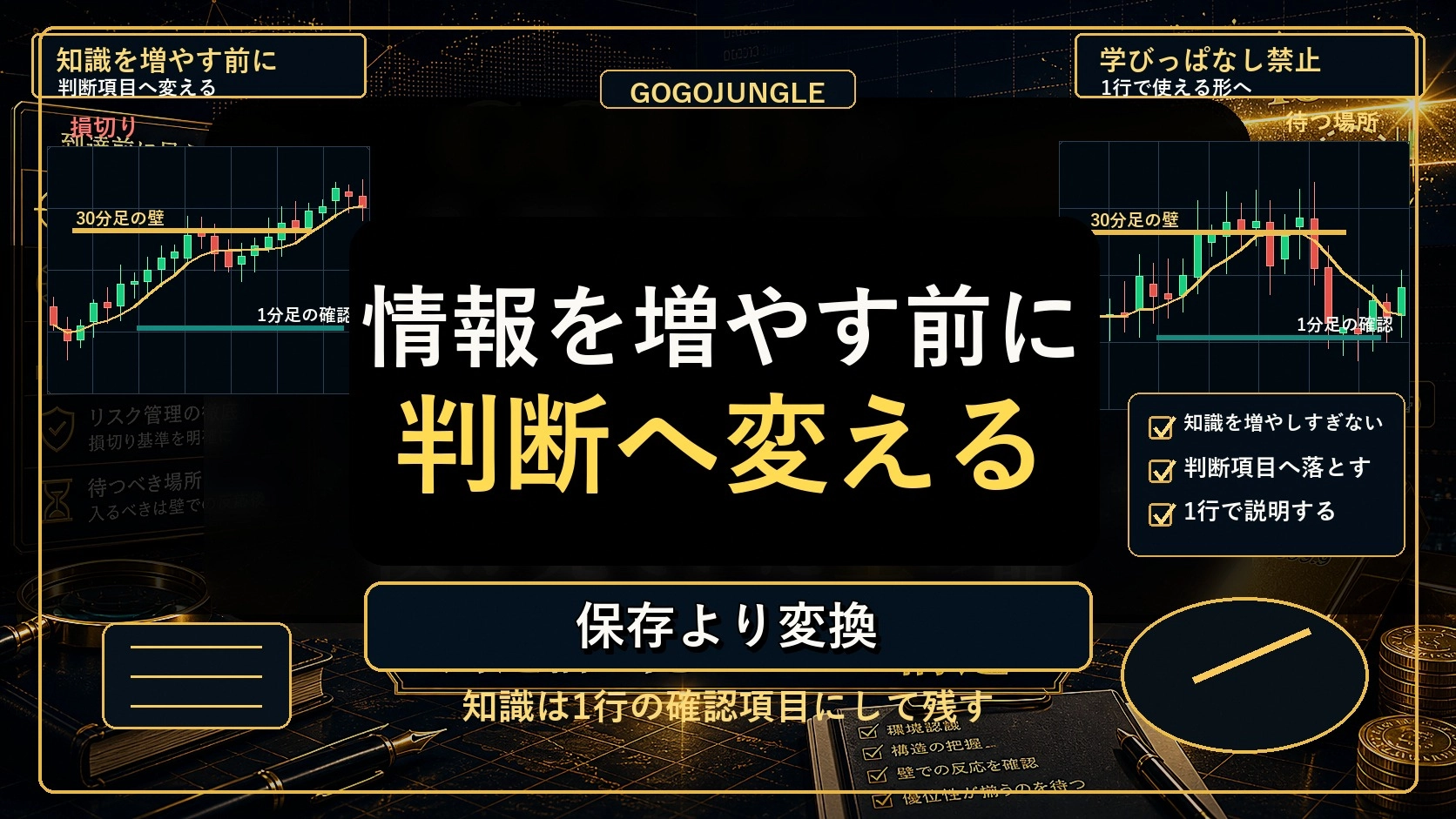
[Reasons Why You Can't Win Despite Collecting Information] How to Turn Knowledge into Judgment
? Reasons you can’t win despite information gathering|How to turn knowledge into judgment with GOLD Trade
For those studying GOLD trading but still lacking stable judgment on the right edge, this article summarizes what to do to convert information into judgment before increasing it.
Good evening!
This is Masashi^^
↓ A special feature with GOLD antidote has been organized ^^
Please join now while you can.
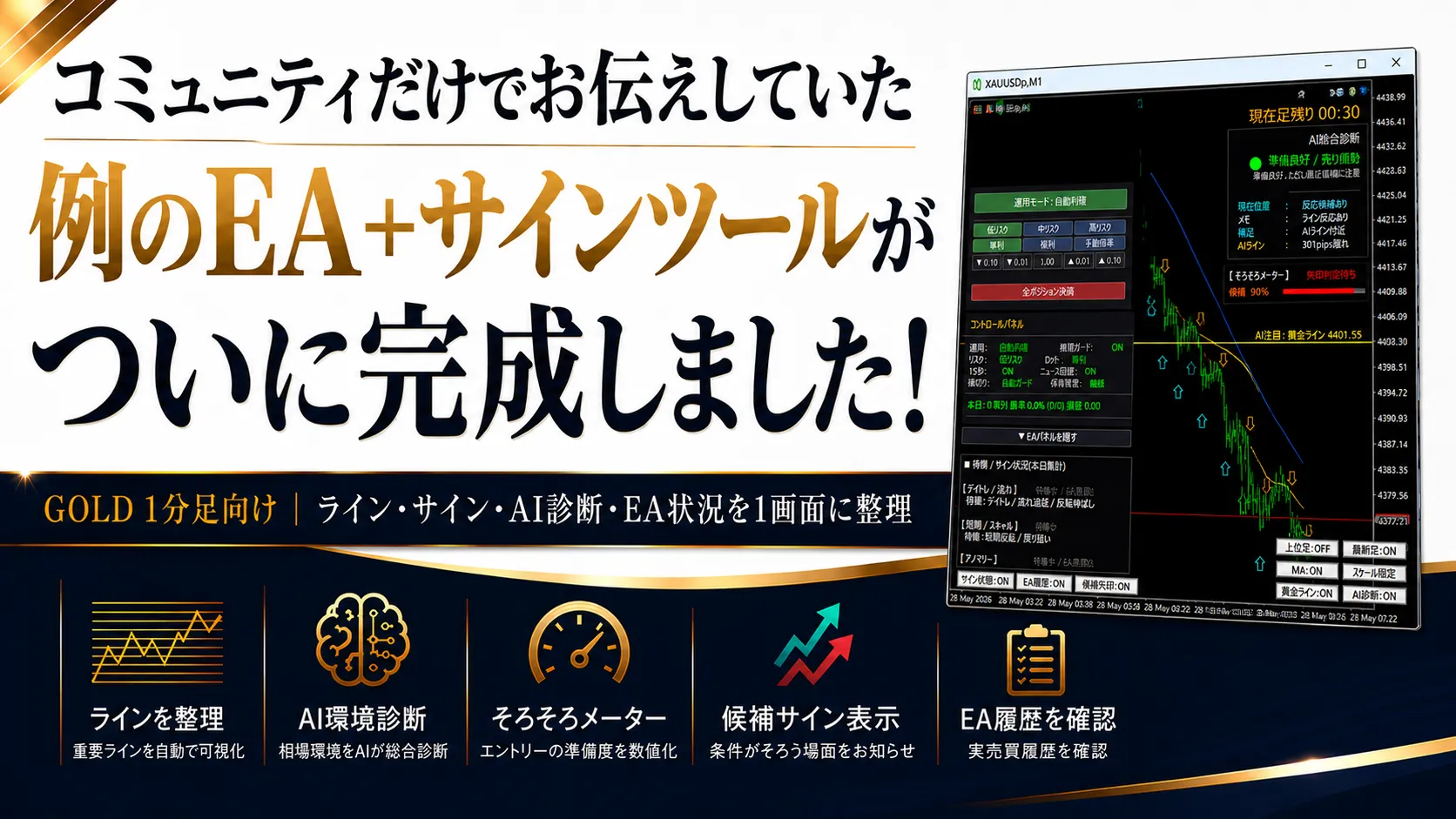
https://www.gogojungle.co.jp/tools/indicators/80000
This time I will write about “the real reasons you can’t win even after gathering information.”
In the past, after losing, I would search, watch videos, add another way of thinking, and end up more confused (;'∀')
It’s not that you’re not studying.
On the contrary, you study more than others.
And yet, judgment on the right edge of the chart stops.
This is quite painful.
Even though you’re putting in effort, results don’t follow, making you feel lacking in sense.
But after 18 years, I think the issue isn’t the amount of information.
Knowledge hasn’t transformed into your own judgment itemsso you can’t use it at the right edge.
? Even if the study amount increases, if it doesn’t become a judgment word, it can’t be used in real trading.
❌ The more information you gather, the more you hesitate at the right edge
After a loss, people search for information.
I was the same.
“What was missing?”
“Isn’t there a better way to look at it?”
“Maybe a different method would solve it.”
Thinking this, you seek the next information.
At first, it feels like study is happening.
You learn words you didn’t know.
You learn new viewpoints.
You feel you understand the chart descriptions better.
But in practice, you stop.
Why? Because information by itself does not become judgment.
The rules others talk about are built on that person’s experience, their chart, and their judgment axis.
Even if you bring them as-is, you often can’t use them at your right edge.
As you increase knowledge, you also see more.
The more you see, the more judging materials you gain.
If you accumulate too many judging materials, you won’t know what to prioritize.
This is a common trap for people who study but don’t win.
It’s not a lack of information but where you place the information.
⚖️ If increasing information makes you hesitate, what’s missing isn’t knowledge but priority.
⚖️ The more you rely on others’ correct answers, the thinner your own judgment becomes
What’s scary about information gathering is turning others’ correct answers into your own without adaptation.
That person’s chart is correct.
That person’s experience works for them.
But it doesn’t necessarily work the same at your right edge.
Skipping this makes knowledge accumulate but your judgment grow薄く薄く
That person said this.
Another person said the opposite.
The教材 said it like this.
The video explained it this way.
Even with all of it in your head, you still can’t decide what to look at on this chart now.
I believe this is the true fatigue of information.
What’s important isn’t to negate others’ correct answers.
It’s to convert them into your own verification items.
Information that can’t be converted can be set aside for now.
I used to try to use all the gathered information.
I thought it wasteful not to use what I learned.
But in reality, standing at the right edge with unused information is riskier.
Judgment is determined not by how much knowledge you hold but by the order in which you use it in the current moment.
So, prune after studying.
Leave only one line that you can use on the next chart you’ll look at.
⚖️ Other people’s correct answers won’t become your judgment as-is. You must convert them into one line to use them.
? Knowledge becomes usable only after it becomes a one-line confirmation item
So, how should you handle information?
The answer is simple.
After learning one thing, turn it into one-line confirmation.
For example, you learn about walls.
If you simply remember “walls are important,” it’s hard to use at the right edge.
Instead,
Transform it into: “Is the current price close to the wall or far from it?”
If you learned about waves,
Turn it into: “Is the current wave moving toward the wall or away from it?”
If you learned about stop-loss placement,
Turn it into: “Can I say the basis would collapse if I cross this point?”
If you can’t make this conversion, the knowledge remains only in your head.
When you read it, you agree.
But the moment you open a chart, it vanishes.
It’s crucial to boil down the knowledge to what you will check on the next chart.
✍️ Knowledge only becomes yours when it becomes a verification item, not when you just memorize it.
? Winners prune before increasing information
It may be surprising, but successful people don’t constantly add information.
Rather, they prune quite a bit.
Narrow what you use.
Decide the order of viewing.
Set aside information you can’t judge for now.
Being able to do this makes right-edge decisions less likely to be confused.
When you’re losing, you tend to want to add information.
But what’s truly needed isn’t more information, but deciding how to use the information you already have.
When looking at a chart, limit yourself to three checks each time.
The current location.
Relation to the wall.
Where it would be if different.
At first, this is plenty.
Without a judgment axis, adding information makes everything look like it’s important.
If everything looks important, you won’t be able to use any of it.
To prune information doesn’t mean stopping studying.
It means shaping what you study to fit your judgment.
? Before increasing information, prune existing knowledge so it can be used at the right edge.
✍️ Dropping it onto one chart changes your understanding
The fastest way to make studied content usable is to drop it onto a single chart.
If you simply summarize what you learned in a notebook from books or videos, you’re just organizing knowledge.
That has value, but to approach real practice, you need to fit it to the right edge of a chart.
The method is simple.
Stop at one chart.
Consider that moment as now.
Write down what you will confirm using what you learned.
“Check if it’s close to the wall”
“See if the wave is breaking”
“See if the stop-loss position can be determined by structure”
If you can write like this, that knowledge is closer to practical use.
Conversely, if you can’t write anything, your judgments aren’t formed yet.
What matters here isn’t hitting the correct answer.
It’s articulating what you intend to look at.
When you can verbalize it, you can review it.
When you can review it, you can fix it next time.
This is the flow that turns study into practice.
✍️ Knowledge that can’t be dropped into one chart isn’t yet usable for practical judgment.
? Separate notes for saving and for practice
Collecting information isn’t bad in itself.
Having an attitude to learn is important.
However, if the notes you save and the notes used in practice are the same, it becomes heavy on the right edge.
A notebook that collects all learned content tends to be long.
Explanations increase.
Examples increase.
Insights increase.
But during trading you won’t read such long notes.
Even if you look, you’ll hesitate about what to use.
Therefore I think it’s important to separate saving notes from practice notes.
For saving, leave detailed notes of what you learned.
For practice, leave only the next one-line item you’ll look at from that content.
For saving, it’s fine to have many explanations about walls and waves.
But for practice,
“Is the current price close to the wall?”
“Is the wave state in a recognizable form?”
“Can you say the different-location point?”
That level of detail is enough.
The words you use on the right edge should be short to be usable.
Long explanations are good for study but can slow judgment in practice.
Separating this greatly organizes information gathering.
Separate where you learn from where you use.
This small separation reduces right-edge hesitation.
? It’s okay if study terms are long; practice terms should be shortened to usable length.
✅ Four conversions you can start tomorrow
Step 1: Turn what you learned into one line
Not a long notebook, but a confirmation item you’ll check the next time you open a chart.
Not “look at the wall” but “now is it close to or far from the wall.”
Step 2: Test that one line on one chart
Stop on a past chart and check if you can use it at the right edge.
If you can’t explain it, your words are still too large.
Step 3: Don’t immediately increase unused knowledge; prune it
If you add more information while it remains unusable, you’ll be more confused.
First, shorten the current knowledge into a briefer confirmation.
Step 4: Also record reasons why it doesn’t fit
“There is information, but it couldn’t be used for judgment.”
Keeping this record reveals gaps in your study.
Doing these four steps changes the meaning of information gathering.
It’s not just reading; it remains for the next judgment.
✅ It’s not that you win just because you study; you win when you turn what you studied into judgment and can use it in practice.
? Conclusion: Before increasing knowledge, transform it into judgment
The reason you don’t win despite information gathering isn’t necessarily lack of effort.
Often, knowledge hasn’t become your own judgment items yet.
Therefore, what you should do next isn’t to increase information.
Turn the knowledge you already have into one line.
Test it on a single chart.
If it’s not usable, shorten it further.
And leave out reasons why it doesn’t fit.
If you can do this, study finally connects to practice.
There’s no need to rush.
First, write in one line what you will look for the next time you open a chart.
This content will deepen understanding for those who already have “the market’s answer.”
We’ve organized a thorough guide on converting the back-and-forth between walls, waves, and timeframes into your own judgment items on the教材 side.
If you’re curious, please take a look ^^
? Finally, a final recap
✅ Look at the location. ⚖️ Cross-check the conditions. ✍️ Leave a reason. ? Try it on the next chart. That’s enough ^^
? The market’s answer
https://www.gogojungle.co.jp/tools/ebooks/77829
? Free AI tool for trade analysis