

Is the job statistics alone enough to determine the market? The "market expectation" that moves the dollar-yen
The market won’t be ruled by employment data alone? The market’s “expectation value” that moves the USD/JPY
When it comes to economic indicators that draw the most attention every month in the FX market, the US Employment Situation (nonfarm payrolls) is still king.
There are moments when the dollar/yen moves by more than a full yen at the moment of release, and many traders focus on the results.
However, when you actually look at the market,
“The payroll data was strong, but the dollar didn’t rise.”
“The figure could have beaten expectations, yet the dollar wasn’t sold.”
These kinds of scenes are not rare.
Why does this happen?
The answer is
because the market is looking at the “expectation value,” not the result.
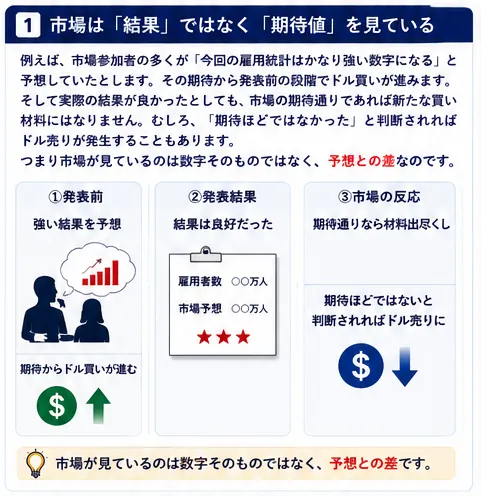
For example, suppose many market participants
anticipate that “this payroll report will show quite strong numbers.”
From that expectation, dollar buying tends to advance even before the release.
And even if the actual results are good, if they meet market expectations, they don’t become a new bullish driver.
Rather, if it’s judged that
“not as strong as expected,”
there can be dollar selling.
In other words, what the market is watching is not the numbers themselves,
but the difference from expectations.
This is still highly important in today’s USD/JPY market.
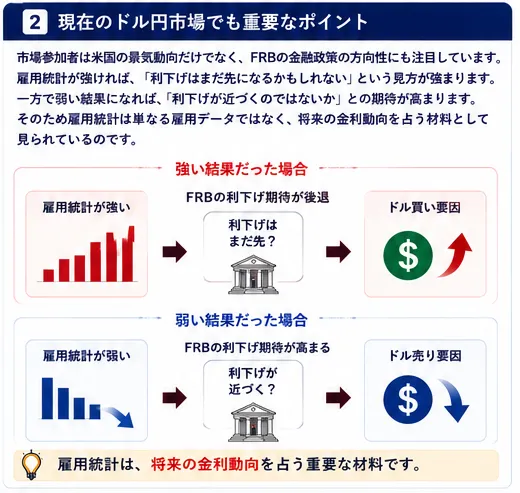
Market participants are paying attention not only to US economic trends but also to the direction of Federal Reserve policy.
If the employment data are strong,
the view that “rate cuts may be further off” strengthens.
Conversely, if the results are weak,
the expectation that “rate cuts may be coming closer” rises.
Therefore, employment data are not just employment data, but a factor used to gauge future interest rate trajectories.
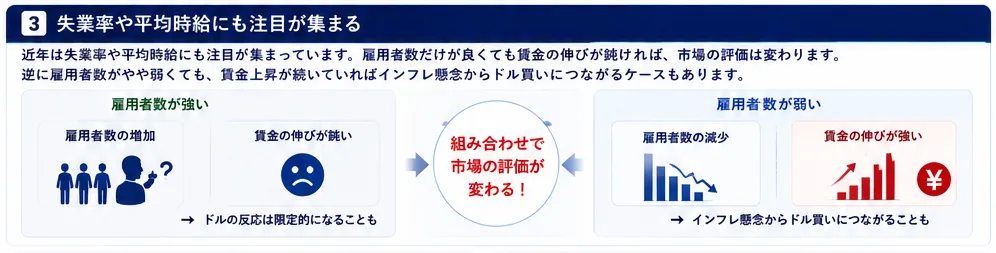
Moreover, in recent years, attention has also focused on unemployment rates and average wages.
Even if the number of employed persons is good, if wage growth is sluggish, market assessment can change.
On the other hand, even with slightly weak employment numbers, if wage growth continues, inflation concerns can lead to dollar buying.
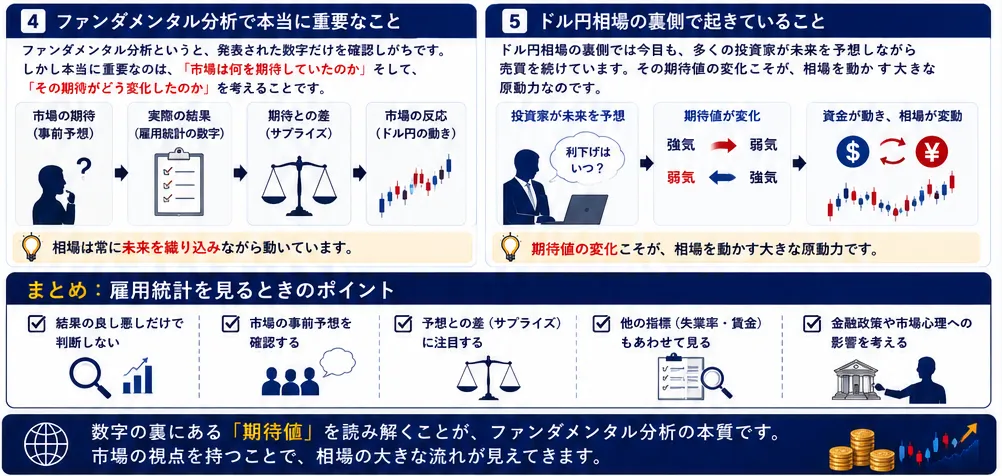
When people think of fundamental analysis, they tend to focus only on the released numbers.
But what’s truly important is
“What was the market expecting?”
And
“How did those expectations change?”
because markets always move while weaving in the future.
Therefore, when looking at employment data, it’s important not to decide based solely on the results, but to be aware of how those numbers influence monetary policy and market sentiment.
Behind the USD/JPY market today as well, many investors continue to buy and sell while forecasting the future.
That change in expectation value is the major driving force behind market movements.
★ Our URL:https://www.gogojungle.co.jp/users/186761?via=indicators_detail_users