

〔Updated June 24, 2026〕AITrendVision Verification Log|Is that EA really strong? Fixed lot 10 years with no collapse & high leverage compounding test from about 110,000 yen to about 16,736,000,000 yen | Zero-collapse Continuation Record 3,676 days
Hello, this is Tsumo.
I will update the validation logs for AITrendVision. This time, the theme is not just the profit amount.
Is it not just fixed lots?
Are you also enduring in compounding mode?
AITrendVision is not an EA that merely shows “it grew” or “it won.” Of course, the numbers on the backtest are quite strong.
With fixed lots, starting from an initial margin of 1,000 USD (about 110,000 yen), there has been no blowup for over 10 years. In compound mode, from the same approximate 110,000 yen equivalent, it reached about 1,633,600,000 yen equivalent.
However, the most important thing here is not the profit amount. Why didn’t it blow up? Does it have underlying strength with fixed lots? Can it endure the high load of compounding? This is the key.
If you are interested in AITrendVision, please see here.
“Backtests are not reliable” — does that justify not showing results?
On an EA introduction page, you may sometimes see explanations like “backtests are for reference.” This is partly true.
Indeed, backtests do not guarantee the future. Spreads, slippage, execution, server environment, sudden changes — in real markets there are many elements that differ from backtests.
But that does not mean you should not show backtests. Backtests are not perfect, but they are a minimum test to judge the EA’s inner logic.
In health check terms, it’s like saying, “test results do not guarantee future health” while not showing blood test values. If you’re told “healthy” without any figures, you cannot judge.
Just because backtests are good does not guarantee future wins. Yet how can a buyer judge an EA that does not show backtests at all? I think this is a crucial perspective when considering a purchase.
Common blind spot of “10 years of steady growth”
Often overlooked is the long-term backtest with fixed lots. No blowup for 10 years with fixed lots is valuable. However, fixed lots have a structural characteristic: as the balance grows, the relative risk declines.
Starting with 1,000 USD and 0.01 lots. At that point there is risk. But as the balance grows to 5,000 USD or 10,000 USD, the lot remains 0.01. The relative weight against the entire account keeps shrinking.
This is not a bad thing in real operation. It is a reasonable, prudent approach. However, if you want to rigorously judge the EA’s capability, it’s a different story. Is the EA truly strong, or did it just avoid early risky market conditions by chance? Was the balance buffer protecting it?
Users run the EA not from backtest start dates. They run it today. Tomorrow. There is no guarantee it will start from a favorable point like the backtest. Therefore, I do not judge solely by fixed lots.
First confirm stability with fixed lots
In AITrendVision v1.01, I first validated with fixed lots. Even if profits rise, I do not increase the lot; I assess the core strength of the EA itself.
| Fixed-Lot Verification Results | |
|---|---|
| Verification period | 2016/06/01 – 2026/06/24 |
| Initial Margin | 1,000 USD (about 110,000 yen) |
| Net Profit | 10,709.79 USD |
| Final Balance | 11,709.79 USD (about 1.89 million yen) |
| Profit Factor | 1.98 |
| Win rate | 78.11% |
| Total Trades | 10,775 |
| Max Drawdown | 1,199.18 USD |
| Max Drawdown Rate | 16.80% |
| Relative Drawdown | 26.45% |
| Zero Drawdown Continuity | 3,676 days |

No blowups over more than 10 years of verification. PF about 2.0, max DD below 20%. This is a very good result for the EA’s trading logic itself.
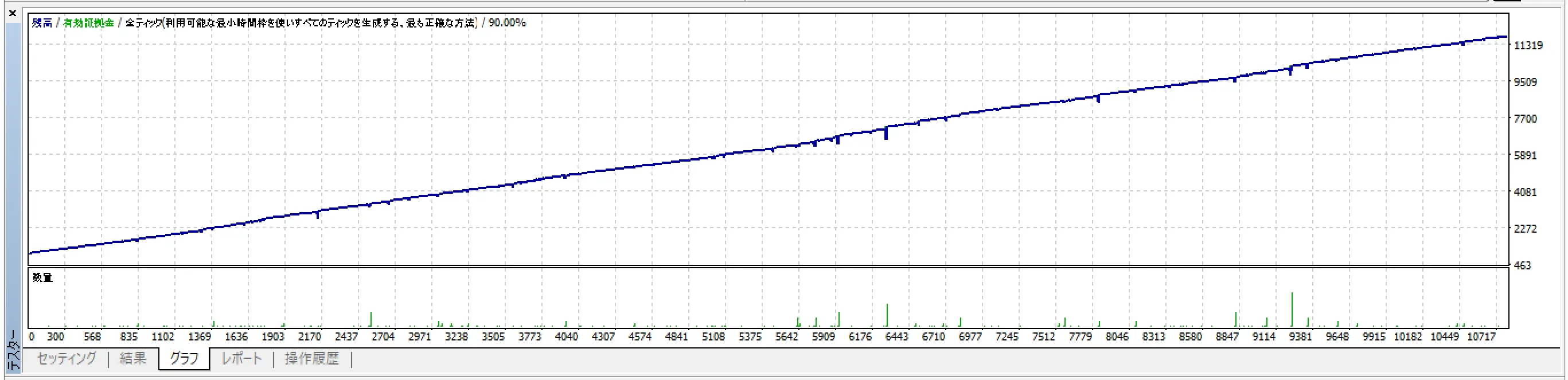
The asset curve for fixed lots is fairly linear. It does not explode suddenly, but it climbs steadily over a long period and does not collapse overall. It is important that this is not contrived by forcing compounding.
In short, I see the core logic of AITrendVision as having a certain stability. However, I will not stop here.
Compounding mode is not to inflate profits
Compounding mode is often thought of as a setting to visibly boost profits. Indeed, compounding makes the asset curve grow more, but that is not all I want to see in compounding mode.
In compounding mode, the lot increases as the balance increases. In other words, the path to safety that fixed lots enjoy as the balance grows is weakened. The real question is whether it can survive more than 10 years under this higher load. That is the true meaning of compounding mode verification.
No-collapse in compounding mode confirms durability.
The same “no collapse” carries different weights.
Results of compounding mode verification
Here are the results of compounding mode verification. The initial margin is the same 1,000 USD as fixed lots.
| Compounding Mode Verification Results | |
|---|---|
| Verification period | 2016/06/01 – 2026/06/24 |
| Initial Margin | 1,000 USD (about 110,000 yen) |
| Final Balance | About 1,035,758 USD |
| JPY Converted | Approximately 167,360,000 yen |
| Profit Factor | 2.06 |
| Win rate | 78.12% |
| Total Trades | 10,781 |
| Buy Win Rate | 77.94% |
| Sell Win Rate | 78.44% |
| Max Drawdown Rate | 56.66% |
| Relative Drawdown | 78.93% |

Compared to fixed lots, PF and win rate do not collapse significantly. It’s not that profits were artificially boosted simply by increasing lots. Even under high load, win rate and PF remain relatively strong. This is meaningful.
However, the maximum drawdown rose to 56.66%. This is not a light figure. But this is a natural result in compounding mode because both balance and lot size increase, so the latter half does not reduce risk.
I do not simply say “DD is large, therefore weak.” A large DD means consistently applying high load. It endured more than 10 years without collapsing under that load. That is the value here.
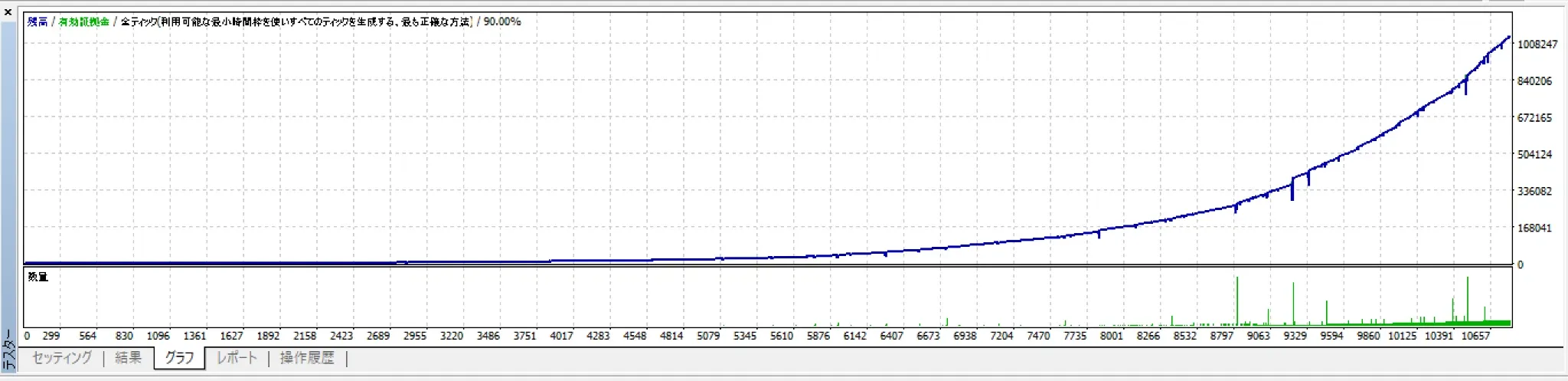
The compounding mode asset curve is completely different from fixed lots. It grows slowly in the early stage, then gradually in the middle, and accelerates sharply in the latter half. This is due to the profit-step lot increase mechanism.
Comparison of fixed lots and compounding mode
Fixed lots and compounding mode are not the same backtest. They have different goals.
| Item | Fixed Lot | Compounding Mode |
|---|---|---|
| Profit Factor | 1.98 | 2.06 |
| Win Rate | 78.11% | 78.12% |
| Final Balance | 11,709.79 USD | About 1,035,758 USD |
| Max Drawdown Rate | 16.80% | 56.66% |
| Purpose of Verification | Stability | Durability under high load |
Fixed lots verify the core strength of the EA. Compounding mode tests high-load durability as balance grows and lots increase. It is not correct to say fixed lots are superior just because DD is lower. Both have meaning, and viewing both gives a three-dimensional view of the EA.
Parameter settings for compounding mode
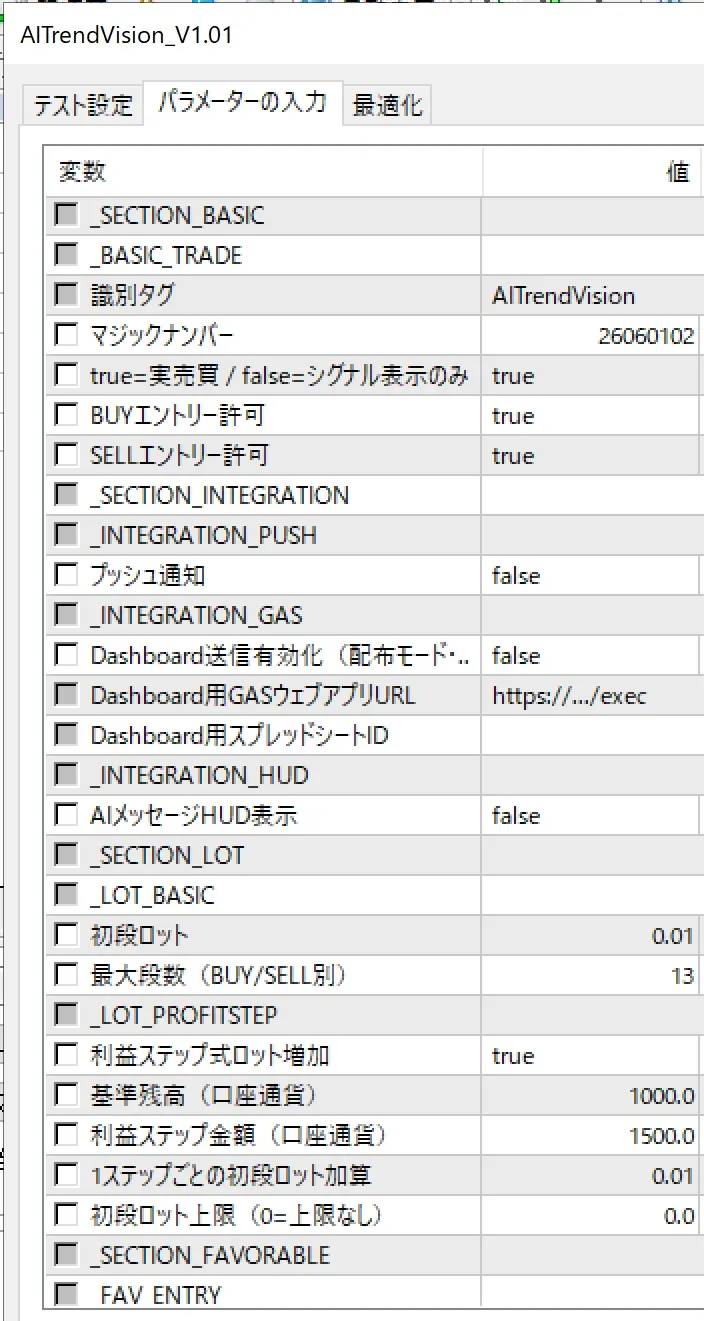
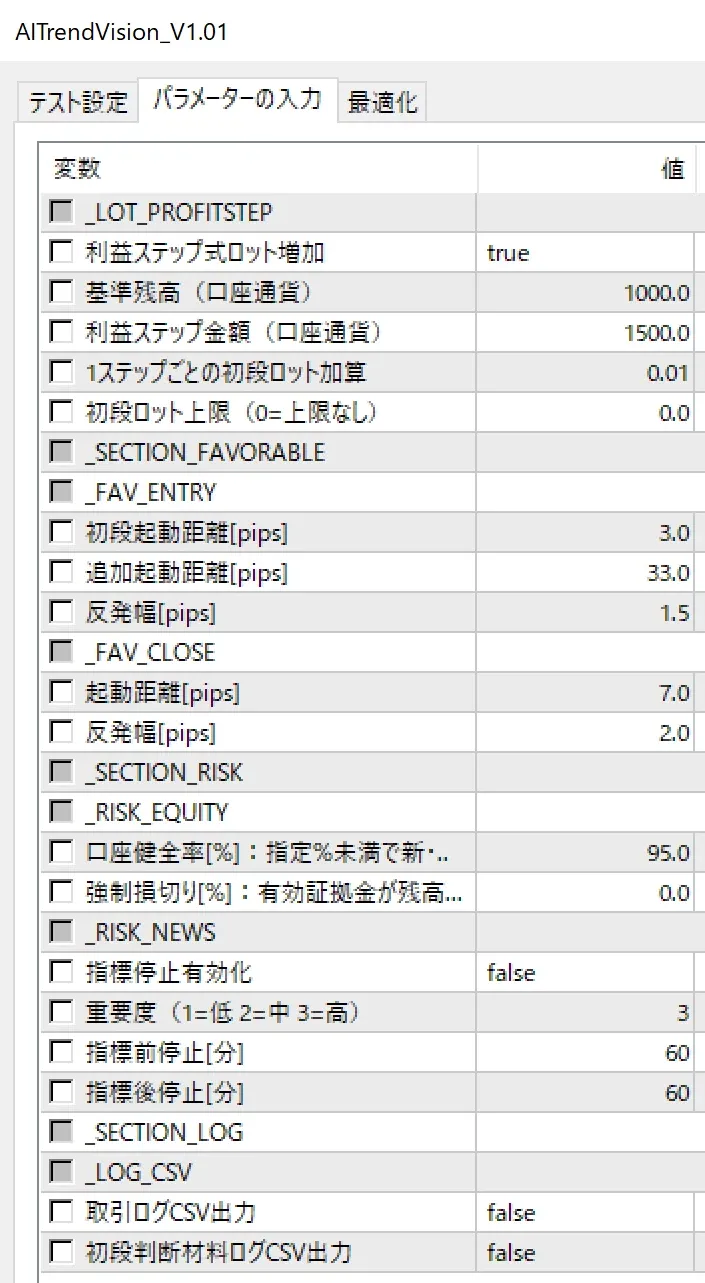
| Main Parameter Settings | |
|---|---|
| Initial Lot | 0.01 |
| Maximum Stages | 13 stages |
| BUY Entries | Allowed |
| SELL Entries | Allowed |
| Live Trading Mode | true |
| Profit-Step Lot Increase | ON |
| Reference Balance | 1,000 USD |
| Profit Step Amount | 1,500 USD |
| Lot Increment per Step | 0.01 |
| First-Step Lot Cap | 0.0 (No cap) |
Every time profits increase by 1,500 USD, the first-step lot increases by 0.01. As balance grows, lots increase and profits also grow. At the same time, drawdown also grows. If you don’t understand this and only look at compounding mode numbers, it can be dangerous.
Initial Lot Guidance by Initial Capital
In this test, with 1,000 USD, the initial lot is 0.01. AITrendVision can hold up to 13 stages, and increasing the first-step lot also increases later-stage load. In real operation, starting from the more conservative right-hand side guidance may be better.
| Initial Capital | Simple Proportional Guidance | Conservative Guidance |
|---|---|---|
| 1,000 USD | 0.01 lots | 0.01 lots |
| 2,000 USD | 0.02 lots | 0.01 lots |
| 3,000 USD | 0.03 lots | 0.02 lots |
| 5,000 USD | 0.05 lots | 0.03 lots |
| 10,000 USD | 0.10 lots | 0.05 lots |
Settings that perform well in backtests differ from those that stay in real accounts for a long time. Do not confuse the two.
Favored Entry and Favored Close
In this setup, the favorable-entry feature is also used. First-step activation distance 3.0 pips, additional activation distance 33.0 pips, rebound width 1.5 pips. This is the idea of not jumping at the moment a signal appears, but waiting for the price to move in a favorable direction once, then entering after confirming the rebound.
On the favorable-close side, activation distance 7.0 pips, rebound width 2.0 pips. Instead of simply closing when TP is hit, it aims for a favorable close after the price has recovered to a recoverable position and a rebound is observed. In grid or multi-entry systems, the exit is very important. Where to recover, where to not wait for too much profit. This greatly affects the asset curve.
Compounding is not magic
The results of this test are quite striking: from about 110,000 yen equivalent to about 16,736,000,000 yen. Looking at that number alone, compounding seems amazing. Indeed, compounding is powerful. But compounding is not magic. It is an accelerator.
Profits accelerate when growing. But declines also accelerate. Lot size increases. Unrealized losses grow. A single adverse move becomes heavier. In this test, the first-step lot cap was 0.0 (no cap), which extended to about 167 million yen, and at the same time the drawdown extended to 56.66%.
Therefore, when considering AITrendVision with compounding, you must have operational rules. Use fixed lots as a base. Or employ a very gradual compounding. Include a cap for first-step lots (e.g., 0.05/0.10/0.20). Withdraw profits at fixed intervals. Stop increasing lots during drawdown. An EA is not guaranteed to maximize profit. The correct approach is to remain durable over the long term.
Purchase page here
AITrendVision is for sale on GoGoJungle. The product page summarizes overview, verification results, features, and operating cautions.
AITrendVision is an MT4-exclusive EA. It supports both an indicator-style usage and automated real trading. It includes favorable-entry, favorable-close, account-state visibility, mobile alerts, risk management, and recovery design as a standalone EA. It is not meant to be run with immediately large lots. Please start with a demo account or small lots to confirm operation.
Who this is suitable for
- People using EAs on MT4
- People who want to view backtests with both fixed lots and compounding
- People who want to verify the EA’s decision state on the chart
- People who want to understand the risks of grid and recovery-type EAs
- People who want to manage capital rather than leave it idle
- People interested in risk-managed EAs
- People who want to earn by leaving it completely unattended
- People who do not want to manage lot sizes
- People who will not tolerate any drawdown
- People seeking guaranteed profits
- People who move large amounts without reading risk explanations
- People who aim to rapidly increase in a short period
AITrendVision is not a magic EA. It is an EA used with an understanding of risk and with operating rules.
Today's conclusion
AITrendVision v1.01, as of June 24, 2026, shows zero-collapse continuity for 3,676 days. With fixed lots, starting from 1,000 USD (about 110,000 yen) to final balance of 11,709.79 USD (about 1.89 million yen). PF 1.98, win rate 78.11%, max DD 16.80%. The logic itself is quite stable.
In compounding mode, from the same roughly 110,000 yen, it reached about 167,360,000 yen. PF 2.06, win rate 78.12%, max DD 56.66%. The drawdown is large, but this is because compounding mode always imposes a high risk load in the verification.
Move toward an EA that lasts, not just a winning EA.
The phrase “long-term no collapse” is easy. But its meaning changes entirely depending on whether it is fixed lots or compounding mode. I want to judge the EA by looking that far.
If you’re interested in AITrendVision, please see here.
- This article documents the development of the EA and backtest verification.
- This article does not guarantee future profits of AITrendVision.
- The verification results shown are past backtests under specific conditions and do not guarantee future performance in live trading.
- The yen conversion for initial funds uses USD/JPY rate of 109.5471 on the verification start date, June 1, 2016. The final balance in yen is an approximate figure based on the rate at the time of article creation. Rates vary.
- Since AITrendVision includes a recovery logic, if the market moves strongly in one direction, unrealized losses may widen.
- Compounding carries potential for larger profits as well as larger losses and drawdowns. In some cases, losses may exceed the invested principal.
- There are risks in FX and automated trading including market fluctuations, widening spreads, order execution delays, communication failures, and margin insufficiency.
- Use of the EA, opening accounts, deposits, VPS contracts, and trading decisions should be done at your own risk.
- During first operation, be sure to test on a demo account or with small lots.