
What kinds of "strategies" exist for automated trading
TrendSync ― trade, verify, and strategy planning
Last time, we introduced that TrendSync trades can be verified afterward (answer checking).
This time, the content of those trades. What kind of "strategies" are used for buying and selling, and how they actually move in real trading, organized so that beginners can understand.
Why have multiple "strategies"
Markets change every day.
Some days move clearly in one direction, others go back and forth. Some days the market’s character changes between the morning and afternoon sessions.
Trading with only one strategy may win on days when that strategy excels, but lose on days when it is not strong. The moves can become volatile.
So, TrendSync provides several strategies with different characteristics and combines them according to the market conditions.
Rather than searching for a universal one-size-fits-all solution, it uses multiple strategies with different roles to smooth out hits and misses. This way of thinking is the foundation.
Three representative strategies
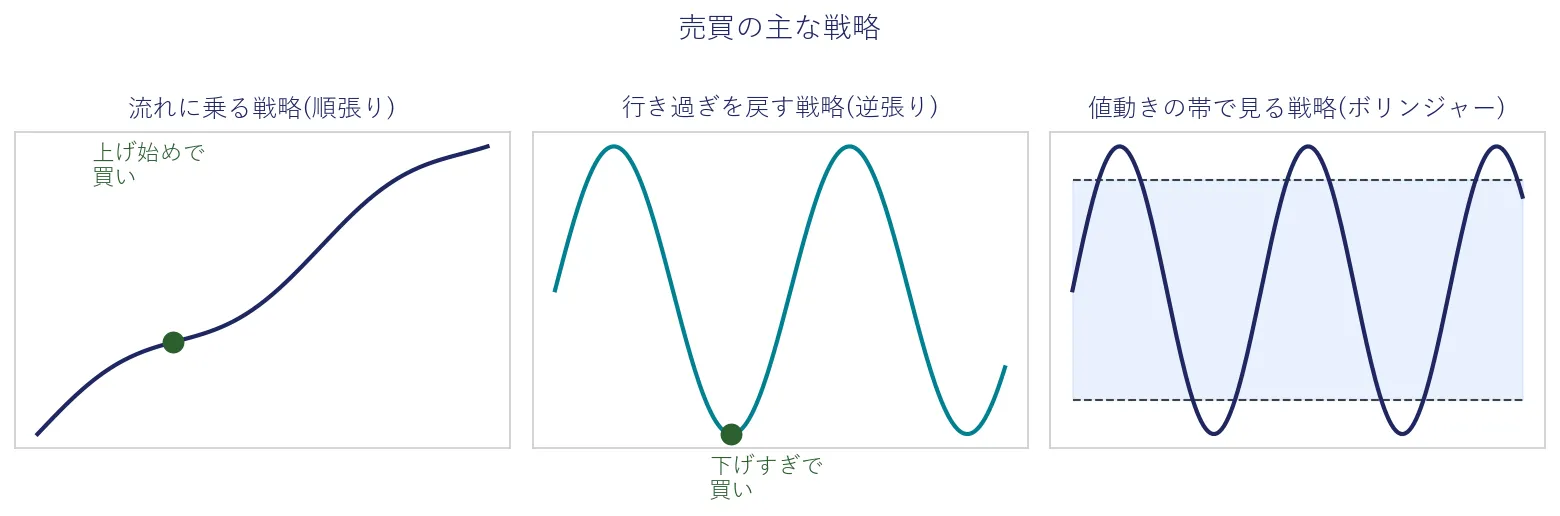
・Trend-following strategy (trend following)
Buy when the price starts rising and sell when it starts falling. It shows strength on days with a clear one-way move.
It’s not about “picking the top or bottom,” but about “following the direction of movement.”
・Reversion strategy (mean reversion)
Enter in the opposite direction indicated by overshooting up or down.
The idea that the pendulum will swing back after swinging too far. It handles markets that go up and down.
・Bolinger-based movement band strategy (Bollinger)
Draw the typical price range as a “band,” and use moves outside that band as signals.
Judge whether the movement was larger than usual by its shape.
There is no single correct answer. Each market type has its own strengths.
Since words can be hard to grasp, let’s look at actual trading.
Here is a day for Shin-Etsu Chemical Industry (4063). It was a day when three trades were made using a trend-following approach.
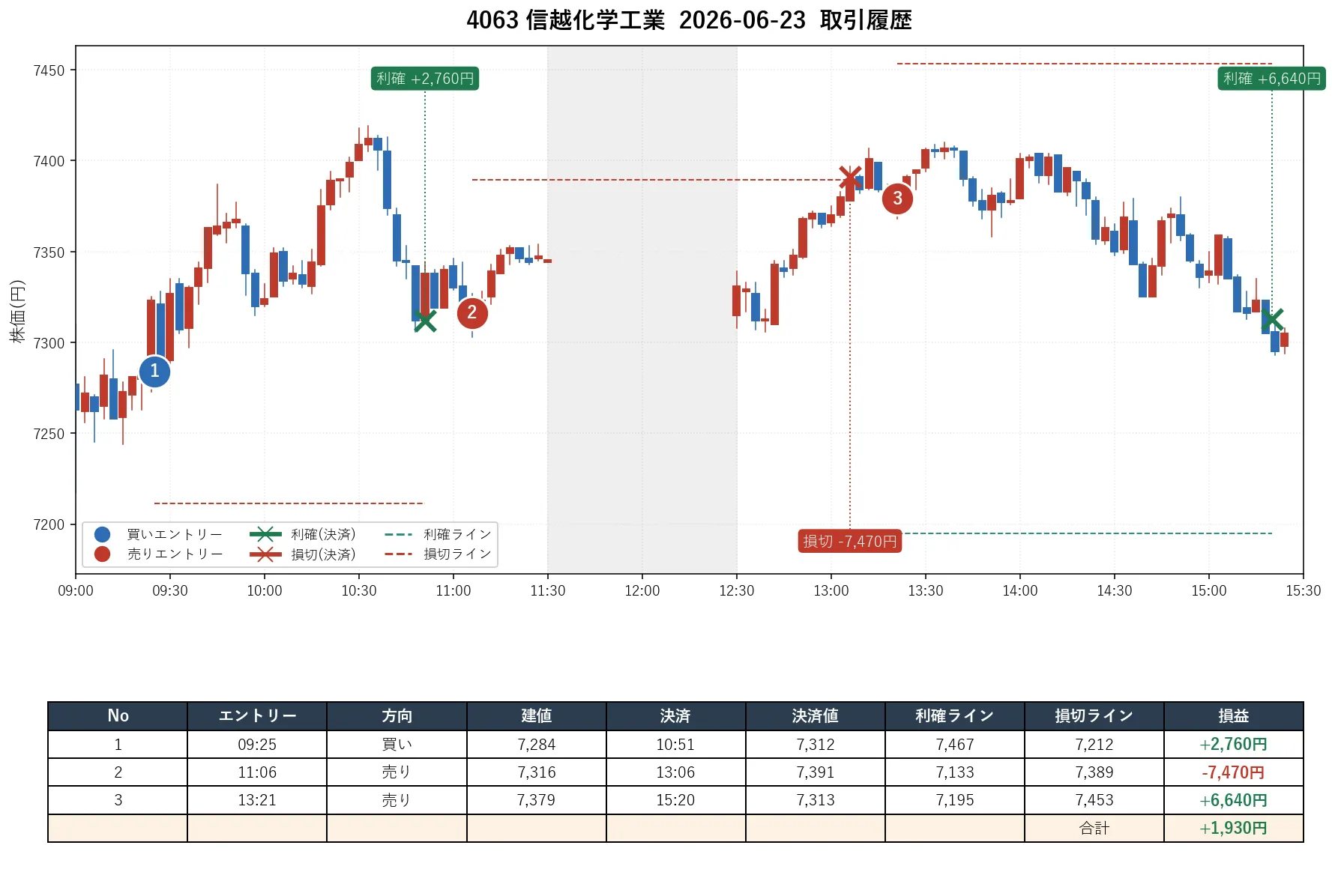
Trend-following is “following the direction of movement.” In the diagram, the blue and red circles show the order in which trades were entered. The green line is the take-profit line, and the red line is the stop-loss line.
① was bought as it rose in the morning and closed when the rise paused (+2,760 yen).
③ was sold as it declined in the afternoon and the decline continued, with a profit-taking (+6,640 yen).
When the trend clearly showed, you could make profits like this.
On the other hand, ② rose just after you sold at the top, so it closed at the stop-loss line (−7,470 yen).
In a range-bound market, it closes like this with a stop loss.
That day totaled +1,930 yen across three trades. 2 wins, 1 loss.
Trend-following can profit when the trend is clear, but it can take losses when the market ranges. Both can occur within a single day.
Every strategy has unfavorable market conditions. That’s why we do not rely on any single strategy.
Idea of role assignment
Trend-following and mean-reversion have opposite strengths; when one performs well, the other may not.
On days with a clear direction, trend-following grows; on range-bound days, mean-reversion takes over.
Even if one side struggles, the other compensates.
The premise that there is no perfect strategy leads to combining strategies with different personalities to reduce the amplitude of wins and losses.
Rather than a single flashy win, aim to keep losses shallow and continue. This combination of strategies is part of the design.
Which strategies to use for which instruments, and at what settings (take-profit and stop-loss widths, timing to view, etc.).
These are not fixed once decided.
In the verifications introduced earlier, you can re-test daily according to that day’s market.
The quality of strategies is validated not by assumptions but by actual market feedback.
Summary
TrendSync trades are built not on a single guaranteed method, but on a combination of strategies with different characteristics.
And whether that combination fits the current market can be verified at any time by backtesting.
Also, the trades shown in this article are just one example. Results vary with market conditions and settings, and profits are not guaranteed every time. Please view as a reference.
Next time, we plan to introduce a procedure to test strategies yourself using that verification.