

"Buy for as cheap as 1 yen!" The key to improving performance with long-term investing lies in the purchase price
The investment advisory service I offer used to show recommended stocks, and members would purchase at whatever timing they preferred. I believed that for high-quality, undervalued stocks, long-term profits over years were highly likely.
Even though we bought the same stock, some people benefited and others incurred losses
Because it was a long-term investment,I thought there was no need to worry too much about precise buying timing. I myself often bought at various timings.
At one point, my view on the recommended stocks changed, and I advised selling. The increase from the recommendation time was about 10%. Although I didn’t gain a large profit, I considered it good because I didn’t suffer a loss.
However, members’ reactions were extremely varied.Some people thanked me for making a profit, while others criticized me for taking a loss.
The difference in responses was so great that
“There is something wrong with this service.”
I began to think that way. Since the previous approach left the buying timing to the members,the buying price differed completely from person to person.
If you think about it, it makes sense. However,I had been neglecting to think deeply under the pretense of long-term investing. It was truly a painful realization.
The results are completely different depending on whether you bought at 90 yen or at 110 yen
Indeed, if a stock goes from 100 yen to 200 yen, you can make a decent profit whether you bought at 90 yen or at 110 yen.
However, if you have to sell at 100 yen,the difference between buying at 90 yen and buying at 110 yen becomes a huge profit-versus-loss gap.
My recommendations are not foolproof. Sometimes you are forced to cut losses or sell before reaching a target. To avoid losses in such cases, the buying price holds a very large key.
Of course, if it rises to 200 yen and yields a profit, buying at 90 yen is still better than at 110 yen. The difference in the growth rate is 82% versus 122%.Focusing on the buying price can dramatically improve investment performance.
| Buying price / selling price | 100 yen | 200 yen |
| 90 yen | +11% | +122% |
| 110 yen | ▲9.1% | +82% |
To become an investment advisor who can show what to buy, when, and at what price…
I reconsidered what it means to be an investment advisor. The stocks I recommend are important, but more than thatthe act of “when and at what price to buy” is the content that should be truly advised.
From this, I decided to use a “pilot operation” to indicate buy prices and timing via limit orders. By making timely decisions,I want to minimize doubts for members as much as possible.

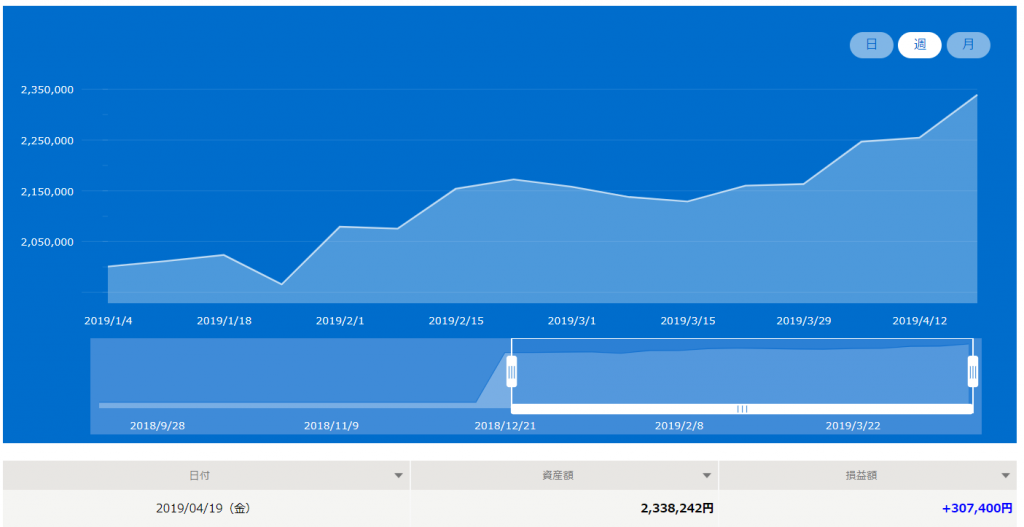
With investment focused on buying price, the current balance is about 2,000,000 yen in deposits, with roughly a 15% (300,000 yen) gain. Supported by stocks that rose significantly,even dull stocks are purchased cheaply, so the overall gain is maintained.
Long-term investing is essentially waiting for the value to realize after purchase, so buying price is not everything, but not an understatement.
Like a homemaker comparing supermarket flyers, I want to be relentless about“buying as cheaply as possible, even by 1 yen”.