
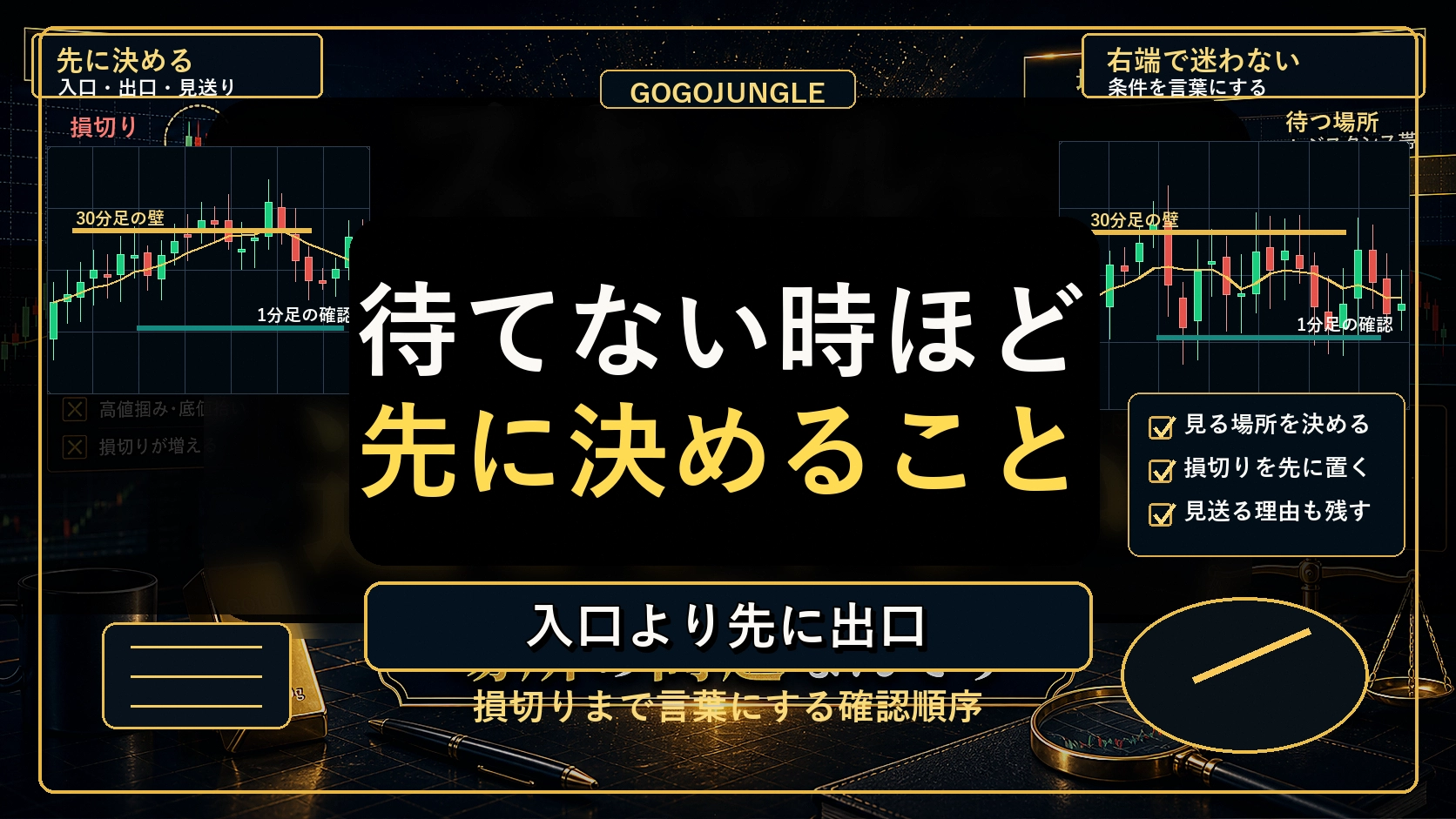
【Confirmation order to express in words before stopping loss】When you can’t wait, decide first
? When you can’t wait, decide things in advance|Why GOLD trading requires articulating your stop loss
For those who intend to “wait” in GOLD trading, yet immediately place a trade the moment the chart opens. This article summarizes a way of thinking that builds waiting discipline not from willpower, but from the structure of preparation.
Good evening!
This is Masashi ^^
↓ A feature on GOLD with a specialized antidote^^
Please join in while you still can.
This time, I’ll write about “the more you can’t wait, the more you should decide in advance.”
I used to think I was calm in front of the screen, but there was a period when I would react like a different person the moment the candlesticks moved even a little (’‵)
“I decided to wait, so why do I end up entering?”
“Even after entering, I realize it was too early.”
“I already hold a position before deciding the stop loss.”
If you have had experiences like these, this article is very important.
This isn’t because your mental state is weak.
The reason you’re giving up control to the right edge is that there are few things you decide before entering, so you hand the movement on the right edge the lead.n desu.
? The reason you can’t wait isn’t weak will, but that your reason for waiting hasn’t become words.
❌ “Waiting” yet actually not waiting for anything
Open the chart and glance at it for a while.
It seems to move a little.
It appears there’s a reaction.
Then you think, “this could be now,” and enter.
Does this pattern look familiar?
You think you’re waiting, but in reality you’re mostly just waiting for movement to appear.
But you don’t enter just because movement appears.
Where did that movement appear?
Does that place have meaning?
Where would you stop if it’s wrong?
If you wait without having decisions made up to here, waiting becomes mere endurance.
Endurance doesn’t last long.
Moreover, GOLD moves fast, so if you’re merely enduring, the small movement at the right edge can quickly carry you away.
I used to think, “If I could wait longer, I’d win.”
But it wasn’t so.
The problem isn’t that you can’t wait, but that you can’t explain to yourself what you’re waiting for.
Even if you say, “wait for the pattern to form,” if you don’t decide where that pattern can be used, you’ll end up moving based on visual impression.
Even if you say, “enter with the stop loss in mind,” if the stop loss location isn’t connected to the structure, judgment will shake the moment you’re in a drawdown.
✍️ Waiting means not moving, but continuing to verify until conditions are met.
⚖️ The reason you can’t wait is you’re looking only at the entrance
There are common patterns in how you view a chart when you can’t wait.
You search for the entrance too early.
“Can I enter here?”
“Would this shape work?”
“Has it already started moving?”
When you only look at the entrance, convenient clues pop out at you.
It paused a bit.
There was a little reaction.
There was a similar pattern before.
But if you don’t have a clear exit at that point, your overall trade preparation isn’t finished yet.
Here, the exit isn’t the dream of profit; it’s “where to admit that your judgment was different.”
Placing this exit first changes how the entrance looks.
Even patterns that look good, if the stop loss is too far, you should pass.
Even if there’s a reaction, if the wall relationship is unclear, you should still wait.
If the conditions aren’t met, don’t take action.
If you can do this, the waiting time becomes verification rather than endurance.
With verification, you don’t need to stay glued for long.
Just decide at the moment you look at the chart whether you should trade now or what you’ll verify next.
If you trade while living your life, more important than the ability to watch for long is the ability to confirm in short bursts, right?
⚖️ Decide the location for what to do if conditions turn out differently before you enter. That alone reduces urgency considerably.
✅ People who win have a reason to pass before waiting
The difference between people who can wait and those who can’t isn’t about willpower.
It’s whether they have reasons to pass in advance.
When losses continue, people search only for reasons to enter.
There’s a little reaction.
The pattern seems to appear.
It resembles the previous time.
They collect these signals to steer toward entry.
But winners do the opposite.
First, they look for reasons not to enter.
If the distance to the wall is large, they don’t enter.
If the wave state is unclear, they don’t enter.
If the stop loss can’t be defined by structure, they don’t enter.
Having these pass conditions allows you to wait.
Because the reason you can’t enter is verbalized, you’re less likely to be pulled by the movement in front of you.
If you don’t build this, simply saying “wait” becomes extremely painful at the right edge.
There’s no reason to wait.
If you just look at the screen, your heart reacts the moment movement occurs.
That’s why I believe it’s more important to create a reason to pass before entering.
This isn’t a negative thing.
Rather, it’s the most practical preparation to reduce wasted trades.
✅ Because you have a reason to pass in advance, waiting becomes a process of verification rather than endurance.
? Practice viewing one chart as “now”
When people think of backtesting, they imagine reviewing long periods of data.
Of course that’s important, but starting with a large scope isn’t sustainable.
What I’d recommend this time is a smaller practice.
Randomly rewind the chart and look at one frame where you paused.
Treat that one frame as the chart right now and judge accordingly.
Don’t look at the future to the right.
From what you can see now, decide what you’ll verify.
Are you close to a wall?
What’s the state of the waves?
Is there a reason to enter?
Where is the place if things go differently?
Write these steps one by one on separate lines.
Rather than seeking a winning scenario, record what you would look at on the rightmost edge if that were the chart now.
This practice reveals where you’re rushing.
Are you only looking at the entrance patterns?
Are you delaying the stop loss?
Are you reacting without considering the wall’s distance?
When you can see these, the reasons you can’t wait become much more concrete.
Once the reasons are concrete, you don’t need to force them with willpower.
✍️ Judgments you can’t explain with the right-edge frame are hard to reproduce in real trading.
⚖️ If you decide the stop loss in advance, money management becomes less fragile
The problem of not waiting seems like it’s just about entry.
But in reality it’s closely tied to money management as well.
Reason is that trades where you decide the stop loss later tend to have your lot size and mood decided on the fly.
You enter and then look at the unrealized loss to decide where to cut.
Then the stop loss becomes a mood-based decision rather than a structural one.
When the unrealized loss is small, you think it’s still okay.
When it grows a bit, you want it to come back.
When it grows larger, you become afraid to cut.
Entering this flow is no longer the same as your initial judgment.
At first you were looking at the chart, but halfway you end up looking only at profit and loss.
So you decide to verbalize the stop loss before entering.
If you cross this point, your justification collapses.
If you come this far, you exit according to your rules.
Within this range, you can accept it as part of your capital management.
Deciding this before entering changes how you think about unrealized losses when they occur.
You exit not because you’re scared, but because the conditions have collapsed.
You endure not because you’re angry, but because the conditions haven’t collapsed yet.
This difference is significant.
Deciding the stop loss in advance isn’t about imagining defeat.
It’s preparation to prevent emotion from controlling judgments during a trade.
⚖️ If you state the stop loss position in words in advance, you’ll be less likely to have your later judgment taken away by unrealized losses.
? If you’re changing from tomorrow, you only need these four things
You don’t need to suddenly be perfect.
First, starting tomorrow, try these four things alone.
Step 1: When you open the chart, look at the location first
Don’t search for the entrance right away.
Determine whether you are near the wall or between walls.
Confirm that first.
Step 2: Write the place where you would stop before the reason to enter
If you can’t say “I’ll stop if this isn’t right,” you’re still in planning mode.
Trying to find a stop loss afterward tends to become a mental decision.
Step 3: Also record the reasons you passed
Only recording trades you entered makes validation biased.
Storing successful waiting moments stabilizes your criteria.
Step 4: Finally, summarize in one line
“Near the wall, but the stopping place is far, so I pass.”
“The location is good, but the pattern hasn’t formed yet, so I wait.”
That brevity is enough.
Continuing this will change the meaning of waiting.
It won’t be a time of doing nothing, but a time of verifying conditions.
✅ Once you can record moments you could have waited, the quality of your trading will dramatically improve.
? Conclusion: The more you can’t wait, the more you increase what you decide in advance
The reason you can’t wait isn’t a matter of sheer will.
Often, you only look at the entrance first, while passing conditions and stop loss positions are put off.
So, what you do is simple:
Look at the location before entering.
Decide the location for what to do if things turn out differently.
Put into words the reasons for passing.
Finally, summarize in one line.
Even this much alone will significantly reduce urgency at the right edge.
Don’t try to excel all at once.
First, write what you would look at now on a single chart.
What we covered this time will be more deeply understood by those who already grasp the market’s answers.
How to use the wall, how to confirm the waves, how to set stop loss by structure. This is systematically organized in the course material.
If you’re curious, please do ^^
? Finally, one more summary
✅ Look at the location. ⚖️ Verify the conditions. ✍️ Leave your reasons. ? Try it on the next chart. That’s enough ^^
? The market’s answer
https://www.gogojungle.co.jp/tools/ebooks/77829
? Free trading analysis AI tool