
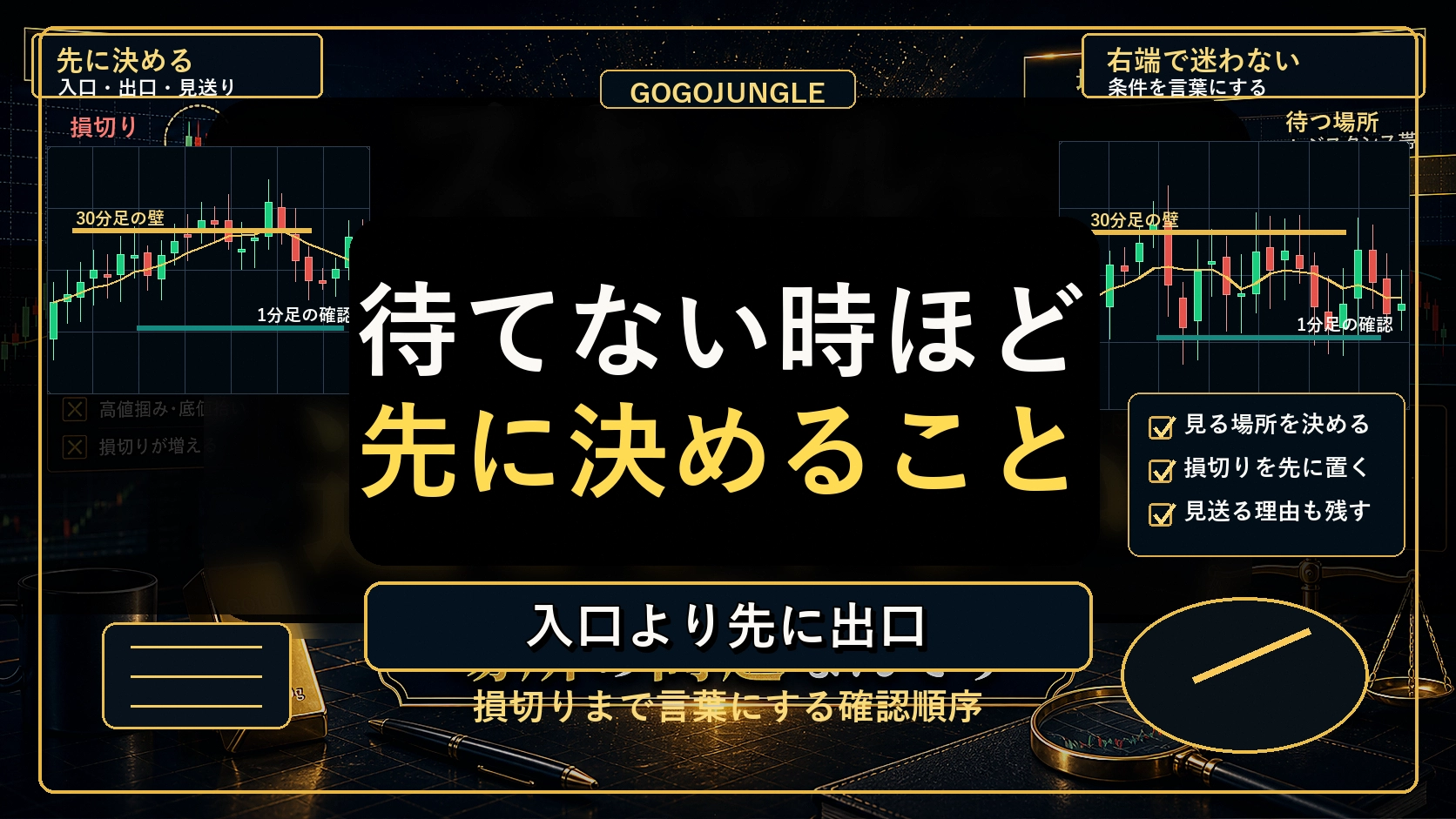
[Confirmation order to verbalize loss-cutting] Decide in advance when you can’t wait
? When you can’t wait, decide first: why you should phrase your stop loss in GOLD trades
For those who intend to “wait” in GOLD trading, yet instinctively act as soon as a chart opens. This article outlines a mindset of building waiting power not through willpower but from the structure of preparation.
Good evening!
This is Masashi^^
↓A GOLD antidote feature has been organized ^^
Please participate while you can.
This time, we’ll write about “the more you can’t wait, the more you should decide first.”
I used to think I was calm in front of the screen, but there was a period when my reaction would change completely the moment a candlestick moved even a little (;’∵)
“I decided to wait, but somehow I entered.”
“After entering, I realized it was still early.”
“I already had a position before deciding the stop loss.”
If you’ve had experiences like this, this article is quite important.
This isn’t because your mental state is weak.
There are few things you decide before entering, so you hand over control to the movements on the far right.to you.
? The reason you can’t wait isn’t a lack of willpower, it’s that the reasons for waiting aren’t put into words.
❌ “Wait” while actually not waiting at all
Open the chart and stare at it for a while.
It seems to move a little.
It looks like a reaction has occurred.
Then you think, “this might be now,” and you enter.
Does this flow sound familiar?
You think you’re waiting, but in reality you’re just waiting for movement to occur.
But the move doesn’t guarantee entry.
Where did that movement occur?
Does that place have meaning?
Where would you stop if it were different?
If you’re waiting without a plan up to this point, the waiting time becomes mere endurance.
Endurance doesn’t last long.
Moreover, GOLD moves quickly, so if you’re just enduring, you’ll be swept away by small movements on the right edge.
I used to think, “If I could wait longer, I’d win.”
But that wasn’t the case.
The problem isn’t that you can’t wait, but that you can’t explain to yourself what you’re waiting for.
Even if you say you’ll “wait for the form to appear,” if you don’t know where that form will be usable, you’ll end up moving based on appearance.
Even if you say you’ll enter while thinking about the stop loss, if the stop loss level isn’t connected to a structure, your judgment will shake the moment you’re in a loss.
✍️ Waiting means not standing still, but continuing to confirm until the conditions are met.
⚖️ The reason you can’t wait is that you’re looking only at the entry
There are common points in how you view charts when you can’t wait.
You’re looking for the entrance too early.
“Can I enter here?”
“If this shape, maybe I can.”
“Has it already started moving?”
When you only look at the entry, convenient factors keep popping up.
It paused a little.
It reacted a little.
There was a similar shape before.
But if the exit isn’t decided at that point, the overall trade preparation isn’t finished yet.
Here, the exit isn’t about a dream of profit, but “at what point will I admit my judgment was wrong.”
Placing this first changes how the entry looks.
Even a seemingly good shape, if the stop loss is too far, you should pass.
Even if it looks like there’s a reaction, if the relationship to the wall is unclear, wait more.
If conditions aren’t met, don’t enter.
If you can do this, waiting becomes verification rather than endurance.
Verification doesn’t require long hours glued to the screen.
At the moment you view the chart, simply decide whether to trade now and what to check next.
If you trade while living life, the ability to confirm briefly is more important than the ability to see longer., right?
⚖️ Decide the place for the potential exit before you even consider the entry. That alone greatly reduces impatience.
✅ Successful traders have reasons to pass before waiting
The difference between those who can wait and those who can’t isn’t about endurance.
It’s whether you have reasons to pass ahead of time.
When losses pile up, people search for reasons to enter.
It moved a little.
The shape appeared to form.
It’s similar to previous times.
They gather this information to somehow push toward an entry.
But winners do the opposite.
First, they look for reasons not to enter.
If it’s far from the wall, they don’t enter.
If the wave state is unclear, they don’t enter.
If the stop loss can’t be determined structurally, they don’t enter.
This pass condition is what allows waiting.
Because the reasons to pass are in words, you’re less easily dragged by the movement in front of you.
If you don’t build this, waiting becomes painful at the right edge.
There’s no reason to wait.
Just watching the screen makes the mind react the moment price moves.
That’s why I believe it’s more important to create reasons to pass before entering.
This isn’t something negative.
Rather, it’s the most practical preparation to reduce pointless trades.
✅ Since you have reasons to pass in advance, waiting becomes a process of verification, not endurance.
? Practice viewing one chart as “now”
When people talk about backtesting, they often imagine reviewing a long period in full.
Of course that’s important, but if you start big, you won’t keep it up.
What I’d like to recommend this time is a simpler practice.
Randomly rewind the chart and look at one frame where you paused.
Judge that one frame as if it were the chart right now, and decide.
Do not look at the future to the right.
From what you can see now, think about what you need to confirm.
Are you close to a wall?
What is the state of the wave?
Is there a reason to enter?
Where is the place if it’s different?
Write these steps one per line.
Don’t look for winning moments; instead note what you would look at at the right edge if you were in that position.
This practice makes it clear where you’re rushing.
Are you only looking at the entry shape?
Are you postponing the stop loss?
Are you reacting without checking the distance to the wall?
Seeing this makes the cause of not waiting much more concrete.
When causes become concrete, you don’t need to force it with willpower.
✍️ Explanations that can’t be described by one edge on the right are hard to reproduce in real trading.
⚖️ If you decide the stop loss first, your capital management becomes less likely to crumble
The problem of not waiting often looks like it’s about entries alone.
But in reality, it’s closely linked to money management.
This is because trades where the stop loss is decided later tend to have lot sizes and moods decided more by emotion.
You enter and then consider where to cut after seeing the unrealized loss.
Then the stop loss becomes a mood-based decision rather than a structural one.
While unrealized losses are small, you think it’s still okay.
As it grows a bit, you want it to come back.
As it grows further, you fear cutting it.
Entering this flow diverges from your initial judgment.
You start by watching the chart, but later you only watch profit and loss.
So, before you enter, you should phrase the stop loss in words.
If you cross this point, your own reasoning collapses.
If you reach here, exit according to your rules.
Within this range, it’s acceptable as part of your capital management.
Deciding up to this point before you enter changes your thinking when you incur a loss.
Not because you’re afraid, but because the conditions have collapsed, you exit.
Not because you’re stubborn, but because the conditions haven’t collapsed yet, you continue to watch.
This difference is significant.
Deciding the stop loss first isn’t to imagine loss.
It’s preparation to avoid letting emotions judge you during trades.
⚖️ If you state the stop loss position first, after seeing unrealized losses, you’re less likely to have your own judgment taken away.
? If you’re changing from tomorrow, these four things are enough
You don’t need to become perfect overnight.
First, from tomorrow, try these four things only.
Step 1: When you open the chart, look at the location first
Don’t immediately search for an entrance.
Check whether you’re near a wall or between walls.
Confirm that first.
Step 2: Write the place to stop before the reason to enter
If you can’t say, “I’ll stop if this is different,” you’re still in preparation.
Step 3: Leave the reasons you passed also
If you only record trades that entered, your analysis becomes biased.
Keeping a record of times you could have waited stabilizes your personal criteria.
Step 4: Finally summarize in one line
“I passed because I was near a wall but the place to stop was far.”
“The location is good, but the pattern hasn’t appeared yet, so I wait.”
That short is enough.
If you continue this, the meaning of waiting changes.
It becomes a time of verification, not just idling.
✅ Once you can record moments when you could wait, the quality of your trades will dramatically improve.
? Conclusion: The more you can’t wait, the more you should decide first
Not waiting isn’t a matter of willpower.
Often entry is looked at first, while pass conditions and stop loss positions are deferred.
So, the actions are simple.
Before entering, look at the location.
Decide the location where you would exit if it’s different.
Put your reasons to pass into words.
Finally, write a one-line summary.
Even this alone reduces right-edge impatience considerably.
You don’t have to become perfectly skilled all at once.
First, with one chart, write down what you would look at now.
The content this time is deeper for those who have an answer from the market.
How to use the wall, confirm waves, and set stop loss by structure is organized systematically in the教材.
If you’re curious, please feel free ^^
? Finally, one more summary
✅ Look at the location. ⚖️ Verify the conditions. ✍️ Leave the reasons. ? Try with the next one frame. That’s enough ^^
? The answer of the market
https://www.gogojungle.co.jp/tools/ebooks/77829
? Free trading analysis AI tool