

Is it not numbers that move the market? The true source of the “comfort” that USD/JPY reacts to
Is it not numbers that move the market? The true source of the “comfort” that dollar-yen reacts to
In the FX market, economic indicators and remarks from key figures are released almost every day.
U.S. employment statistics.
Consumer Price Index (CPI).
Speeches by Federal Reserve officials.
BOJ monetary policy.
Many traders use this information to forecast market direction.
However, when you actually look at the market,
“the results were as expected but the market rose sharply”
“bad news and the market didn’t fall”
are scenes you may encounter.
Why does this happen?
One reason is
market reassurance
The market is not moving only by numbers.
The psychology of market participants also has a large impact on price formation.
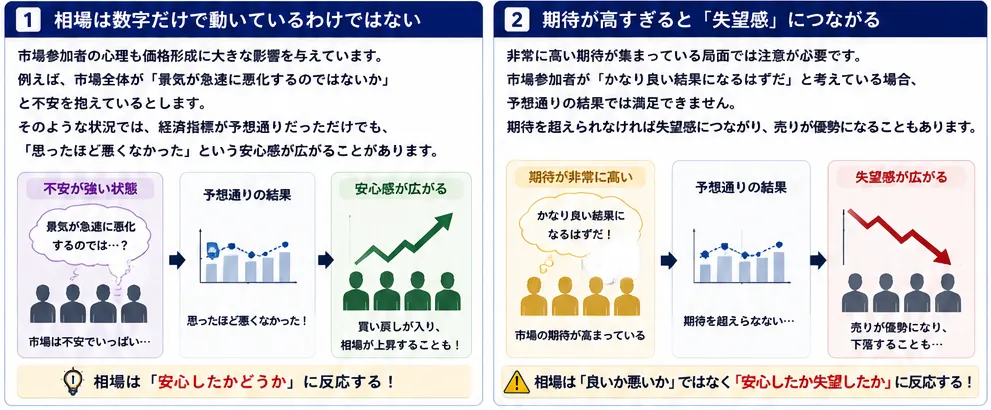
For example, suppose the entire market is worried that
“the economy may deteriorate rapidly.”
In such a situation, even if the economic indicators come in as expected,
there is a sense of relief that “it wasn’t as bad as feared.”
This can lead to a rebound and a rise in the market.
Conversely, in a situation where very high expectations are present, caution is required.
If market participants think that
“the results should be quite good,”
they may not be satisfied with results that merely meet expectations.
If they cannot exceed expectations, it can lead to disappointment and selling pressure.
In other words, the market responds
not to whether it is good or bad
but to whether it is reassuring or disappointing.
This way of thinking is also very important in the current dollar-yen market.
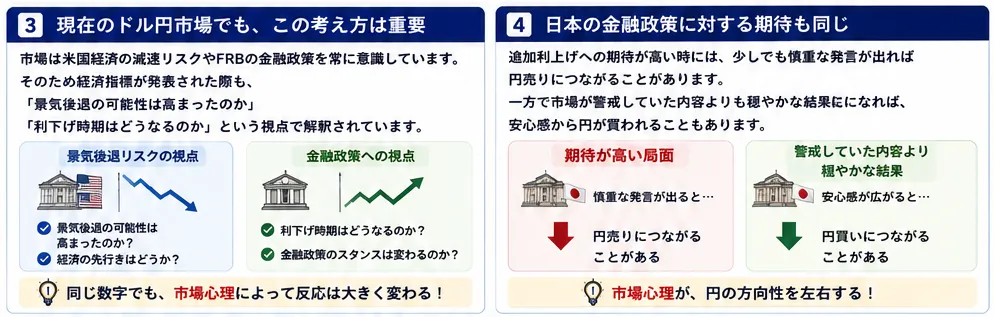
The market is continually aware of the risk of U.S. economic slowing and the Federal Reserve’s monetary policy.
Therefore, even when economic indicators are released,
they are interpreted from the perspective of
“has the risk of recession increased?”
“when will rate cuts be?”
As a result, the same numbers can provoke very different market reactions depending on market psychology.
Expectations for Bank of Japan policy are similar.
When expectations for additional rate hikes are high, even a slightly cautious remark can lead to yen selling.
On the other hand, if the result is milder than what the market had feared, yen buying can occur from a sense of relief.
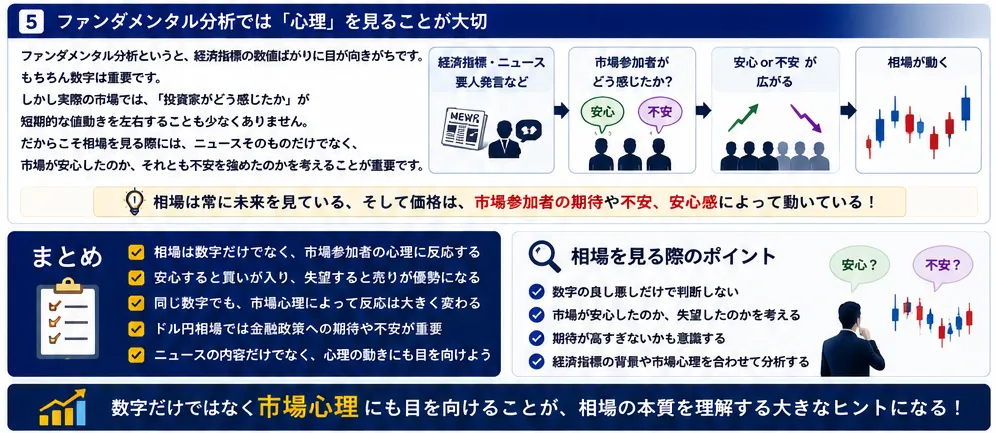
When people talk about fundamental analysis, they tend to focus on indicator figures.
Of course, numbers are important.
But in actual markets,
“how investors feel”
often drives short-term price moves.
Therefore, when looking at the market, it is important to consider not only the news itself, but also
whether the market feels relieved,
or whether it has become more uneasy.
The market is always looking to the future.
And prices move based on market participants’ expectations, fears, and sense of reassurance.
When examining the dollar-yen market going forward,
please also pay attention to market psychology, not only numbers.
That perspective will be a major clue to understanding the essence of the market.
★ Our URL:https://www.gogojungle.co.jp/users/186761?via=indicators_detail_users