

Why does the market suddenly reverse? The market is hiding the "position skew"
Why do sudden market reversals occur? The “position bias” hidden by the market
When you look at the FX market,
“A sharp drop despite no major news”
“An uptrend that suddenly reversed”
Have you ever experienced something like that?
Economic indicators aren’t bad.
Central bank statements are as expected.
Yet the market moves significantly.
Behind such price movements,
there is often a bias in the positions held by market participants
that is hidden.
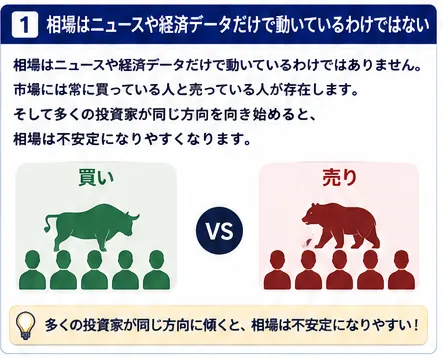
The market isn’t moved only by news or economic data.
There are always buyers and sellers in the market.
And when many investors start moving in the same direction, the market tends to become unstable.
For example,
the view that “the USD/JPY will rise further”
spreads across the whole market.
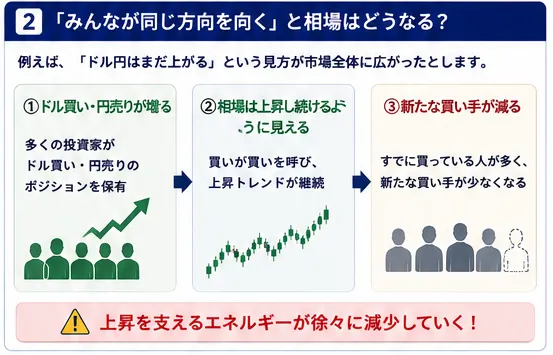
Then many investors hold long USD and short JPY positions.
As a result, the market appears to continue rising.
But the problem comes afterward.
When most market participants have already bought, there are fewer new buyers.
In other words, the energy supporting the rise gradually wanes.
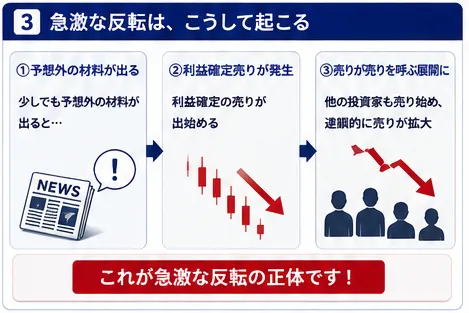
If at such a time any unexpected material appears,
profit-taking selling occurs.
Then other investors start selling as well,
and selling begets more selling.
This is the true cause of a sharp reversal.
This thinking is also very important in the current USD/JPY market.
The market trades based on factors such as Fed monetary policy expectations and BoJ policy tweaks.
However in reality,
not only the policy content itself, but
“which way market participants are leaning”
is an important determinant.
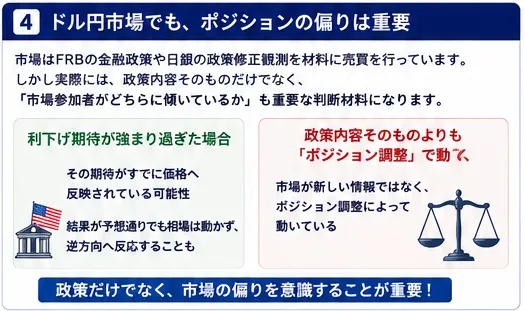
For example, if rate-cut expectations become too strong, those expectations may already be reflected in prices.
In that case, even if outcomes are as expected, the market may not move and may react in the opposite direction.
This is because the market is driven not by new information
but by position adjustments.
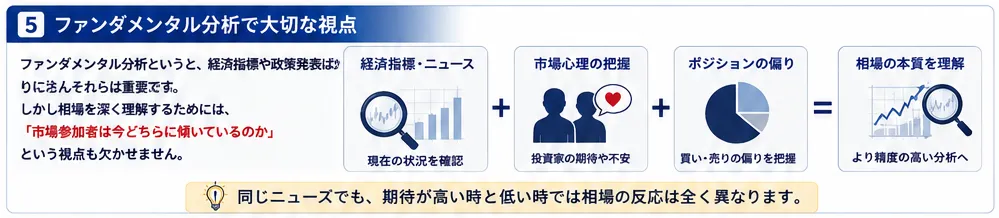
When people talk about fundamental analysis, they tend to focus on economic indicators and policy announcements.
Of course, those are important.
But to deeply understand the market,
you also need the perspective of “which way market participants are leaning now.”
The market moves on expectations.
And when those expectations tilt too far in one direction, a strong counter-move can occur.
That is why,
not only look at the news,
but also pay attention to market sentiment and position bias.
When looking at the market in the future,
also be mindful of the perspective of whether
“everyone is not headed in the same direction.”
That way of thinking will provide a big hint for understanding the background of sudden moves.
Behind price movements, market participants’ expectations and positions continually influence price formation.

★ URL:https://www.gogojungle.co.jp/users/186761?via=indicators_detail_users