

Does the market move on expectations rather than reality? The future prospects that sway the USD/JPY
Does the market move more by expectations than reality? The “speculations about the future” that steer USD/JPY
When you look at the FX market,
“The market is moving even though nothing has been decided yet.”
There are times you encounter such scenes.
A rate cut has not been officially announced.
The Bank of Japan has not changed its policy either.
Yet the USD/JPY pair sometimes rises or falls sharply.
Why does this happen?
The answer is,
because the market moves on expectations rather than reality.

There are always participants who try to forecast the future.
Institutional investors, hedge funds, and large financial institutions buy and sell while predicting the economic situation six months to a year ahead based on information currently available.
In other words, the market is
not about “what is happening now,”
but about
“what will happen next.”
It moves by pricing in that expectation.

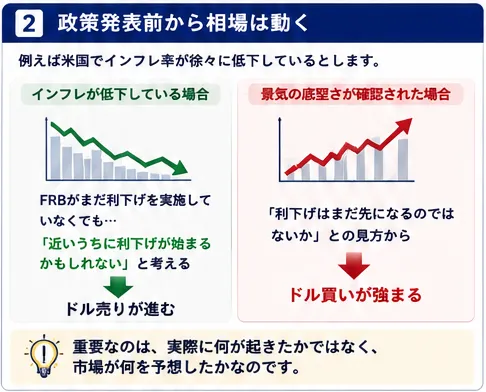
For example, suppose U.S. inflation is gradually decreasing.
Even if the Fed has not yet cut rates at that stage, the market begins to think
“a rate cut may start soon.”
As a result, there can be USD selling even before an actual policy change.
Conversely, if the economy’s bottom proves solid,
the view that “rate cuts will be further postponed”
can strengthen the USD as buyers step in.
What’s important is
not what actually happened, but what the market expected
to happen.
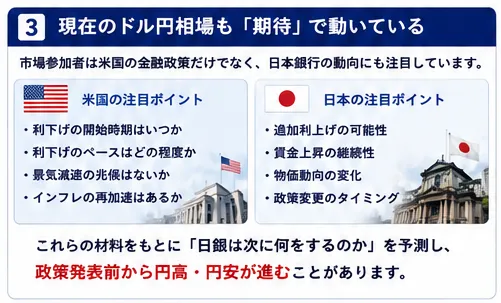
The current USD/JPY market is no exception.
Market participants pay attention not only to U.S. monetary policy but also to the Bank of Japan’s movements.
The possibility of additional rate hikes.
Sustainability of wage growth.
Changes in price trends.
With these factors in mind,
they forecast
“what will the BOJ do next?”
As a result, a surge in yen appreciation or depreciation can occur even before policy announcements.
Also, there are times when expectations go too far in the market.
If many market participants predict the same direction, that expectation is reflected strongly in prices.
However, if actual results do not meet expectations, a sharp reversal can occur.
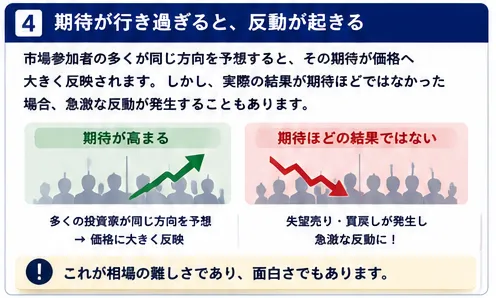
This is both the difficulty and the fascination of the market.
When people think of fundamental analysis, they often imagine checking economic indicators and news.
But what is truly important is
“how the market interpreted that news.”
Even the same news can produce completely different market responses depending on whether expectations are high or low.
The market is always looking toward the future.
And prices move with changes in those future expectations.
When looking at the USD/JPY market in the future, consider not only the current situation but also
the kind of future the market is envisioning
as a perspective.
That way of thinking will deepen your understanding of fundamental analysis.
Behind the market, there are always participants’ expectations and speculations about the future.

★ Our URL:https://www.gogojungle.co.jp/users/186761?via=indicators_detail_users