

Same indicators, different reactions? The market is looking at another answer
Even with the same indicator, why do reactions differ? The market's “other answer” it’s watching
In the FX market, many important economic indicators are released every month.
US employment statistics, Consumer Price Index (CPI), GDP growth rate, retail sales, and many other events attract the attention of market participants.
However, when watching the markets, you may feel these questions.
“It rose last time, but fell this time.”
“Even though the numbers are good, the dollar isn’t being bought.”
“It moved dramatically despite expectations being met.”
Even with similar economic indicators, it’s not rare for the market’s reactions to differ each time.
So why does this happen?
The answer is,
“Because the market looks at interpretation, not the numbers.”
For example, suppose the US CPI comes in higher than market expectations.
At first glance, it implies stronger inflation pressure and seems like a reason to buy the dollar.
However, when the market looks at the result,
it may interpret it as
“inflation acceleration again”
or
“only temporary factors.”
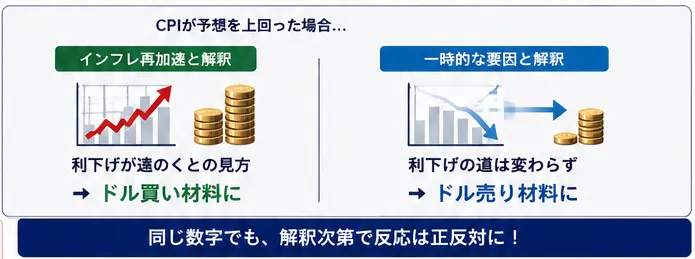
Therefore, the market’s reaction changes greatly depending on whether it interprets it as
“a lasting trend in inflation”
or as
“a temporary spike.”Currently in the USD/JPY market, this way of thinking is extremely important.
Market participants are always mindful of the Federal Reserve’s monetary policy.
Therefore, even with the same economic indicator,
if it is perceived as“easing is pushed further away”
it leads to dollar buying.
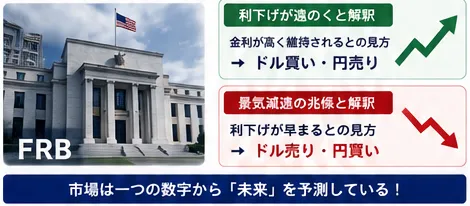
On the other hand,
if it’s interpreted as
“signs of an economic slowdown”
it can lead to dollar selling.In other words, the market is trying to forecast the future from a single number.
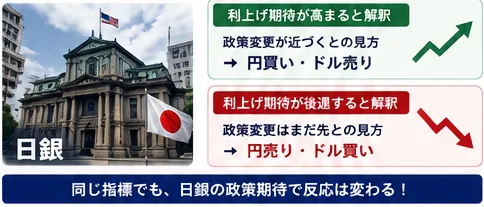
The same goes for the Bank of Japan’s policy.
When price indices and wage trends are released, the market doesn’t simply look at the results; it analyzes from the perspective of
“has the likelihood of additional rate hikes increased?”
“has the policy change become closer?”
Therefore, even with similar numbers, different reactions occur.
When people think of fundamental analysis, they tend to focus on economic indicators and the contents of news.
Of course, that’s important.
But in actual markets,
“how market participants interpret it”
has a significant impact on price formation.
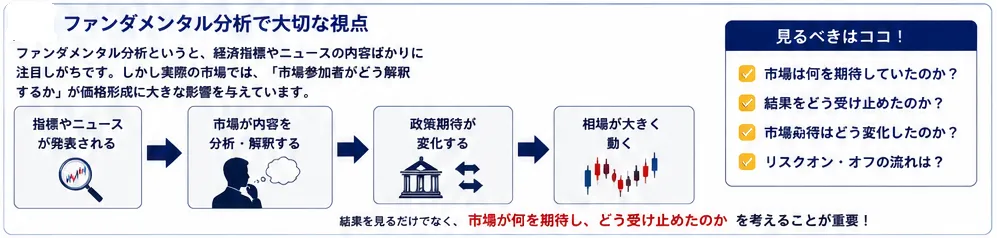
That’s why in market analysis,
not only looking at the results but
considering what the market expects and how it interprets it
is important.
The market is always trying to foresee the future.
And when that forecast changes, large price moves occur.
When looking at economic indicators in the future, don’t just look at the numbers;
try to consider,“how will the market interpret this result?”
You’ll find the market’s perspective changes dramatically from before.
The essence of fundamental analysis is not to know the news.
It’s about interpreting market psychology and thinking about the future beyond it.
Therein lies a big clue to understanding the markets.


★ URL:https://www.gogojungle.co.jp/users/186761?via=indicators_detail_users