

Is the thing that moves the market not the result? The true meaning behind market forecasts
Isn't the result what moves the market? The true meaning of market expectations
In the FX market, important economic indicators are released almost every month.
There are many events that many traders watch, such as the US employment statistics, the Consumer Price Index (CPI), GDP growth rate, and policy interest rate announcements.
However, when looking at the market, you may encounter a strange phenomenon.
“Even though the result was better than expected, it didn’t rise.”
“The numbers were bad, but the market didn’t fall.”
Many people may have experienced confusion with such price movements.
In fact, what the market truly pays attention to is not the numbers themselves that were released.
What matters is,
‘the difference from market expectations’
.
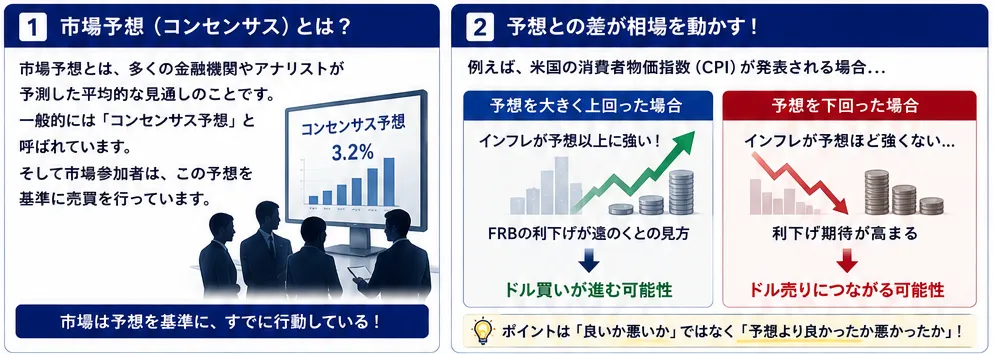
Market expectations refer to the average outlook predicted by many financial institutions and analysts.
They are generally called the “consensus forecast.”
And market participants base their buying and selling on these expectations.
For example, when the US CPI is released, the market shares the expected value in advance.
If the actual result significantly surpasses the forecast,
it may be judged that “inflation is stronger than expected.”
Then, from the view that the Fed’s rate cuts are delayed, dollar buying may advance.
Conversely, if it undershoots expectations, expectations for rate cuts rise and it can lead to dollar selling.
In other words, the market is looking at
“whether the numbers are good or bad”
rather than
“whether they were better or worse than expected.”
What’s more interesting is when the results are as expected.
If the result is the same as what the market had already priced in, market reactions can be limited.
Because that information is already reflected in prices.
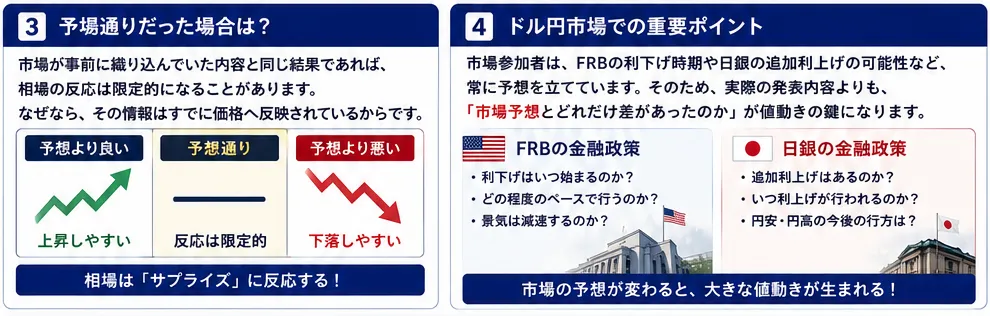
This way of thinking is extremely important in the current USD/JPY market as well.
Market participants are constantly predicting the timing of Fed rate cuts and the possibility of further BOJ rate hikes.
Therefore, more than the actual announcement content,
“how much the difference from market expectations was”
is often the key to price movements.
When people think of fundamental analysis, they may picture chasing only news and economic indicators.
But what is truly important is to consider what the market participants are predicting and what they are expecting.
The market looks at the future, not the present.
And when that future forecast changes, large price movements occur.
From now on, when looking at economic indicators, pay attention not only to the results but also to market expectations.
By adopting the perspective of “the difference from expectations,” you should find it easier to understand market movements than before.
The essence of fundamental analysis is not to know the news.
It is to interpret what the market expects and how those expectations change.

★URL:https://www.gogojungle.co.jp/users/186761?via=indicators_detail_users