

Good news but it doesn’t rise? The market prices in the “future” it foresees in advance
Even though it's good news, it doesn't rise? The true “future” that the market already prices in
When you trade FX,
“Even though the economic indicators were better than expected, the USD/JPY didn’t rise”
“Bad news but it didn’t fall”
You may encounter such scenes.
Looking at only the news, it may feel odd.
But in fact, within the market, this isn't rare.
A term often used as a reason is
“priced in”
In the investment world, markets do not move by looking at the present, but by looking ahead to the future.
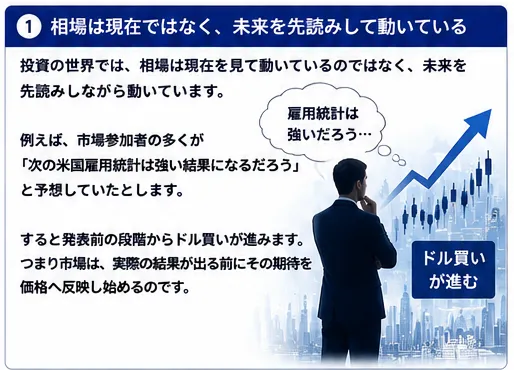
For example, if many market participants
expect the next US employment report to be strong
,
then buying USD will progress even before the announcement.
In other words, the market begins to reflect that expectation in prices before the actual results are out.
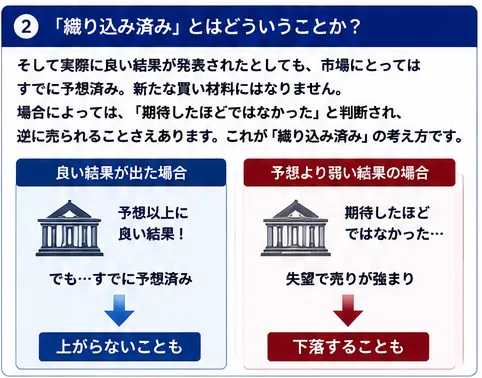
And even if the good results are announced, for the market they are already anticipated.
They do not become a new buying catalyst.
Depending on the situation,
they may judge it as “not as expected”
and, conversely, may even be sold off.
This is the idea of “priced in.”
Even in the current USD/JPY market, this perspective is extremely important.
In the market, expectations for the Federal Reserve’s monetary policy are always changing.
When will rate cuts begin?
At what pace will they proceed?
Will the economy slow down?
Investors trade based on these future forecasts.
Therefore, rather than looking only at the numbers of the economic indicators released,
you need to consider “what did the market anticipate beforehand?”
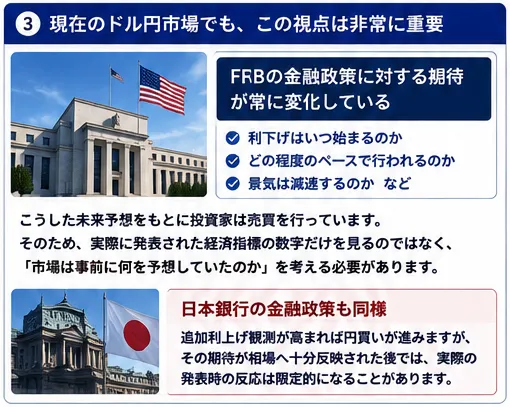
Also, the Bank of Japan’s monetary policy is the same.
If expectations for additional rate hikes rise, yen buying may intensify, but once those expectations are fully reflected in the market, the actual reaction at the time of the announcement may be limited.
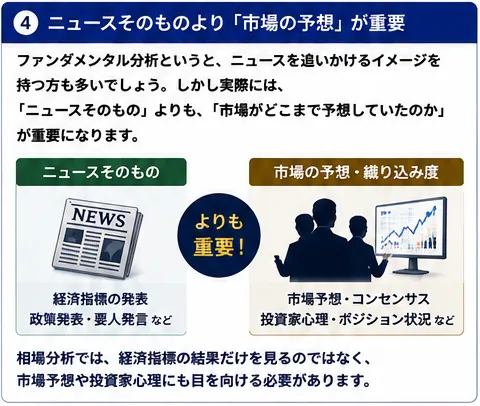
When people think of fundamental analysis, many imagine following the news.
However, in reality,
“the news itself”
is less important than
“how much the market anticipated.”
This is why, in market analysis, you should not only look at the results of economic indicators but also pay attention to market expectations and investor sentiment.
The market is always looking ahead to the future.
Rather than what’s happening now,
it values
“what will happen next.”
If in the future you find yourself thinking
“Why isn’t good news causing a rise?”
consider recalling the concept of “priced in.”
Just having that perspective should make market movements easier to understand than ever before.
The essence of fundamental analysis is not to watch the news.
It is to consider how the market views the future.
There lies a major hint for deciphering the market.

★ Our URL:https://www.gogojungle.co.jp/users/186761?via=indicators_detail_users