

Is the USD/JPY era not just moving on interest rate differentials? What points should really be watched in the current market
Is the USD/JPY era not moved by interest rate differentials alone? Key points to watch in the current market
“USD/JPY moves with the interest rate differential between the US and Japan.”
It’s a phrase you’ll hear at least once when studying FX.
In fact, in recent years, during U.S. rate hikes, the dollar strengthened and the yen weakened, and the interest-rate gap has had a significant impact on the exchange rate.
However, when looking at the current market,
“Even though the interest rate gap hasn’t changed, USD/JPY is falling.”
“Even though U.S. rates are rising, the dollar isn’t being bought.”
There are quite a few scenes like that.
Why does this happen?
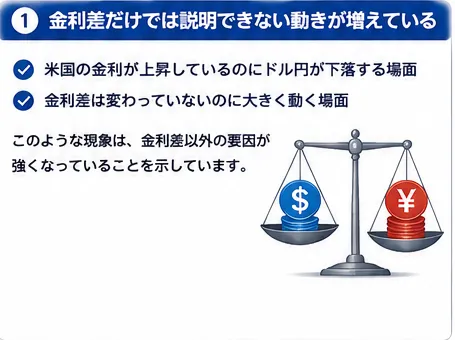
The answer is that the market is no longer moving solely on the interest rate differential.
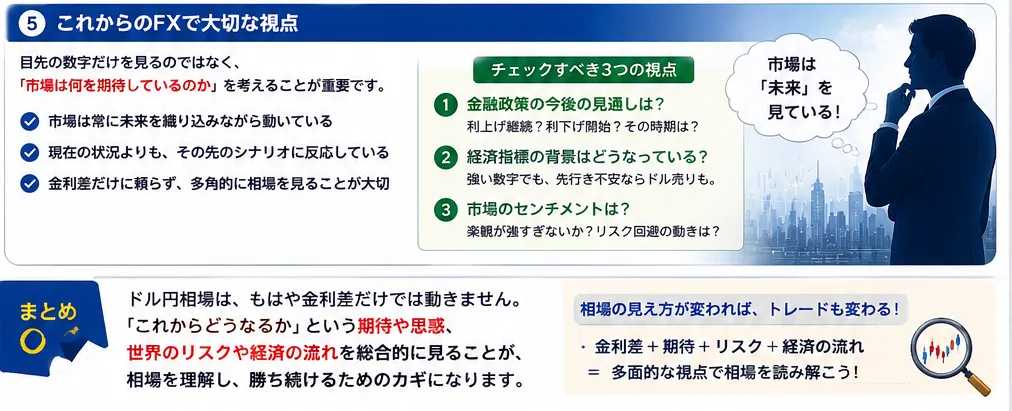
In today’s FX market, “expectations for the future” are a major theme in addition to the rate differential.
For example, in the current U.S. market, the Federal Reserve’s monetary policy is the key focus.
Investors are
“When will the next rate cut be?”
“How many times will it be implemented this year?”
“Will the economy slow down?”
continuously considering future scenarios.
In other words, the market is watching not today’s interest rates, but
“what will happen to rates in the future”
.
Therefore, even if the current interest rate gap is maintained, expectations for future rate cuts can lead to dollar selling.
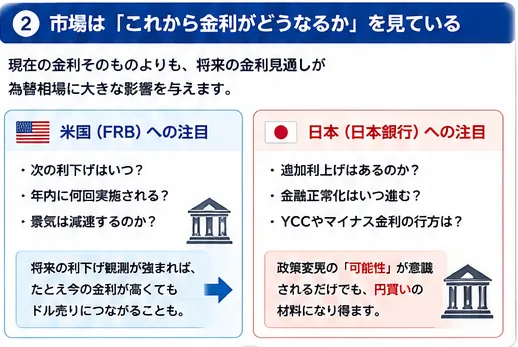
Meanwhile, the Bank of Japan is also drawing attention.
Japan has long pursued ultra-low interest rates, but as moves toward monetary normalization become visible, yen buying tends to increase.
Of course, policy changes are not guaranteed to happen immediately.
However, the market
“whether it will actually occur”
instead focuses on
“the possibility of it happening”
and tries to price it in in advance.
This is part of what makes fundamental analysis interesting.
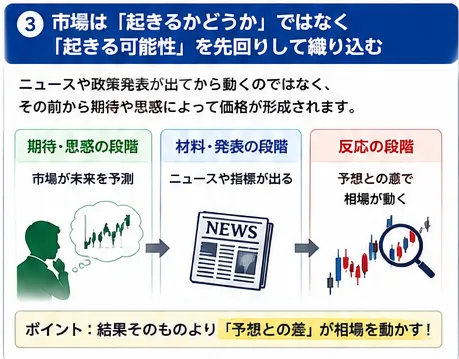
Prices form not after news or policy announcements, but in advance due to expectations and speculation.
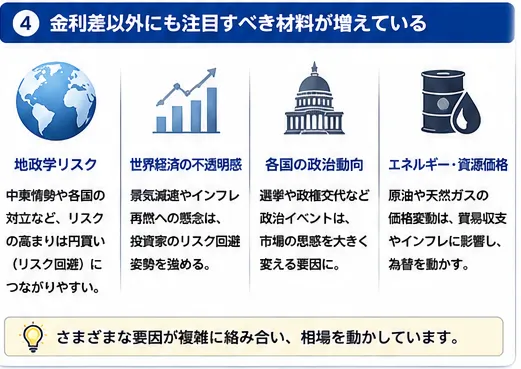
Moreover, geopolitical risks and global economic uncertainty cannot be ignored lately.
Middle East developments and political trends in various countries provide more materials that can affect the FX market than before.
As a result, it is no longer simply a time when
“the interest rate differential widens, so buy dollars.”
is the scenario.
That’s why, in future FX trading, it’s important not to look only at near-term numbers, but to
consider “what the market is expecting.”
The market is always moving while pricing in the future.
Often, it reacts to scenarios beyond the current situation.
When looking at USD/JPY from now on, pay attention not only to the interest rate differential but also to the future that market participants are envisioning.
You’ll likely find that your view of the market changes a little from before.
★ URL:https://www.gogojungle.co.jp/users/186761?via=indicators_detail_users