Create a flow
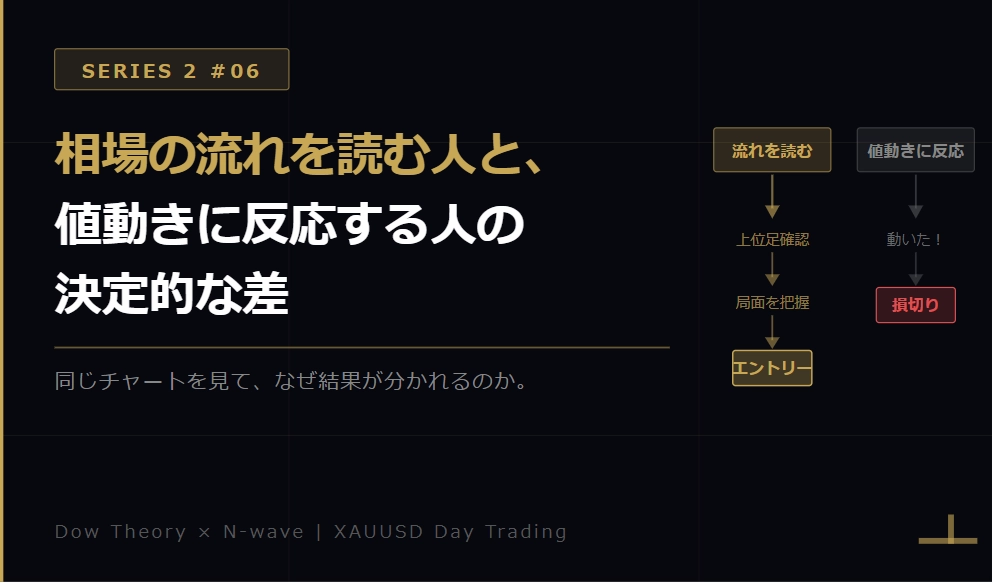
The Decisive Difference Between People Who Read Market Trends and Those Who React to Price Movements
So why are the results so different?
The gap between people who keep winning in trading and those who keep losing is not talent, capital, or information量.Whether you are reading the market flow or reacting to price movements—this single point is the crux.
Traders who react to price movements buy when the candlestick goes up and sell when it goes down. They enter simply based on the fact that “it is moving now.” The direction of the higher timeframe trend or the market phase does not matter. They just react impulsively to the movement in front of them.
Traders who read the market flow are different. Before entering, they grasp the overall context of the market. With the premise that “this is a pullback in an uptrend, so we aim to buy,” they time their entries on lower timeframes. They do not react to price movements;they act with an understanding of where they are within the flow.
Patterns That Reactive Traders Fall Into
Reactive traders share common losing patterns.
First,they enter too often.To react to price movements means wanting to enter whenever it moves. Entering multiple times a day and taking stop-outs each time erodes capital through trading costs.
Next,they hesitate after taking a position.Since the justification is only “it just moved,” when the position goes against them they become unsure of whether this direction is really correct. They move their stop-loss, or add positions without a solid reason. This leads to large losses.
Furthermore,they cannot explain the patterns of wins and losses.Because they cannot articulate why they won or why they lost, there is no room for improvement. They repeat the same mistakes.
What Does It Mean to Read the Market Flow?
To read the market flow, simply put,“to understand what phase the current market is in.”.
Whether it is an uptrend, a downtrend, or a ranging market. Even within a trend, whether the price is in a strong move or forming a pullback. Check this from higher timeframes in order, and be able to explain it in your own words. This is what it means to “read the flow.”
When you can read the flow, the situations in which you should enter and those you should pass become clear. You can decide, “Now is forming a pullback, so wait a bit longer and confirm a reversal before entering.” You won’t need to jump in reacting to price movements.
So, specifically, how do you change from a “reactive” to a “flow-reading” trader? The method will be explained in the latter part.
We explain the concrete thought processes to break away from reacting, and
the practical decision-making criteria of a flow-reading trader.