

Does the market move before news comes out? The real reason the market anticipates it
Does the market move before the news is released? The real reason the market anticipates
When you first start forex trading, there are things many people find puzzling.
That is,
"The market moves before important economic indicators are announced."
This is the phenomenon.
Logically, price moves should occur after the results are announced.
However, in the actual currency market, it is not rare for the USD/JPY to rise or fall even before news is released.
Why does this happen?
The answer is,
because the market is looking ahead to the future
In the forex market, traders and financial institutions from all over the world participate.
They don't judge only after seeing the news that is announced.
By analyzing past data, the economic situation, central bank statements, etc.,
they predict
"what will happen next"
.
For example, suppose the US employment statistics are approaching.
Market participants check the consensus in advance and
"This time the result is likely to be strong"
"The economy may still be solid"
and begin to think accordingly.
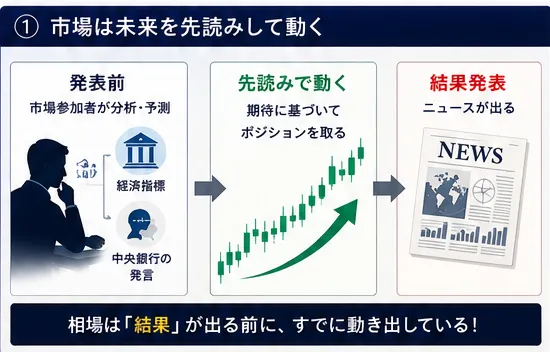
As a result, there are times when dollar buying progresses even before the actual announcement.
In other words, the market moves
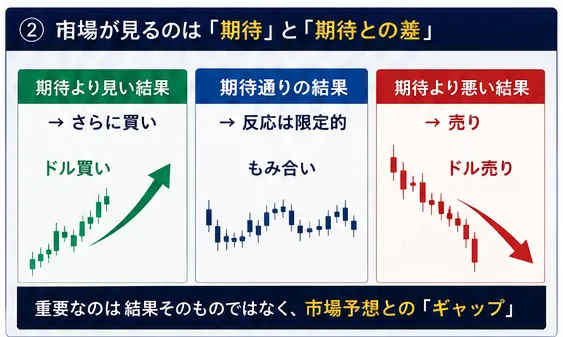
not by the results themselves, but by expectations of the results
.
And here, market expectations are crucial.
Even if the employment statistics are good, if the market expects even better results, there can be disappointment selling.
Conversely, even with a slightly bad result, if the market had anticipated worse, there can be buying from a sense of relief.
This tendency is pronounced in recent USD/JPY moves.
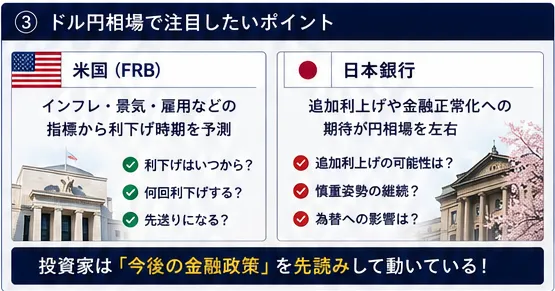
In the market, interest in the Federal Reserve's monetary policy and the timing of rate cuts is rising.
Each time economic indicators are released,
"Have rate cuts come closer?"
"Or will there be further postponement?"
This is how it is interpreted.
In other words, investors are looking at how the numbers will affect future monetary policy rather than the numbers themselves.
Also, the Bank of Japan's policy trends are the same.
If expectations for additional rate hikes rise, it becomes a factor for buying yen; if a cautious stance is felt, it leads to selling yen.
Such expectations and speculations are priced into the market even before the actual announcements.
When people think of fundamental analysis, they may imagine chasing news.
But what is truly important is
"what is the market expecting"
to consider.
The market is always looking to the future.
Therefore, rather than reacting in a panic after news comes out, it is important to be aware of what market participants are thinking beforehand.
From now on when viewing the market, please pay attention not only to the content of the news but also to
“what the market is anticipating in advance”
as well.
Just by having that perspective, the way you view the market will change significantly.

★Our URL:https://www.gogojungle.co.jp/users/186761?via=indicators_detail_users