
[FX exposes lies part 2] The illusion that "the Granville's Equation is the Golden Rule." Why you can't win with moving averages (MA) alone
Protored CoachingMaxdesu.
“FXno uso o abaku” series, the2nd theme is theFXthat anyone who has studied a little knows—the Granville’s Law.
If you follow the textbook, you enter at a “buy on pullback” when the price has fallen to the moving average (MA), but then it often falls below the MA and you get stopped out sadlyMA……. Haven’t you had a similar experience?
Many traders who come to me for advice also worry, “I did Granville’s Law as instructed and still can’t win.” However, it’s not that your method is bad. In the first place, the idea that you can win with “Granville’s Law” is itself an illusion that misses the essence of the market.
■The fragility of the hypothesis dependent on lagging indicators
The representative buy point of Granville’s Law is said to be when the moving average has fallen, then flat or turns upward, and price breaks the moving average from below to above.
At first glance this sounds reasonable. But think about it calmly. A moving average (MA) is literally a lagging indicator that averages past price movements.
Granville’s Law relies on a grand, yet weak, hypothesis: “When price reaches near the past average, the market will resume its trend.”
The actual market does not move neatly up and down around the average. Mass psychology and large capital inflows can easily invalidate this hypothesis, and price can break through the past average without a care.
■The trap hidden in the “royal road method”
In reality, there are countless products sold that claim to be the “royal method” by following Granville’s Law and repeatedly trading around the “MA area.” But what is the outcome?MA alone leads to a herd of losers who exit the market, proving that this method does not work.
Of course, I am not denying displaying moving averages on a chart itself. However, you should strongly recognize thatMA is merely a “reference level” at best.
Instead of relying on the past average value as a “lagging indicator,” measure the current market’s real-time momentum with oscillators, identify the clear wall that forces the market to rebound, and only then build a highly low-risk, stable trading approach. That is the key to consistency.
End the “pray-like trading” that hinges on the moving average’s past average value today.
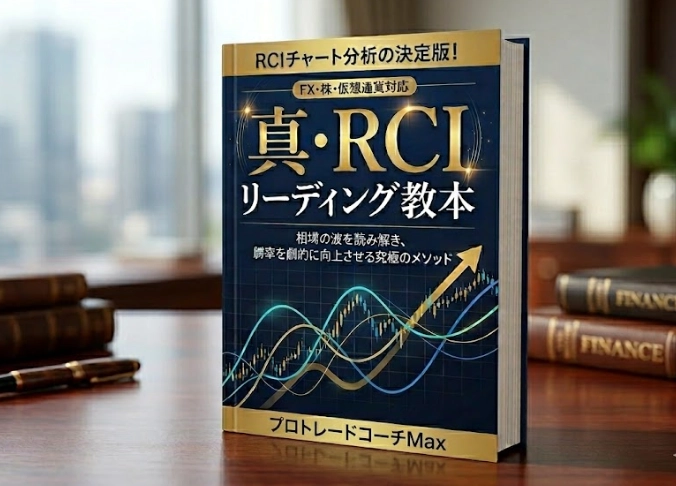
If you want to avoid the crowd’s trap of textbook trading and develop the ability to identify the market’s correct answer on your own, please check out the upcoming release of “Shin-RCI Leading Textbook” and Max’s program within GoGoJian. We also welcome you to follow on Investment Navigator+.
Protored CoachingMax