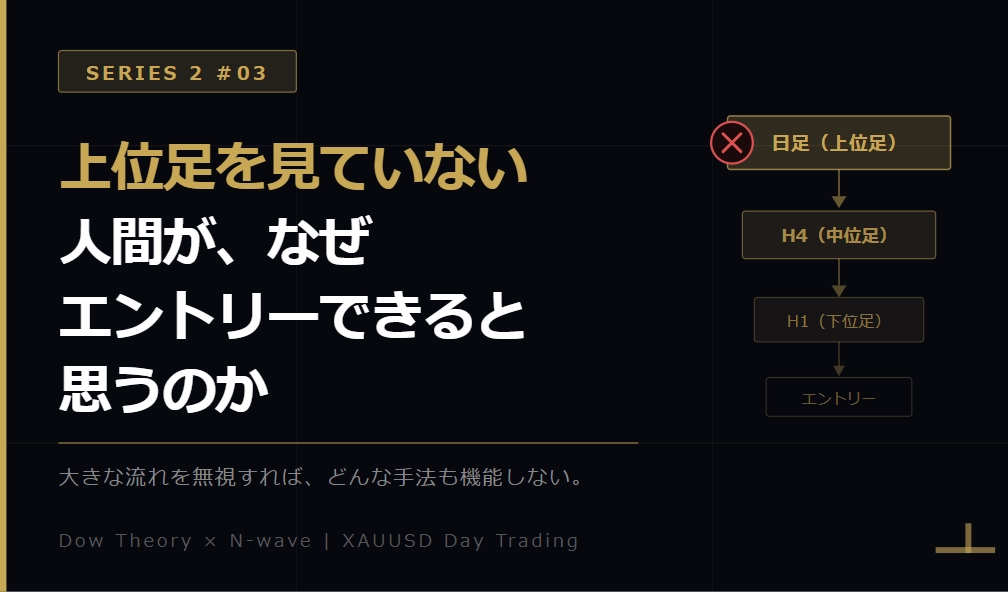
Look at the upper leg
Why would a person who isn’t looking at the higher timeframes think they can enter
So why do you think you can trade without looking at the higher timeframes?
Right now, what timeframe are you using to judge entries?
Many people use around M5, M15, or H1. But before you enter, do you check the daily chart or H4? Some may say they “roughly look at it.” However, “roughly” is not enough.
Upper-timeframe analysis isthe ability to clearly verbalize what phase the current market is innot just a vague bullish bias. It means being able to say: “on the daily chart, highs and lows are rising according to Dow Theory, an uptrend is continuing, and on the current H4 a pullback is forming.” Only when you can say this can you say you have looked at the higher timeframes.
If you cannot do this, you end up judging entries only from lower timeframes. What happens as a result?You end up repeatedly trading against the currentand moving in the wrong direction.
Why you keep losing with only the lower timeframes
Lower timeframes contain movements that align with the higher timeframe trend as well as movements that go against it. If you only look at M15, even in a pullback within an uptrend it may appear as “going down.” Then you enter a sell, and it immediately pushes higher.
This isn’t a misanalysis, it’s alack of perspective. If you look at the higher timeframes, you should be able to tell, “the pullback is forming now, selling is a counter-trend move.” What you can’t see is because you aren’t looking at the higher timeframes.
Another trap for traders who rely only on lower timeframes: on M5 or M15 there are dozens of signals each day. Without the higher-timeframe context, you can’t decide which to ride. As a result, you start choosing entries based on emotion or mood. This is the essence of “somewhat random trading.”
Three things the higher timeframes teach you
When you read the higher timeframes correctly, three things become clear.
- Direction of the trend:the basic premise of whether you should be buying or selling
- The current phase:whether the trend is continuing, forming a pullback or reversal, or is range-bound
- Which direction you should look for entries:which side’s signals you should pick up
Once these three are determined, decision-making on the lower timeframes becomes dramatically simpler. If you view only the lower timeframes without the higher-timeframe context, you’ll see signals for both buy and sell and be torn about which to take.
So, how exactly do you read the higher timeframes and translate that into lower-timeframe entries? The concrete steps will be explained in the latter part.
It explains the concrete steps of top-down analysis and
the flow of situational awareness using a XAUUSD example.