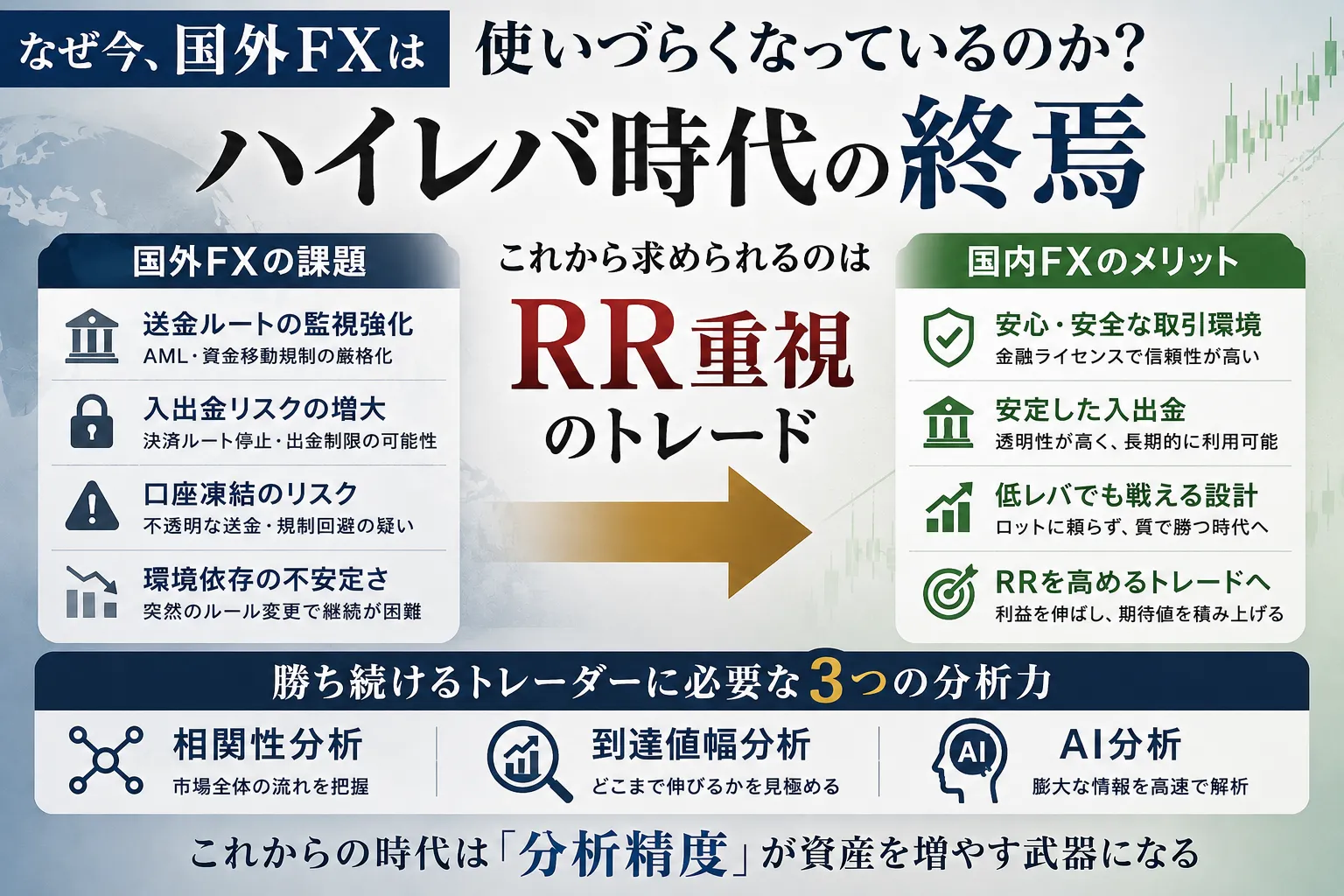
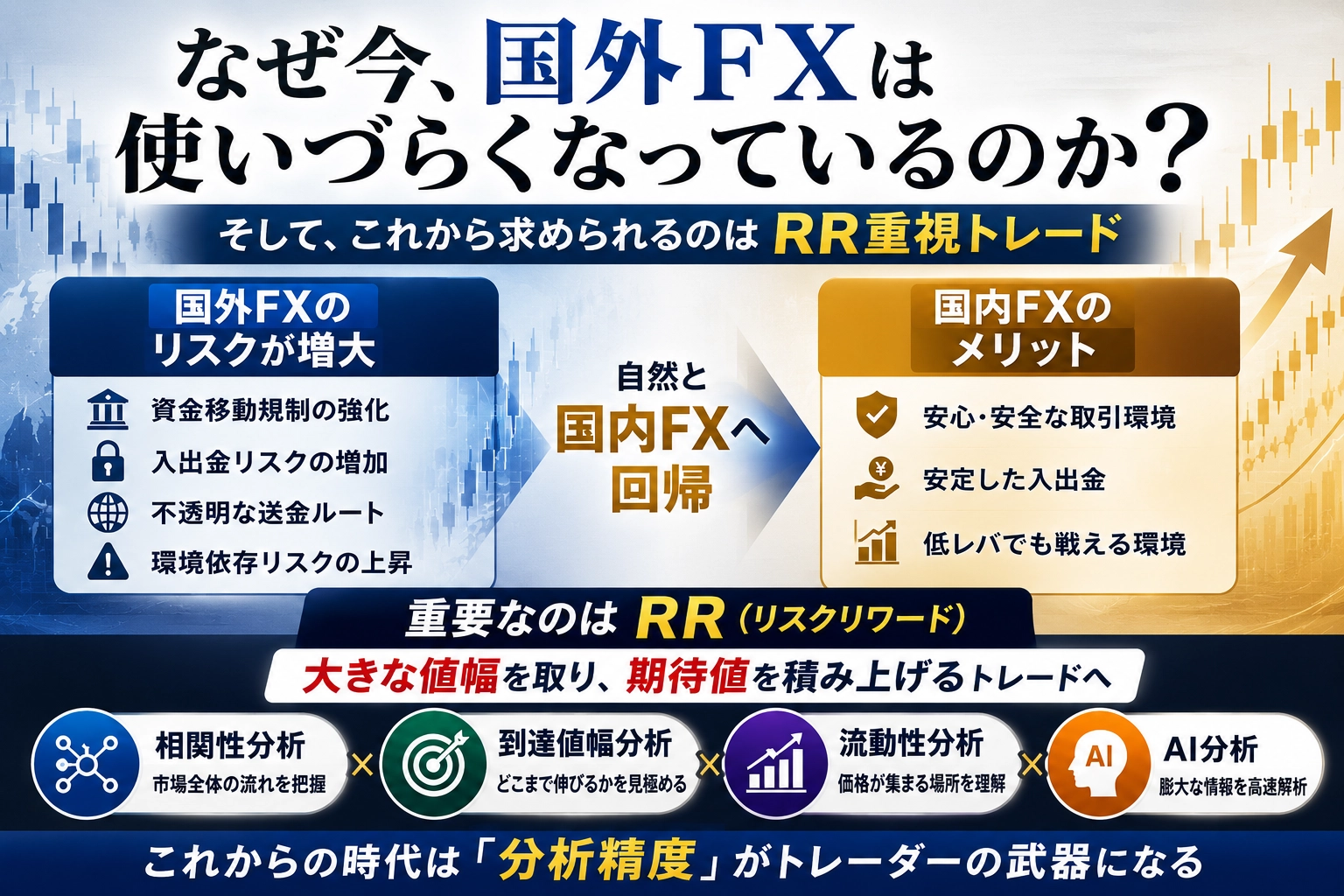
"FX is at its End?" June 2026 marks a turning point in the FX world
Why now,
Forex overseas (unregistered domestic brokers)
are becoming harder to use?
And,
the mindset of “ultra RR-focused trading” that will be demanded from now on
The environment surrounding overseas FX has begun to change significantly in recent years.
When it comes to FX,
- high leverage
- low-margin high lots
- bonuses
- zero-cut
used to seem attractive.
There was a time when
however, now
that environment is gradually changing.
Moreover, the issue is not merely
regulations based on leverage alone.
It goes deeper.
That is,
"funding movement infrastructure"
is the key.
Why are overseas FX becoming harder to use now?
This part can be hard to understand, but
many people think that
“the Financial Services Agency dislikes overseas FX”
to some extent.
In reality,
it's more complicated.
In recent years,global tightening has been increasing in
- AML (Anti-Money Laundering)
- cross-border payment monitoring
- funds transfer regulations
- countermeasures against opaque settlement routes
Thus,
"where the money ends up"
is being strictly monitored by each country.
The biggest problem with overseas FX is the “remittance structure”
This is the essence.
Most overseas FX brokers do not hold financial licenses in Japan.
Then,
how are remittance and withdrawals carried out?
What is used here are
- remittance代理
- overseas wallets
- fund transfer agents
- intermediary settlements
Thus,
from the user's perspective,
it may look like they are just requesting transfers to domestic banks
but beyond that,
funds may flow overseas via multiple settlement routes.
The problem lies here.
From the banks’ perspective,
the final destination of funds is hard to see
creating a structure that is easy to miss.
Why do banks tighten up?
What banks fear is not FX itself.
What they truly watch out for is,
- money laundering
- opaque remittance
- fraudulent funds
- unregistered fund movements
- remittance to evade regulations
If banks keep processing questionable transfers,
they may be flagged by financial authorities as having AML deficiencies.
In other words,
banks are forced to strengthen their defenses.
As a result, in recent years, monitoring has intensified for
- overseas FX-related activities
- online casinos
- high-frequency overseas transfers
- opaque remittance代理
and other areas.
In other words, the issue is not only leverage, but
the remittance infrastructure itself
that causes constraints.
“Overseas FX = Freedom”
Is the era changing?
What matters is
the risk that depends on the environment
is increasing.
For example,
bank routes that used to be available may suddenly freeze.
Withdrawal conditions may change,
remittance limits may tighten.
These become the fundamental causes making the “ultra-high leverage” style hard to implement,
A natural return to domestic FX environment
A turning point where reconciliation begins with domestic FX
can be said to be
For those reasons,
the domestic FX environment is being reexamined,
but previously
in the past,
the image was
“domestic = low leverage puts you at a disadvantage.”
However now,
the situation is changing.
Because what truly matters in trading is
not simple leverage, but
capital efficiency and expectancy
therefore.
In domestic accounts, whether it is “lot size” or not, the question is about “expectancy”
In domestic accounts,
ultra-high leverage like overseas FX cannot be used.
Thus,
unlike before,
- low RR
- high lots
- high turnover
and so on, cannot be forced through easily.
Then, what is required from trading changes.
It becomes the
value per trade
per trade.
Why will RR focus become inevitable from now on?
What becomes important here is
RR (risk-reward).
For example,
win rate 80%
average profit 10 pips
average loss 30 pips
in this trade,
it may seem excellent at first glance.
But in terms of expectancy,
it is not strong.
Because,
the loss when you lose is larger than the profit when you win.
In reality,
many traders who have high win rates do not see their funds grow,
falling into this pattern.
What matters more than win rate is "price range"
Many beginners focus only on win rate.
However,
the professionals look at expectancy rather than win rate.
For example,
even with a 40% win rate,
if you can take profits three times larger than losses,
funds can grow in the long run.
Conversely,
even with an 80% win rate,
if profits are only one-third of losses,
your equity curve will eventually collapse.
In short,
the truly important thing is
not how many times you hit, but how wide a range you capture
that’s what matters.
The hidden importance of “range” not seen in high-leverage environments
With overseas FX,
high leverage allowed you to profit from small ranges.
Therefore,
the elements that should have been important
- profit width
- RR
- holding capability
were easily overlooked.
But in the domestic account environment, this is different.
Since you cannot compensate with lots,
you must increase the profits themselves.
In other words,
going forward,
how large a wave you can ride becomes important
Many people drop off the growing wave midway
In reality,
many traders are not losing at entry.
They lose on holding.
They exit a wave that would have grown from 200 pips
- 20 pips
- 30 pips
- 50 pips
instead.
As a result,
the RR becomes small,
and even with a high win rate, funds do not grow.
In short,
the important thing from now on is not only where you enter, but
how far you can hold
that’s the point.
What is needed to capture range?
Here is the main topic.
To capture range,
simple directional guessing is not enough.
What matters is
- where liquidity exists
- where profit-taking is easy
- where it is easy to reach
- where it tends to stall
to understand.
In other words,
the ability to analyze reachable range
is key.
Markets move toward areas where orders集まる
Markets are not a complete random walk.
Prices tend to move toward areas where there is concentration of
- stop-loss orders
- take-profit orders
- break orders
- liquidity
of liquidity is concentrated.
Institutions and algorithms use that liquidity for trading.
That’s why,
the important thing is
not just whether prices go up or down, but
whether they can reach a target
think about the goal first
that is
Next, why is correlation analysis important?
The current market does not move on a single chart alone.
For example with GOLD,
- the dollar index
- US Treasury yields
- risk-on/risk-off indicators
etc.,
it moves within relationships with multiple markets.
In other words,
looking at a single chart alone makes the true strength hard to see.
What becomes important here is
correlation analysis.
What correlation analysis means: looking at market-wide capital movements
For example, capital exits from the stock market and flows into bonds or GOLD.
In such times, the market experiences risk-off.
In other words,
looking at the whole market reveals the backdrop to price movement.
As a result,
it becomes easier to distinguish which waves are likely to grow.
What AI is changing
And now,
AI is starting to drastically change
the accuracy of analysis.
AI does not predict the future.
However,
- correlation markets
- multiple timeframes
- waveform structures
- attainable range
- liquidity analysis
can process a large amount of information that humans cannot, at high speed all at once.
In the future, analysis accuracy will be the difference
Going forward,
as the domestic FX environment becomes mainstream,
the important things will be
- RR design
- range analysis
- attainable range analysis
- liquidity analysis
- correlation analysis
- AI-driven structural analysis
that’s it.
In other words,
not only “where to enter,”
but also “how far range can be extended”
will define advantages in this era.
And
and how reproducibly you can stack expectancy
that is the true skill traders will be asked for going forward.