

Why does it move as expected? What point is the market really watching
As Expected, So Why Does It Move? What Points Is the Market Truly Watching
In the FX market, economic indicators and remarks from prominent figures are released on a daily basis.
Employment statistics, consumer price index (CPI), policy rates, and remarks from central bank presidents—these and other materials move the market.
However, you may have experienced something like this.
“It moved a lot even though the results were as expected.”
“The dollar was sold even though the economic indicators were good.”
At first glance, such movements may seem puzzling, but they are not unusual in today’s market.
This is because the market places importance not on the results themselves, but on
‘What were the market participants expecting?’
.
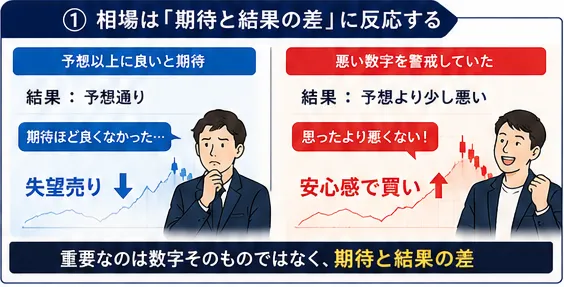
For example, consider if a major US indicator comes in as expected by the market.
Ordinarily, one would think there wouldn’t be a large reaction.
However, if market participants were hoping that the number would come out better than expected before the release, even a result that matches expectations can trigger disappointment selling.
Conversely, if the whole market had been wary of weak numbers, even slightly worse results can attract buying due to a sense of relief.
In other words, what moves the market is not the numbers themselves, but
‘the gap between expectations and results’
.
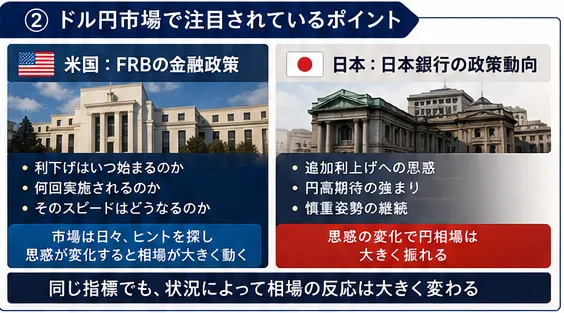
This way of thinking is also extremely important in the current USD/JPY market.
The market continues to focus on the Fed’s monetary policy.
When will rate cuts begin?
How many times will they be implemented?
What will the speed be like?
Market participants are trading daily with these points in mind.
Therefore, even with the same economic indicator, reactions can vary greatly depending on the market’s current circumstances.
Also, the Bank of Japan’s policy developments are an important theme for the USD/JPY pair.
There are moments when anticipation for further rate hikes or a stronger yen grows, and there are moments when cautious stance leads to yen weakness.
In other words, the current foreign exchange market is not simply a “buy on good news, sell on bad news” setup.
.
Therefore, when conducting fundamental analysis, it is important to not only look at the announced results but also
“what the market was expecting.”
.
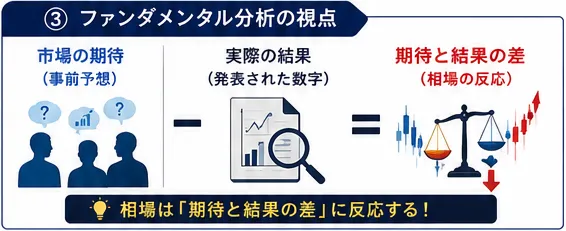
Recent markets have many factors at play and may seem complex at first glance.
However, by viewing through the filter of market psychology, the background of price moves becomes increasingly visible.
The essence of fundamental analysis is not chasing news.
It is considering how the market will perceive that news.
When looking at future markets, why not pay attention not only to the numbers in front of you but also to the expectations and psychology of market participants behind them?
The way the market looks may change somewhat from before.
★URL:https://www.gogojungle.co.jp/users/186761?via=indicators_detail_users