
Do you want to try following the rules?
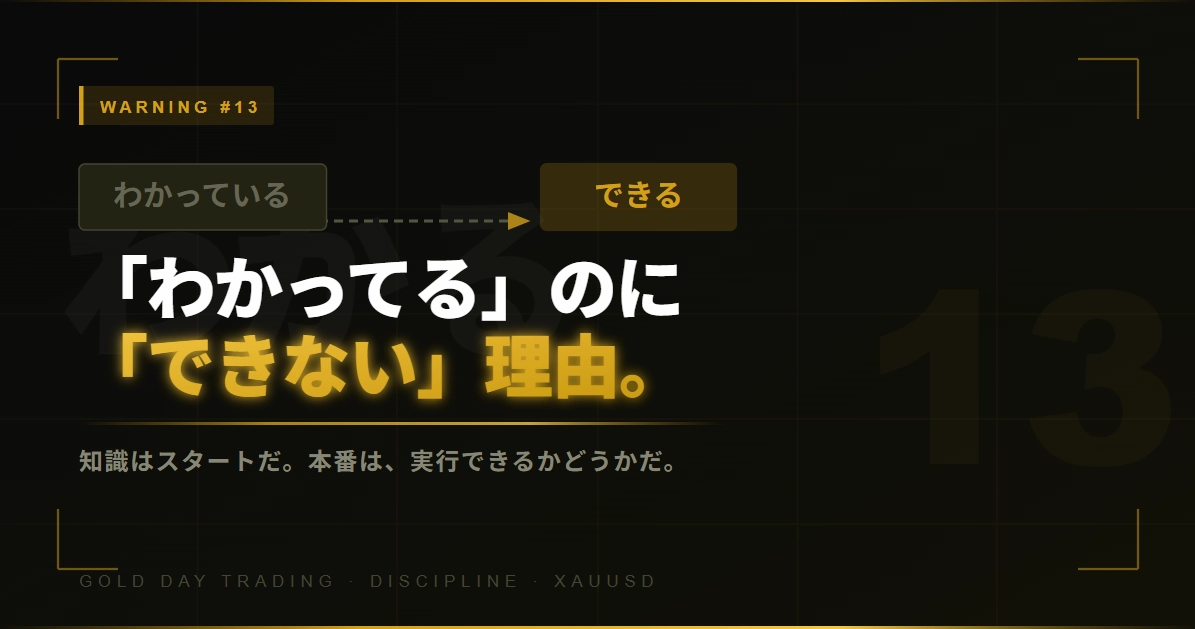
Introduction | The Truth of "I know it, but I can't do it"
Many people studying trading say this.
"I know stopping losses is important. But I can't do it."
"I know I should follow the rules. But I can't."
"I know waiting is important. But I can't wait."
"I know, yet I can't do."
As long as this state continues, no matter how much knowledge you accumulate, the results won’t change.
Because,what you need in trading is not knowledge but execution.
So why does "I know but can't" happen?
And how can it become "I can"? Today, I will discuss that.
“Knowing” and “being able” are completely separate skills
Knowing the importance of cutting losses and being able to cut losses are entirely different things.
Someone who learned how to ride a bicycle from a book and says “I know,” is different from someone who can actually ride.
Someone who learned swimming form from a video and says “I know,” is different from someone who can swim.
Trading is the same.
Knowing the importance of cutting losses as knowledge and actually pressing the cut-loss button in real situations where unrealized losses are growing are completely different skills.
Knowledge is in the head. Skill lives in the body and through experience.
Reading books or watching videos alone won’t build skill.
Skill grows only through actually trying, failing, correcting, and trying again repeatedly.
The only way to turn “I can’t” into “I can”
So, how can we break out of “I know but can’t”?
The answer is simple.
Record the situations where you can’t, and identify patterns.
When you fail to cut losses, you record that trade.
What was the situation? How much unrealized loss was there? What emotions did you feel? What excuses did you make?
Repeating this will reveal patterns.
"I start to lose clarity once unrealized losses exceed 2% of the margin."
"At night, I tend to make entries outside the rules due to impatience."
"After a big loss, I try to recover by increasing my lot size the next day."
If you can identify patterns, you can devise countermeasures.
If you have countermeasures, “I can’t” gradually changes to “I can.”
Rules alone are not meaningful unless you implement them
Many people are satisfied simply by creating rules.
"Always cut losses at ◯ pips."
"Limit trades to a maximum of 3 per day."
"If losses continue, stop trading for that day."
As soon as rules are made, it feels like something has improved.
But in reality, merely making rules changes nothing.
Rules function only when they are broken, reviewed, and strengthened.
When you break a rule, record it and analyze “why you broke it.”
Was the rule set not aligned with reality?
Was there a gap where emotions intruded?
Was it not grounded in understanding to begin with?
This cycle turns rules from “an empty promise” into “a functioning rule.”
Habits to become an “executing trader”
From knowledge to execution. Daily habits bridge this gap.
From my practice, I’ll share three things I found especially effective.
① Before trading, verbally confirm your entry rationale
"The higher-timeframe direction is ◯◯. Entry rationale is ◯◯. Stop-loss line is ◯◯."
Speaking it out loud helps prevent entering with vague rationale.
② After trading, record just three lines
Rationale, result, and emotion. Just these three are enough. Keep it simple to maintain continuation.
③ Once a week, review your records to look for the same mistakes
If the same mistakes keep recurring, it’s a sign you need to adjust your rules.
If repetition disappears, that’s evidence of growth.
Summary | Knowledge is not the goal, but the starting point
Studying trading is important.
But as long as you think accumulating knowledge is the goal, execution won’t come.
Knowledge is the preparation to stand on the starting line.
The real contest is whether you can apply that knowledge in real situations.
There is only one way to break out of “I know but can’t.”
Record the facts of what you couldn’t do, identify patterns, and continuously revise your rules.
It’s plain and takes time. But there is no better shortcut.
We’re waiting for the day your “I know” becomes “I can.”