"FX Coming to an End?" June 2026: A Turning Point in the FX World
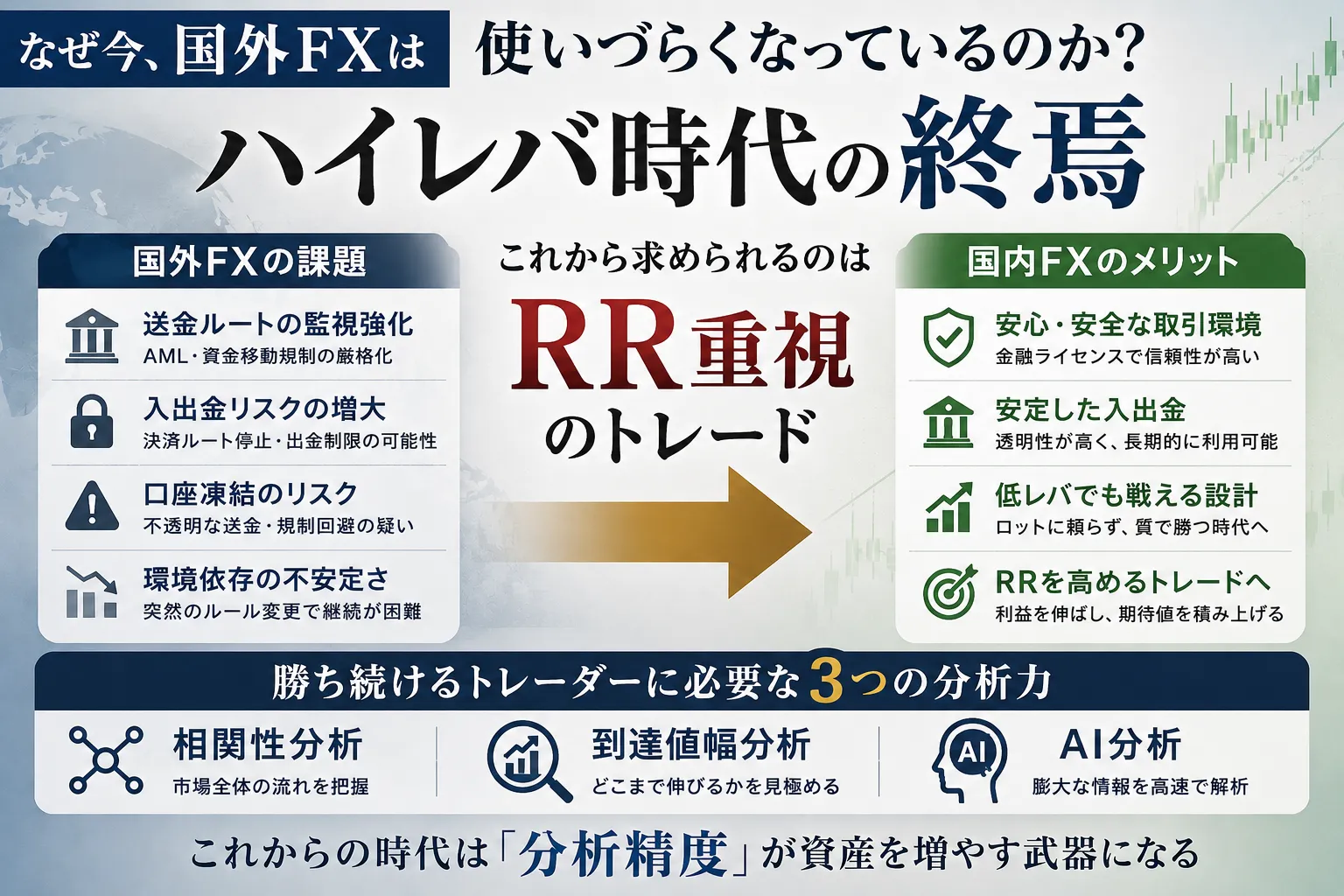
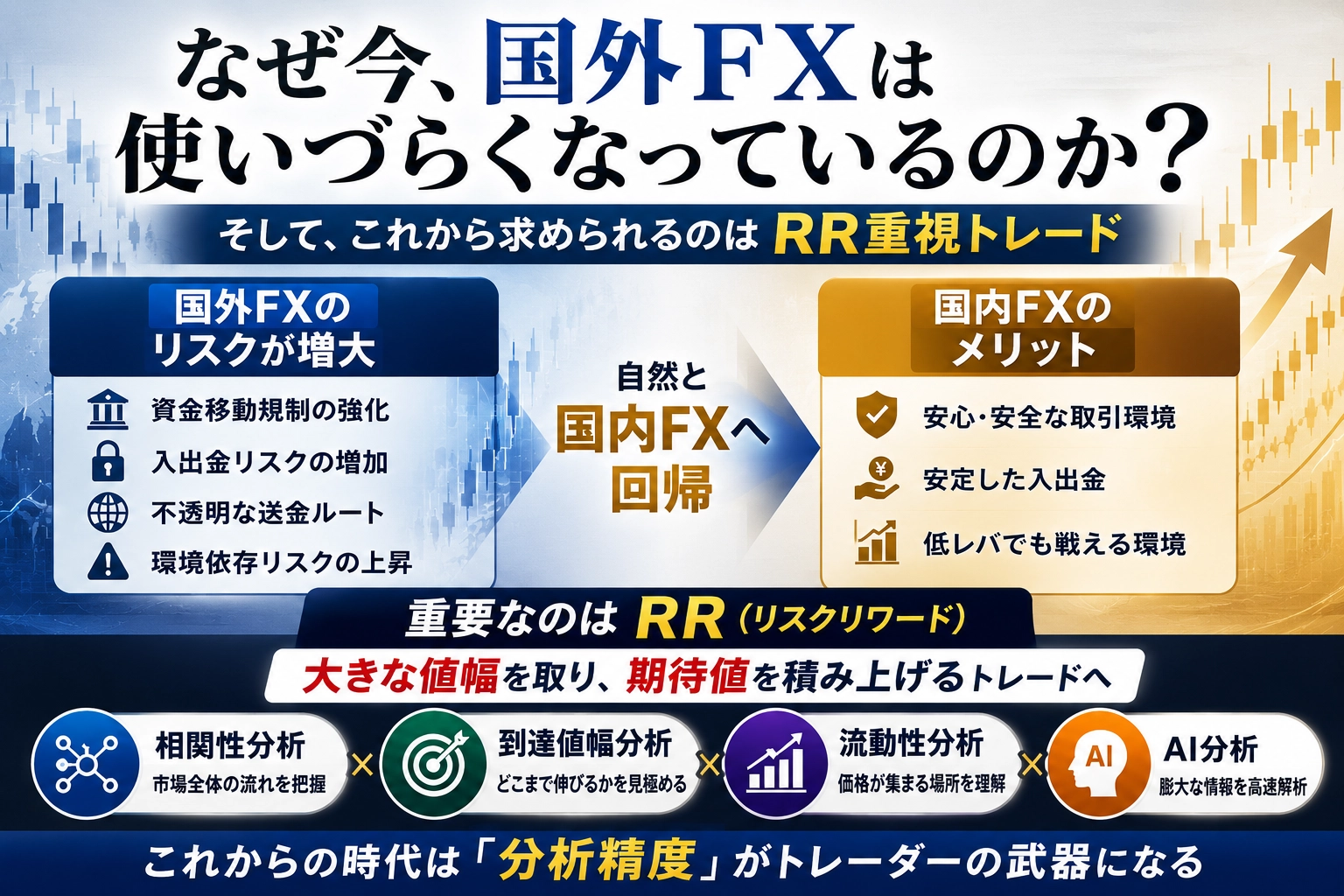
Why now,
FX abroad (unregistered domestic operators)
is becoming difficult to use?
And,
the concept of a trade that highly prioritizes “super RR” is now required
The environment surrounding offshore FX has started to change significantly in recent years.
When it comes to FX,
- High leverage
- Small capital high-lot trading
- Bonuses
- Zero-cut
seemed attractive
There was a time when
However, now,
that environment is gradually changing.
And the problem is not just
regulation that targets leverage alone.
It goes deeper.
More specifically,
“funds transfer infrastructure”
is what it is.
Why is offshore FX becoming difficult to use now?
This part is hard to understand, but
many people think that
“the Financial Services Agency dislikes offshore FX.”
to that extent.
But in reality,
it's more complicated than that.
In recent years,global tightening has been focused on:
- AML (anti-money laundering)
- cross-border money transfer monitoring
- funds movement regulations
- countering opaque settlement routes
That is,
“where that money ends up”
is being extremely tightly watched by each country.
The biggest problem of offshore FX is the “remittance structure”
This is the essence.
Many offshore FX providers do not hold financial licenses in Japan.
Then,
how are transfers and withdrawals done?
What is used here are
- agent settlement
- overseas wallets
- funds movers
- intermediate settlements
That’s right.
In other words,
from the user's perspective,
they are just requesting transfers to a domestic bank
but
beyond that, funds may flow overseas through multiple payment routes.
This is where the problem lies.
From the bank’s point of view,
the final destination of funds is hard to see
and the structure tends to become opaque.
Why do banks become stricter?
Banks worry not about FX itself but
what they are really vigilant about is,
- money laundering
- opaque remittance
- fraudulent funds
- unregistered fund transfers
- transactions aimed at regulatory evasion
That’s it.
If banks keep processing problematic transfers,
they risk being flagged by financial authorities
for AML deficiencies.
In short,
banks must fortify their defenses.
As a result,
in recent years, surveillance has intensified for
- offshore FX-related matters
- online casinos
- high-frequency overseas remittances
- opaque agent settlements
and similar areas.
In other words,
the issue is not only leverage, but
the remittance infrastructure itself
that matters.
“Offshore FX = Freedom”
Is an era beginning to change?
What’s important is
the rising “environmental risk”
that comes with it.
For example,
a bank route that used to work normally could suddenly be frozen.
Withdrawal conditions could change,
remittance restrictions could tighten.
These factors
make the “super-high-leverage-first” style
harder to execute and act as a fundamental cause.
A return to domestic FX environments is beginning
and a turning point that leads to revivalcan be said to bethe trend
Because of such circumstances
domestic FX environments are being reevaluated again,
and
previously it was
“domestic = low leverage at disadvantage”
an image as well.
But now,
the situation is changing.
Because what truly matters in trading is
not simple leverage, but
capital efficiency and expected value
therefore.
In domestic accounts, the measure is “expected value” rather than “lot size”
In domestic accounts,
super high leverage like offshore FX cannot be used.
That is,
unlike before,
- low RR
- high lot sizes
- high turnover
a style that relies on those is
less likely to succeed.
Then,
what is required from trading changes.
It is
the value per trade
.
Why GG RR will become essential from now on?
Here, RR (risk-reward) becomes important.
For example,
winning rate 80%
average profit 10 pips
average loss 30 pips
this trade may look good at a glance.
However, in terms of expected value,
it cannot be considered strong.
Because,
the losses when you lose exceed the profits when you win by a large margin.
In reality,
many traders with high win rates do not grow their funds due to this pattern.
What matters more than win rate is “range”
Many beginners focus only on win rate.
However, what professionals look at is not win rate but expected value.
For example,
even if win rate is 40%,
if you can make profits three times larger than losses,
you may grow your funds in the long run.
Conversely,
even with win rate 80%,
if profits are only one third of losses,
the equity curve will eventually collapse.
In other words,
what truly matters is
not how many times you hit, but how wide you can take the range
.
What the “width of range” was not visible in a high-leverage environment
With offshore FX,
high leverage allowed you to make profits with small ranges.
Therefore,
the items that should have been important
- profit width
- RR
- holding capacity
were often undervalued.
However,
the domestic account environment is different.
Since you cannot compensate with lot size,
you must increase the actual profit.
That is,
going forward,
how big a wave you can ride
will become important.
Many people are quitting the rising waves halfway
In reality,
many traders do not lose on entries.
They lose during holding.
A wave that would normally extend 200 pips is exited at
- 20 pips
- 30 pips
- 50 pips
instead of riding it to full length.
As a result,
the RR becomes small,
and win rate remains high but capital does not grow.
In other words,
how far you can hold
.
What is needed to take advantage of range?
This is where the main discussion begins.
To capture range, simple directional guessing is not enough.
What matters is
- where liquidity exists
- where profit-taking is more likely
- how far it can reach
- where it is prone to stall
to understand.
In other words,
the ability to analyze reachable range
.
The market tends to move toward places where orders accumulate
The market is not a perfect random walk.
Prices tend to move toward
- stop-loss orders
- take-profit orders
- break orders
- liquidity
where liquidity concentrates.
Institutional investors and algorithms use that liquidity for trading.
That’s why,
what matters is
how far it can reach
considering the goal first
.
Next, why correlation analysis becomes important?
The current market does not move based on a single chart alone.
For example, with GOLD,
- the dollar index
- U.S. Treasury yields
- risk-on/risk-off indicators
and so on,
it moves within relationships with multiple markets.
In other words,
a single chart alone makes it hard to see the true strength.
What becomes important here is correlation analysis.
Correlation analysis means looking at the movement of funds across the entire market
For example, funds flow out of equities into bonds and GOLD.
In this case, the market is risk-off.
That is, by looking at the entire market,
you can see the background of those price movements.
As a result,
you can more easily distinguish waves that tend to rise from those that do not.
AI is starting to change what can be changed
And now,
AI is beginning to greatly change the accuracy of analysis.
AI does not predict the future.
However,
- correlation markets
- multiple timeframes
- wave pattern structures
- reached value ranges
- liquidity analysis
and more,
it can organize a vast amount of information that humans cannot process quickly.
The era to come will be defined by analysis precision
In the future,
as the domestic FX environment becomes mainstream,
what becomes truly important is
- RR design
- range analysis
- reachable range analysis
- liquidity analysis
- correlation analysis
- AI-based structural analysis
is.
In other words,
not only “where to enter,”
but also
“how far the price can extend”
will be analyzed by those who have the advantage,
and that will be to their benefit.
The end of the high-leverage era may be a return to fundamentals
From now on, trading is not about winning with lots.
It is not about excessive leverage or gambling-like turnover.
It is about building up expectations and moving toward a new era
from the initial actions.
In short,
the real differences will come from
how large a position you can place, not
how large a wave you can ride.
And,
how reproducibly you can accumulate expected value.
That is the true ability required of traders from now on.