Steady effort, big payoff!
I am a candlestick FX trader.
Recently I received a question like this.
“I’m concerned about the bottoms and tops, but
when I lose, is it really big?
Before, something I purchased from another seller was a steady drip to a crash
and it reduced my funds, so I’m worried…
” I received this message.
This is a question about“Ten-Tsubo FX Logic”, specifically about losing trades.
It’s about losses.
“Ten-Tsubo FX Logic”aims for maximum profits, but
the stop-loss width is also quite narrow at the same time.
There are logical systems that use a fixed number of pips for stop-loss, which is common, but
even for the same currency pair, volatility is always different, so
if you fix the pip width, it will not be aligned with the market.
A stop-loss should be executed at the moment the justification for having entered disappears,
in my view.
Using fixed pips or fixed amounts for stop-loss is
merely a personal subjective choice,
and even if you take a loss, the price may reverse and return to the original level,
leading to a state of perpetual stop-loss poverty.
Therefore, regarding stop-loss,
I do not use fixed pips or fixed amounts;
I execute it only when the justification for holding a position disappears.
Moreover, once a stop-loss has happened,
it means the justification for holding the position has disappeared,
and the market movement has changed.
Then, by adapting my position accordingly,
I can seize new opportunities for profit.
I may be saying something a bit difficult, but
what makes this possible is
“Ten-Tsubo FX Logic”.
“Ten-Tsubo FX Logic”is
a system that trades using only candlesticks,
and does not use any other indicators or lines at all.
Furthermore,
the entry is determined bythree candlesticks,
and the exit is judged bytwo candlesticks.
Just memorizing this will allow you to trade.
And of coursewithout discretion
so the profits will be similar for anyone who uses it.
And the same goes for stop-loss as well.
So, what kind of trades does it actually produce?
This is“Ten-Tsubo FX Logic”trading results according to the rules.
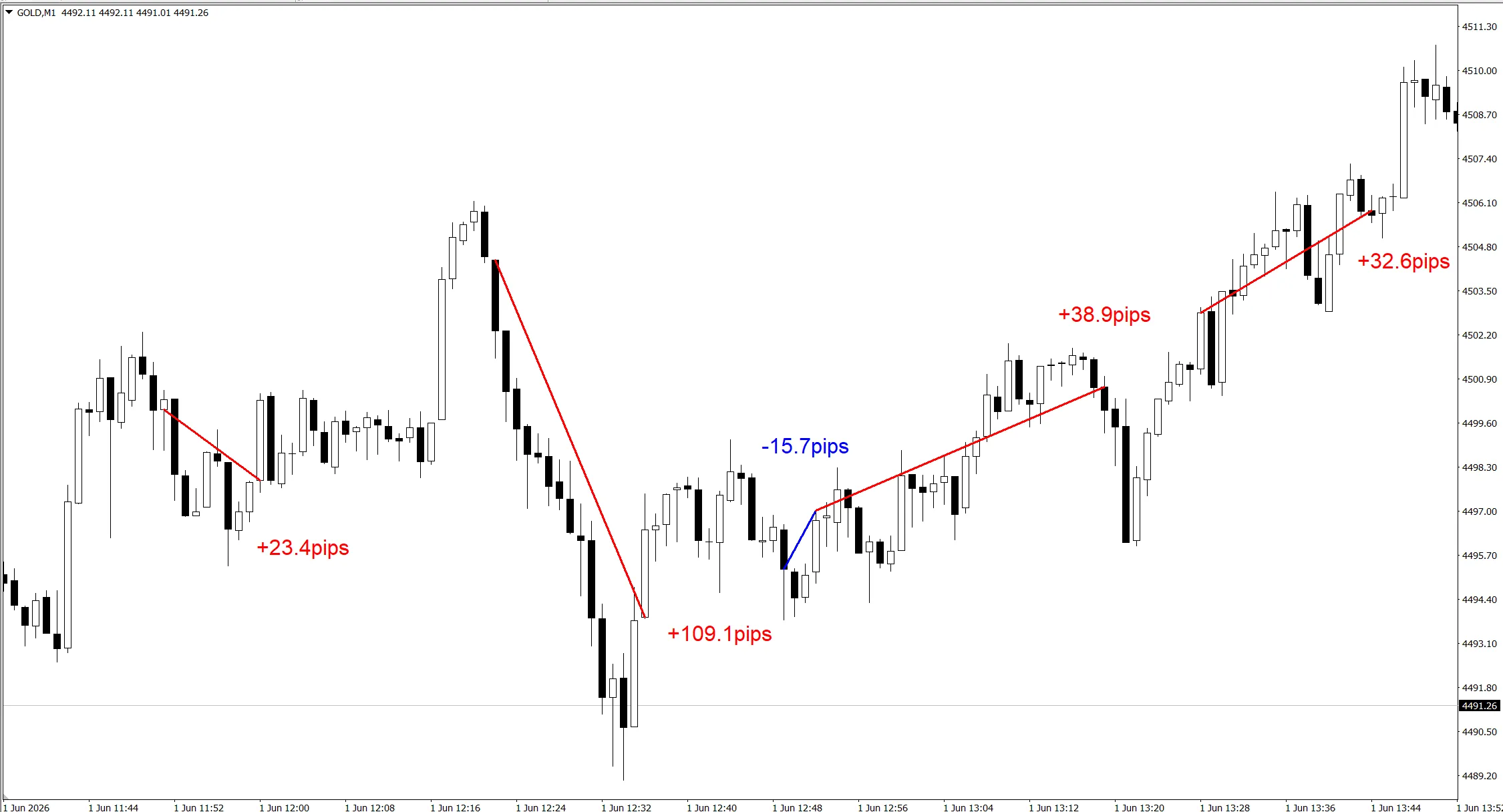
Red indicates winning trades, blue indicates losing trades.
The stop-loss is at -15.7 pips in one case.
Meanwhile, there are times when winning trades exceed 100 pips.
In this way, even when stopped out, the stop-loss is very small, as you can see.
There are often high-win-rate logics where the loss is extremely large when you lose.
In such cases, while winning is good,
when you lose, your funds can drop rapidly.
This is the so-called typical cutesy-dokan (steady small wins followed by a big loss) type logic.
And frighteningly,
especially among discretionary traders,
this tendency actually exists.
And most people don’t realize they are in a cutesy-dokan state.
Discretionary trading, with a wrong step, is on the edge of emotional trading.
• It was too elevated, so I took profit once.
• The market was ranging, so I thought it wouldn’t move further and exited.
• I entered following the momentum.
People who trade discretionary tend to do this.
To be honest, I used to do the same (laughs).
At first glance it may seem to be handled well, but
this is almost no different from emotional trading.
There are times when it temporarily goes well.
However, such trades ultimately decrease funds.
Many people fall into this trap.
And looking back at trade history,
the results are often like cutesy-dokan.
Most people,
without clear rules,
find it inherently difficult to avoid cutesy-dokan.
Unknowingly, they end up trading in a cutesy-dokan pattern.
“Ten-Tsubo FX Logic”has all rules clearly defined, so
as in the chart above, losses are small when you lose,
and you don’t stay down for long, instead you bounce back with profits that exceed them.
Therefore, of course it is not 100% win rate, but
by trading like this, funds tend to grow.
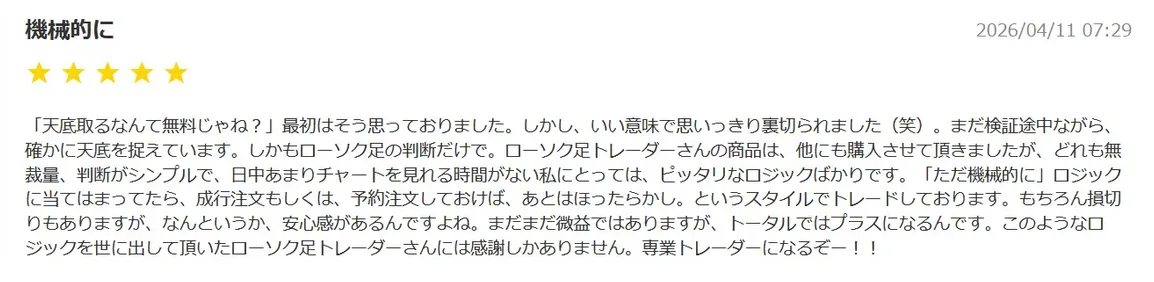
And indeed, I received this feedback.
with the title “Mechanically”.
Indeed,“Ten-Tsubo FX Logic”is a system that trades mechanically and calmly.
And as the person stated,“Of course there are stop-losses.”
And“Overall it ends up plus.”
that is what they said.
Exactly so.
There are stop-losses, but
ultimately it is a logic that ends up plus.
How to minimize stop-loss and,
and how to maximize gains when you do take positions,
is essential for steadily increasing funds.
So, this time, since you asked about stop-loss,
I have explained it.
If you want to know more about this logic, please see here.