
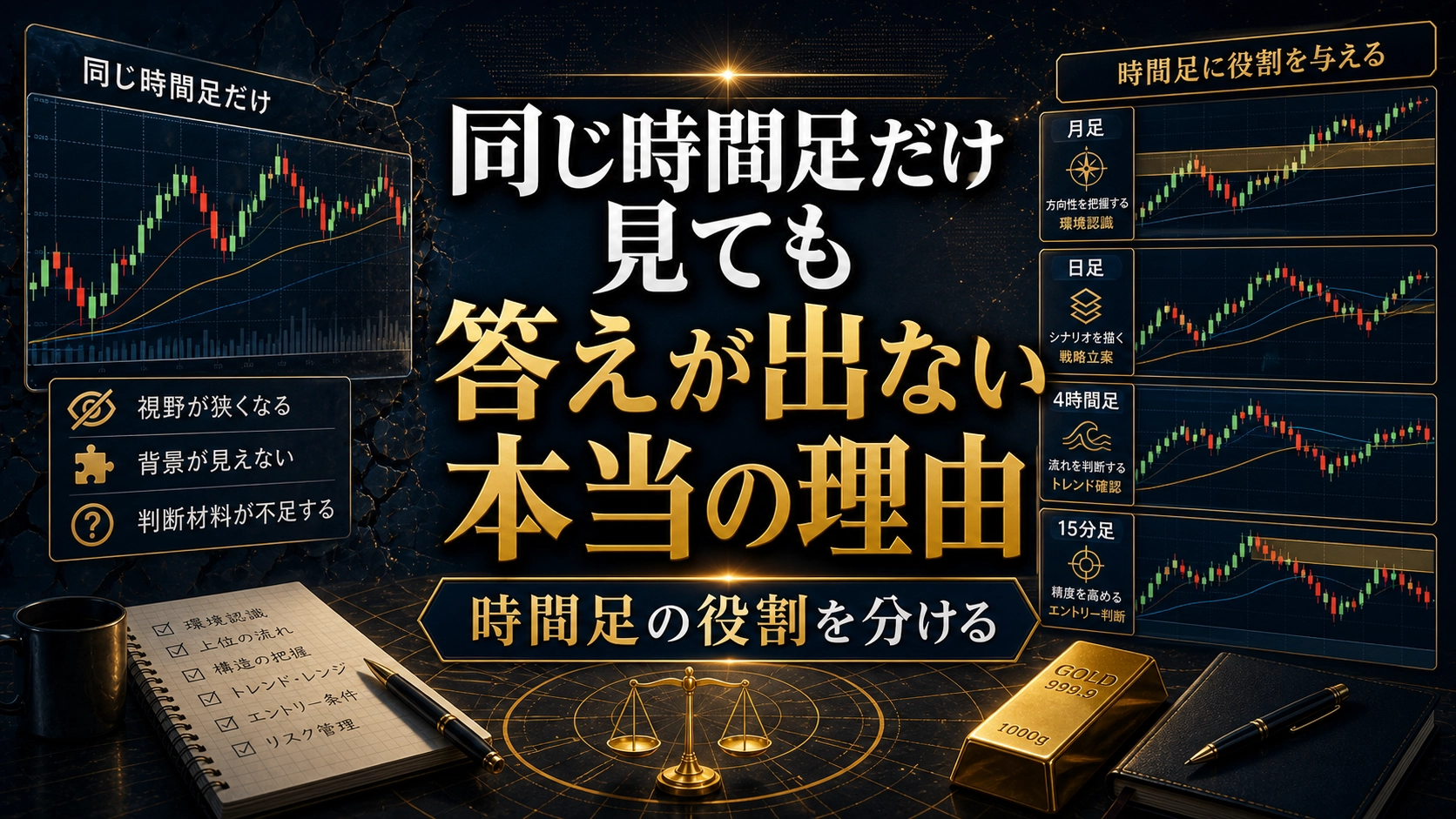
[The Real Reason You Can't Get the Answer by Looking at the Same Time Frame Alone] GOLD Trading 18 Years: A Structural Theory
For those who are troubled by “I keep watching the chart but can’t enter” in GOLD trading, this article summarizes, from 18 years of experience, the structural reasons why you can't get an answer even when you look at the same time frame, and practical confirmation habits you can start using tomorrow.
Good evening!
This is Masashi^^
↓ A GOLD special has been featured as a special."
Please participate now while you can.
Today I will write about “the role of timeframes and the mismatch in the range you are watching.”
In the past, I also looked at the same timeframe for hours and wondered why I couldn’t get an answer(;'∀')
? No matter how much you look, the “answer” won’t come out—the true cause
Open the chart and stare at the same screen for a long time.
5 minutes, 10 minutes, 30 minutes.
Thinking, “maybe it will move soon” or “maybe I can enter here,” but in the end you don’t enter.
Then the market starts moving, and when you think “Oh, it went up after all!” you hesitate with “but it’s too late to enter now…”.
If this rings true for you, you’re not alone.
There is also the opposite pattern.
It looks like a pattern has formed, you think “Alright, let me enter,” and it immediately moves against you.
You think, “If I had watched the chart more carefully, I could have prevented this,” and you end up staring at the same timeframe for a long time again.
This is the cycle.
The problem is not that you don’t have enough viewing time.The problem is that you don’t have enough range you are watching,so you end up always thinking you need to watch longer.
Many people remain blocked in this misunderstanding and keep facing the monitor for long hours.
⚖️ The length of time you watch and the accuracy of your judgment are completely separate issues.
After 18 years of trading, I can say this with confidence.
When I started trading, I thought “I lost because I didn’t watch closely enough.”
So I would watch longer and more seriously next time.
But the result didn’t change.
Why is that? Because if you only watch one timeframe, the movement you see starts to look like the entire market.
In reality, that timeframe only shows a small part of the market.
Yet you try to judge “up or down” from that fragment alone.
❌ The reason you can’t get an answer isn’t that you’re lacking viewing time, but thatthe range you are watching is insufficient.
Without realizing this, you keep staring at the same timeframe for a long time.
Aren’t you doing that right now?
Until you resolve this “range issue,” no matter how much time you spend or how focused you are, your entry accuracy will not improve.
You need to clearly recognize this first.
? The cause: the mismatch between what you can see and the information you need for judgment
So why doesn’t the same timeframe yield an answer?
I will explain the structure a little more carefully.
When making trading judgments, there are two major types of information needed.
One is “where you are now,”the information of current location.
The other is “where the walls are” and “what state the wave is in,”the market structure information.
And these two do not appear on the same timeframe at the same time.
On lower timeframes you can see the movement at this very moment in detail.
But you cannot see where that movement sits within the overall market flow.
On higher timeframes you can see “the wall locations” and “the state of the waves.”
However, you cannot read the exact timing of entries from there.
? If you only look at the same timeframe, you are only able to use either “current location” or “structure” as your basis for judgment.
That is the real reason you can’t get an answer.
I used the word “wall”, and this refers to places in the market where price tends to react.
✅ Anyone glancing at the chart can notice where price repeatedly stops.
That is the wall.
The problem is that in order to judge what state that wall is in right now, you need a fairly wide view.
If you are only looking at one timeframe, you cannot tell whether that wall is functioning or has already broken.
The same goes for waves.
The market moves up and down repeatedly.
How that wave looks depends entirely on which timeframe you are watching, and can look completely different.
On a lower timeframe you may see an upward move, but on a higher timeframe it could be a temporary rebound within a major downtrend.
If you don’t realize this discrepancy and judge only from the lower timeframe, you’ll think it’s rising and decide to buy.
The true cause of many patterns where you move in and the market moves against you the moment you enteris this.
In short, the problem isn’t “not enough viewing time” or “not enough concentration.”
It’s that the “range you are watching” and the “information required for judgment” are misaligned.
⚖️ Winners separate the roles of the timeframes
Even when looking at the same chart, what distinguishes winning traders from those who keep losing?
This is the most interesting part.
It’s not that the tools or analysis methods are hugely different.
On the contrary, simpler people tend to be more stable.
The decisive difference is“whether they assign a role to each timeframe”.
Losing traders try to solve everything with one timeframe.
They try to confirm current location, wall, and entry decision all on the same screen.
That’s why you can’t get an answer, or if you do, it’s based on a vague justification.
? “It feels like the pattern is forming somehow” is a signal that the timeframe is mixing roles.
On the other hand, stable traders have clear “what to confirm” per timeframe.
? On the lower timeframe, confirm the current moment.
? On the higher timeframe, confirm the wall positions and what state the waves are in currently.
And by alternating between these two, you can determine for the first time whether you can enter now.
I think many people might say, “I know that.”
But in actual trading, most people do not properly alternate while maintaining separate roles.
I used to be the same.
I thought I was also checking the higher timeframe, but what I was actually doing was “glance at the higher timeframe for a moment, then return to the lower timeframe.”
I would skip checking the wall state and organizing how the wave is moving now,
and only gained the sense of security from having briefly looked at the higher timeframe(;'∀')
This does not count as checking.
The difference between winning teams and others is not knowledge; it is“whether the checking process is structured”.
What to check on the higher timeframe, and what to check on the lower timeframe.
If these aren’t verbalized, you can’t escape the vague judgment no matter which timeframe you look at.
“Vague sense” is not an issue of method, but a structural problem.
? With the back-and-forth between timeframes, you finally see the market structure
So how should you think about it?
Let’s organize it at a conceptual level.
The basic idea is simple.
“Check the current state on the lower timeframe → Check the walls and waves on the higher timeframe → Return to the lower timeframe to judge whether to enter”
Do this back-and-forth properly every time. That’s all.
However, this “just that” is difficult.
⚖️ If the back-and-forth is sloppy, even looking at two timeframes, your judgment ends up the same as looking at just one timeframe.
What you confirm on the higher timeframe are two things.
One isthe location and state of the wall.
The other iswhat state the wave is in now.
If you try to go beyond these on the higher timeframe, you’ll get information confusion.
Use the higher timeframe strictly for structure verification. The precise timing of entries is the lower timeframe’s job.
“State” of the wall means whether it is still functioning or has collapsed.
Anyone can find the wall’s location.
If you look at the chart, you can immediately see where price stops many times.
But you cannot know if that wall is still effective unless you check it together with the state of the waves on the higher timeframe.
? Returning to the lower timeframe is for the final confirmation of whether the entry-ready state is prepared.
After confirming on the higher timeframe and then looking at the lower timeframe, the way you see things on the same screen changes completely.
Not just “feels likely to move,” but
“approaching the wall confirmed on the higher timeframe and the wave state is in a position where entry can be considered; the rest is up to judging on the lower timeframe”
When you switch to this way of thinking,you can articulate the basis for your entry decision.
Being able to put it into words means you can explain why you entered yourself.
As that accumulates, you will be able to review more effectively.
With effective review, you’ll see what needs to be corrected.
This is the shift from “felt-sense trading” to “structure trading.” .
It’s not about difficult theory; simply organizing the order of viewing and the purpose changes how you see things.
✅ Four confirmation habits you can start tomorrow
The concept is clear. Now, what should you actually do starting tomorrow?
I’ll list four concrete steps.
? A timeframe that isn’t decided how to use it will not serve as a basis for judgment no matter how much you watch.
Step 1: On the lower timeframe, confirm “where you are now”
First, on the lower timeframe, confirm whether the current price action is moving up or down.
Do not consider entries here.
Just be able to say in words, “Now it’s moving upward” or “Now it’s pausing.”
✍️ This habit of confirming in words will form the foundation for later judgments.
Step 2: On the higher timeframe, confirm “the wall and wave state”
Next, open the higher timeframe and confirm “Where is the wall?” and “What state is the wave in now?”
Look for where prices repeatedly stop.
Get a rough sense of whether the wave has recently risen sharply, fallen, or is directionless.
Don’t try to analyze it in detail.
✅ It’s enough to have a rough grasp.
Step 3: Return to the lower timeframe and judge whether you can enter
With the wall position and wave state from the higher timeframe in mind, return to the lower timeframe.
Check whether the current movement is consistent with the structure you confirmed on the higher timeframe.
If it is consistent, consider entering.
If it is not, don’t enter.
✅ Stop entering just because it “feels like it’s taking shape”—go through this confirmation process, and you’ll see a difference.
Step 4: Write the reason for entry in one sentence
After you enter, write in your notebook or notes in one line why you entered.
For example, “approached the wall on the higher timeframe” or “wave was in a retracement timing.” Short is fine.
If you can’t write it, it means you entered for a vague reason.
Practice waiting a little until you can write it.
A lack of verifiable reasoning is not a reason.
There is nothing difficult here.
All you need to do is decide the order of confirmations and write the reason in one line.
Continuing this will gradually transform vague judgments into“evidence-based judgments”.
? Conclusion: What I think after 18 years
The reason you can’t get an answer from looking at only one timeframe is not about concentration or time alone,it’s because the range you are watching and the information needed for judgment are misaligned.
The lower and higher timeframes each have their own roles.
If you try to solve everything with one timeframe while mixing those roles, your judgment becomes vague.
The solution is simple:back and forth between the lower and higher timeframes, deciding what to confirm in each.
And write the reason for entry in one line.
No special skills or advanced analysis are required.
Just organize the order of confirmations and the purpose, and your view will change.
? If you stop predicting and start confirming structure, the market will begin to become an “answerable question.”
First, try it once tomorrow.
? This content,GOLD Special Medical Manual (or the market’s answer) will help you understand more deeply.
▼ The market’s answer
https://www.gogojungle.co.jp/tools/ebooks/77829
? Free AI tool for trade analysis
https://trade-ai-free.streamlit.app/