
【The Real Reason I Can’t Read Waves】Unraveling the Structure of Environmental Perception in 18 Years
To those who know that environment recognition is important in GOLD trading but still have judgment biases. In this article, based on 18 years of experience, we explain the issue at the structural level: why you can’t read the waves and why your environment recognition drifts.
Good evening!
This is Masashi ^^
↓ A GOLD-specific remedy has been featured ^^
Please join now, if you can.
Today I will write about “why you can’t read the waves and how to make environment recognition function”.
In the past, every time I opened a chart I felt “it’s rising somehow” and entered long, only to have it gradually move against me—I don’t know how many times that happened (;'∀')
? Do you have these kinds of worries?
❌ You think you’re doing environment recognition properly, yet losses keep piling up
❌ Even when you look at the chart, you can’t clearly tell where the “waves” are
❌ The more you study, the more you feel迷う (confused)
There are traders around me who have this pattern for 18 years.
What all of these people have in common isthey can see the chart but cannot see the structurein their current state.
Because they can’t see the structure, they end up relying on predictions again.
In this article, I will explain the true nature of this problem in order.
❌ Entering with a vague “upward trend” and losing for sure
Traders who say they are doing environment recognition properly can sometimes be entering dangerous zones.
I was the same (;'∀')
Open the chart and feel, “Okay, it’s moving up.” The candlesticks look like they’re climbing to the right.
Because it feels strong somehow, you go long. Then it gradually goes down and you think, “Huh?”
This looks like you’re doing environment recognition, but in reality you are“only looking by sensation”that’s what’s happening.
⚖️ “Having a sense of direction” and “seeing the wave structure” are completely different things.
Many traders fall into reading the chart’s “vibe”.
They accumulate the color of the candles, the slopes, and a sense of momentum. They judge “rising” based on these.
But there is no justification for this.
The concept of waves is a matter of structure: where the highs and lows are located.This is what it is.
If highs are rising and lows are also rising, it is an upward wave. If highs are not updated and lows are falling, it is a downward wave.
Even though it’s just that simple, reading by feel leads to vague judgments like “somehow strong” or “somehow weak.”
And that vagueness directly undermines the basis for your entries.
What common among losers who say they can recognize the environment but still lose is that they are“feeling” rather than “seeing” the wave.
Even if you can say, “I’m looking from a higher level now,” can you answer immediately when asked, “Where are the current highs and lows, and how far does it need to move next to consider a wave turning?”
If you’re stuck here,perhaps you can’t see the wave.
Environment recognition means “being able to describe in words what state the market is in now.”
It’s not just a feeling or vibe.
After 18 years, I’ve learned something clear:
“If you can’t verbalize it, you can’t use it.”That’s the first hurdle.
Don’t trade with something that's vague. This is the starting wall.
? Why the waves become unseen: a structural explanation
The reason you can’t see waves isn’t mental state or lack of study.
It’s a structural problem.
There is a common pattern among many traders who can’t see waves.
That is“I’m trying to complete everything within the current time frame only.”.
? If you only look at lower timeframes, you can’t tell whether you’re in the middle of a wave or at the end.
For example, you open a lower-timeframe chart and decide, “Since the recent low was broken upward, I’ll look for longs.”
But on a higher timeframe, that movement might just be a “pullback” within a larger downward wave.
What looks upward on the lower timeframe can be entirely within a downward flow on the higher timeframe. This is where the mismatch arises.
And if you ignore this mismatch and enter, you’ll feel like “there was a basis, but I lost.”
In reality, the foundation of the basis was wrong.
Another reason waves become hard to see is“trying to see waves while ignoring the walls”.
Waves don’t move in a vacuum.
On a chart, there are places where price repeatedly reacts—i.e., walls.
Waves form when price bounces off these walls.
If you chase waves without looking at the walls, you won’t know where price will stop.
As a result, you’ll only enter in the middle of a wave.
To identify the start and end of a wave, you must determine the wall positions.
If you know where the walls are, you can judge when a turn might happen in that area.
But if you ignore walls, you’ll realize too late, after the move has begun, “oh, this might stop here.”
That is a structural problem.
The order of viewing is reversed.
Instead of looking at the wave first and then locating the walls, you should first identify the walls and then judge the waves.
If this order collapses, environment recognition will drift every time.
This drift piles up and leads to the conclusion that “the rules don’t apply to this market.”
The real problem isn’t the market but the order in which you look at things.
✅ The winners don’t rely on prediction but on confirmation
I don’t think the difference between winning and losing traders is talent or years of experience.
The biggest difference is,“what you’re looking at.”.
Losing traders try to predict “which direction it will move next.”Prediction.
Winning traders instead try to confirm“what the current structure is doing.”They ask, “What state is the wave in? Where is the wall? Is this a position to make a move?”
? Predictions may hit or miss, but confirmations always support correct judgment.
Where does this difference come from?The purpose of environment recognition is different.
For losing traders, environment recognition is about determining “which way it will move.”
So there are hit-or-misses. If it goes well, you say “environment recognition was correct”; if not, you say “environment recognition is difficult.”
For winning traders, environment recognition is about confirming whether you should be in a position to trade now.
It’s about whether the conditions are met, not about winning or losing.
Therefore, the sense of “this is a fit” or “this is off” doesn’t arise.
Top-tier traders can describe the wave states in words.
“From the higher timeframe I see we’re in the middle of a downward wave, while on the lower timeframe a retracement is forming.
There is a wall in this price range. Therefore I’m aiming for a retracement sell.” The justification is verbalized.
Lower-tier traders say things like “somehow it looks like it will go up” or “it seems strong.”
That’s the essence of “vague.”
I don’t deny that intuition has a place.
But intuition alone cannot yield repeatable results. You won’t know why today went well or why tomorrow won’t.
So you end up repeating the same mistakes.
I used to think, too, that “if I sharpen my intuition I’ll win.”
But in reality, relying on intuition makes you blind to the structure.
When the structure is visible, intuition stops interfering.
You can tell at a glance what state the chart is in.
That sense comes from the accumulated understanding of the structure.
Intuition that isn’t grounded in structure is a different thing.
? How to make environment recognition “work”: three mindset steps
To make environment recognition function correctly,organize the order of looking and the purpose of looking.
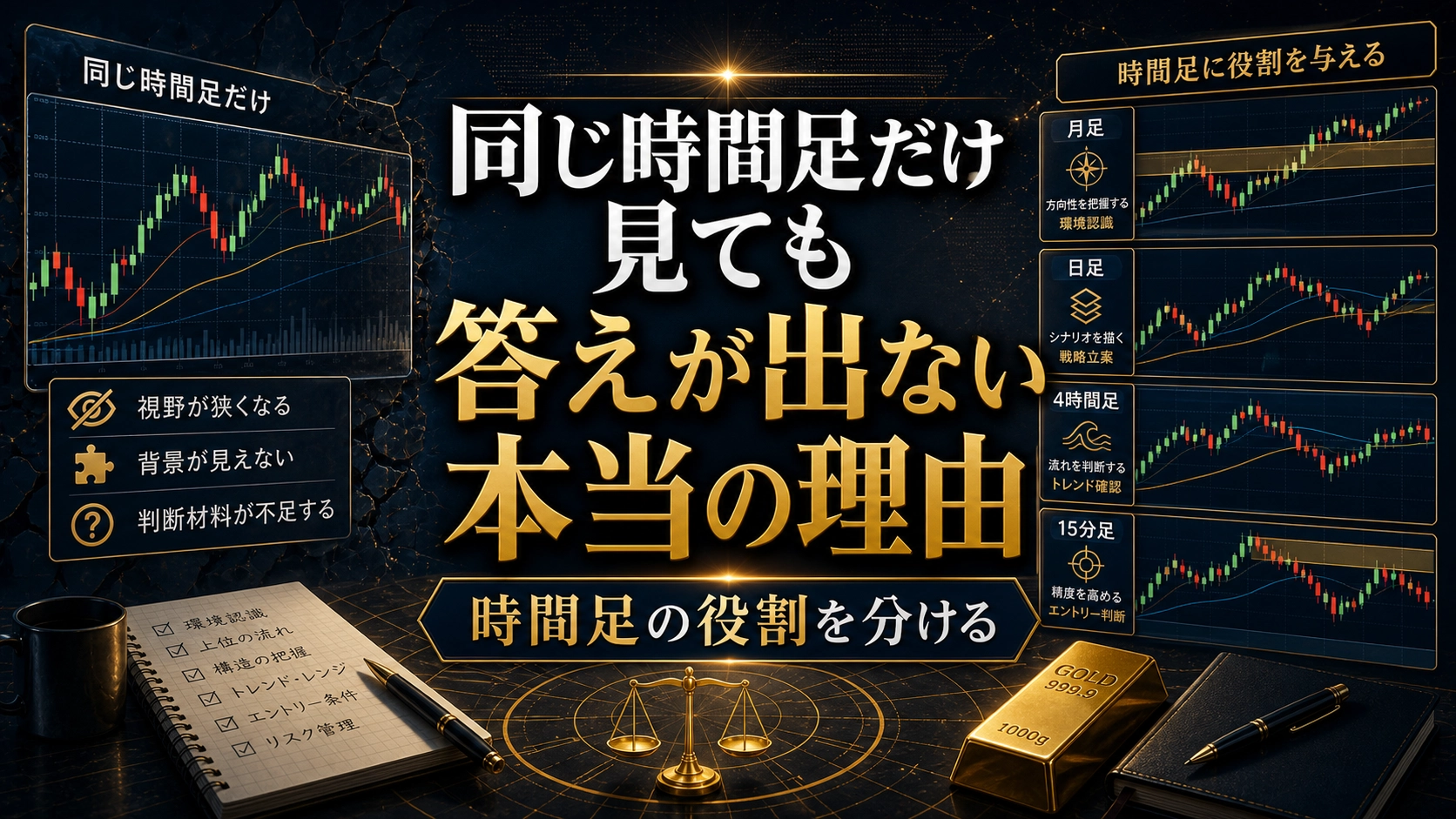
First, lower and higher timeframes have different roles.
?Lower timeframe roleis to confirm the current situation; to understand how price is moving right now and what the most recent wave looks like.
?Higher timeframe roleis to confirm the wall’s position and the wave’s state; to understand where in the big wave the current move lies.
And importantly, you should“ping-pong”between them to confirm.
✍️ Grab the current state on the lower timeframe, verify the structure on the higher timeframe, then go back to the lower timeframe to decide. This back-and-forth is the essence of environment recognition.
The idea of “see the higher timeframe first and then decide” seems reasonable, but actually it’s a trap.
Seeing the higher timeframe first creates a bias.
If you fixate on “the higher timeframe is bullish, so I’ll long,” you’ll ignore other signals on the lower timeframe.
The back-and-forth exists because each timeframe has its own filter criteria.
So, what should you confirm on the higher timeframe?
✅ One: “wall position”
On the higher timeframe chart, there are places where price repeatedly stops or reverses.
These are walls.
Knowing the position of these walls forms the basis for judging where waves will stop.
✅ Another: “wave state”
Is the current wave rising, falling, or oscillating up and down?
By confirming these three states on the higher timeframe, you can see whether it’s a moment to trade now.
The key here is not to use the higher-timeframe confirmation as a prediction.
Don’t say “because there is a wall, it will reverse.” Instead, adopt the stance
“Because there is a wall, I will consider the possibility of a reversal around this area and judge accordingly.”.
If you dogmatically expect a reversal and it doesn’t happen, your justification collapses.
When this mindset is cultivated, environment recognition becomes an axis for decision-making rather than a tool for predicting.With this axis, your actions won’t be undermined by market moves.
So you won’t waver.
Wall, wave, and time frame—back and forth.Only when these three align does environment recognition start functioning.
✍️ Three steps you can start tomorrow
Even if you understand the concept, you won’t benefit unless you actually do something.
Here are three concrete steps you can start tomorrow.
? Don’t end at “I understand.” The only answer is “I tried it.”
Step 1: Before today’s trade, write a one-sentence description of the wave’s state
? When you open the chart, try to describe the current wave’s state in words.
“Right now, on the lower timeframe, highs and lows are both rising.”
“On the higher timeframe, we’re in a retracement within a downward wave.”
And so on.
If you can’t write it, that’s a sign the wave isn’t visible yet.
If you don’t have a basis, entering won’t yield reproducible results.
Practice waiting a day to be able to write it..
Step 2: On the higher timeframe, first note the “wall” positions, then return to the lower timeframe
? Before looking at the lower timeframe, find 3–5 locations on the higher timeframe where price has repeatedly reacted and note them.
Recognize “there is a wall in this price range” and then return to the lower timeframe, so you can see in advance where price might stop.
This alone reduces the urge to chase a move when it suddenly happens.
Seeing the walls allows you to judge, “this might be nearing the end.”.
Step 3: After entering, always record in one line why you entered
? If you can’t write why you entered, that entry had no basis.
“It seemed like it would rise” is not a basis.
Spell it out as, for example, “Because the lower timeframe formed a reversal wave near the wall,” linking the wave, wall, and time frame elements.
Link the three elements of wave, wall, and timeframe in your wording.
✅ If you keep this record for a week, you’ll see where you tend to make vague judgments.
Many people realize the problem isn’t the sharpness of their intuition but the inability to verbalize it.
These three steps are modest. They aren’t flashy.
But after a week, your chart-reading will change.
Environment recognition is not a skill but ahabit.
By incorporating a habit of verbalizing a little every day, your judgment becomes steadier.
You don’t have to rush to change everything at once.
Start with one thing from tomorrow.
? Conclusion: after 18 years, what I think
The essence of the problems of “not reading waves” and “environment recognition drifting” lies inhow you view the structure.
Instead of reading the vibe with intuition, confirm the highs and lows and walls while alternating between lower and higher timeframes.
As this habit takes root, the vague “somehow” disappears, and a justifiable basis for decisions emerges.
You don’t need to predict. You only need to confirm.
⚖️ When the structure is visible, you’ll be less swayed by the market. That’s the essence of being “unshaken.”
First, tomorrow, when you open a chart, try writing one sentence about the wave’s state.
As that one sentence accumulates, your environment recognition will surely change.
Please try it ^^
? The content this time is best understood by those who have the GOLD Remedy Manual (or market answers)—or those who already know the market’s answers.
▼ The market’s answers
https://www.gogojungle.co.jp/tools/ebooks/77829
? A free AI tool for trade analysis
https://trade-ai-free.streamlit.app/