
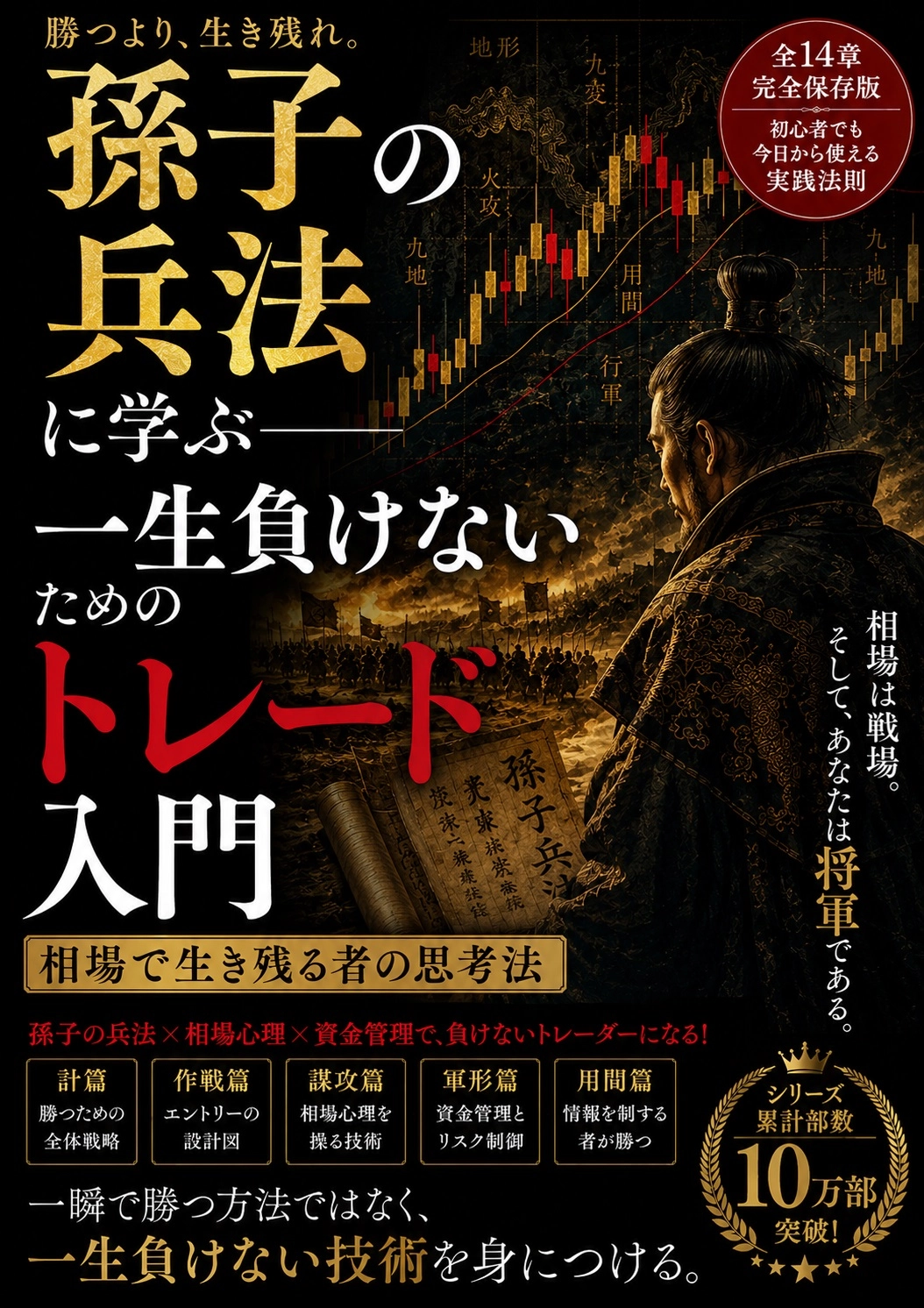
Learn from Sun Tzu's Art of War~~~A Beginner's Guide to Trading That Never Loses a Lifetime~~~
―― The Mindset of Those Who Survive in the Market ――
“Don’t aim to win. First, survive.”
Introduction
In the world of markets, many beginners try to learn “how to win.”
However, what truly matters is,
“how not to be expelled.”
No matter how excellent your method is, if you lose your capital, you cannot remain in the market.
In fact, many beginners fail not because of technical analysis.
・Cannot cut losses
・Position size too large
・Entering based on emotions
・Being swayed by information on social media
・Trying to recover after a string of losses
These “human weaknesses” cause them to exit the market.
This was the same even over two thousand years ago on battlefields.
The Art of War by Sun Tzu is not merely a book about warfare.
It is a survival strategy that explains “how to avoid wasteful battles, survive, and eventually win.”
And that philosophy surprisingly applies to modern trading.
In this book, we translate and practically explain the thirteen chapters of The Art of War for beginner traders.
No need for difficult theories.
What is needed is
・A mindset that avoids losses
・A habit of controlling emotions
・Techniques to protect capital
・Strategies to survive in the market
By the time you finish reading this book, you will understand not only how to win but also
how to survive
Chapter 1
The Market is a Battlefield, You Are a General
Strategy is Essential
Sun Tzu said this.
“If you know your enemy and know yourself, you need not fear the result of a hundred battles.”
The same applies to trading.
Many beginners only watch charts.
But what you should truly observe is,
・When you are likely to lose
・When emotions flare up
・What times of day you tend to make mistakes
・When you tend to make unnecessary entries
that is, your own self.
You cannot completely dominate the market.
However, you can control your own actions.
In other words,
“Before you win in the market, win over yourself.”
This is the first step in strategy trading.
Chapter 2
Those Who Win Do Not Lose First
Beginners think about “how to grow profits.”
But seasoned traders first consider
“how not to incur big losses.”
This is Sun Tzu’s famous thinking.
“First ensure you do not lose, then wait for the enemy to fail.”
In other words,
・Fortify defense first
・Avoid unnecessary losses
・Only trade in situations where you can win
This is the basics.
Ironclad Rules Beginners Should Protect First
① Maximum loss per trade within 2%
For a 100,000 yen account, the maximum loss per trade should be 2,000 yen.
This alone can prevent a fatal blow.
② Always place a stop loss
“It may come back” is the biggest trap for beginners.
The market is not moving to help you.
③ Stop after a losing streak
Take a break after two consecutive losses.
In a state of emotional turmoil, judgment deteriorates significantly.
Chapter 3
Sun Tzu Style: Beginner’s Capital Management
Many beginners are focused on,
“where to enter.”
But what is truly important is,
“how much risk to take.”
Leverage is a tool and also a charge of gunpowder
Leverage itself is not dangerous.
What is dangerous is,
・Too large lot sizes
・No stop loss
・Emotion-driven averaging down
In Sun Tzu’s terms,
“Trying to extinguish a fire while holding firewood.”
This is the state.
Basic Formula for Capital Management
・Loss per trade: within 2%
・Total drawdown: within 10%
・Profit/Loss ratio: at least 2:1
Keeping these alone dramatically increases survival rate.
Chapter 4
Nine Lands — Nine Psychological States Where Beginners Fall
The market has “terrain.”
And traders also have their own “psychological terrain.”
Dispersed Ground
A state of entering haphazardly.
→ Pause for that day.
Light Ground
Becoming anxious with just a small loss.
→ Practice with tiny lots.
Contention Ground
Near an important line.
→ Do not chase breaks.
Encircled Ground
Unable to move due to unrealized losses.
→ Cut losses immediately.
Desperate Ground
On the verge of a margin call.
→ Close all positions and rest.
Many beginners slide from
Dispersed Ground → Encircled Ground → Desperate Ground
and continue downward.
So every day, ask yourself,
“Which terrain am I in right now?”
Chapter 5
Emotions Are the Greatest Enemy
The market’s greatest enemy is not the market itself.
It is your own emotions.