
What is the number of pips for day trading stop loss? How to determine the "correct stop loss width" and practical techniques

▼Detail page for Three-Resonance Wave FX
https://www.gogojungle.co.jp/tools/indicators/65204?via=users_products
This is SEI from Trading Labo+.
Thank you for always taking a look.
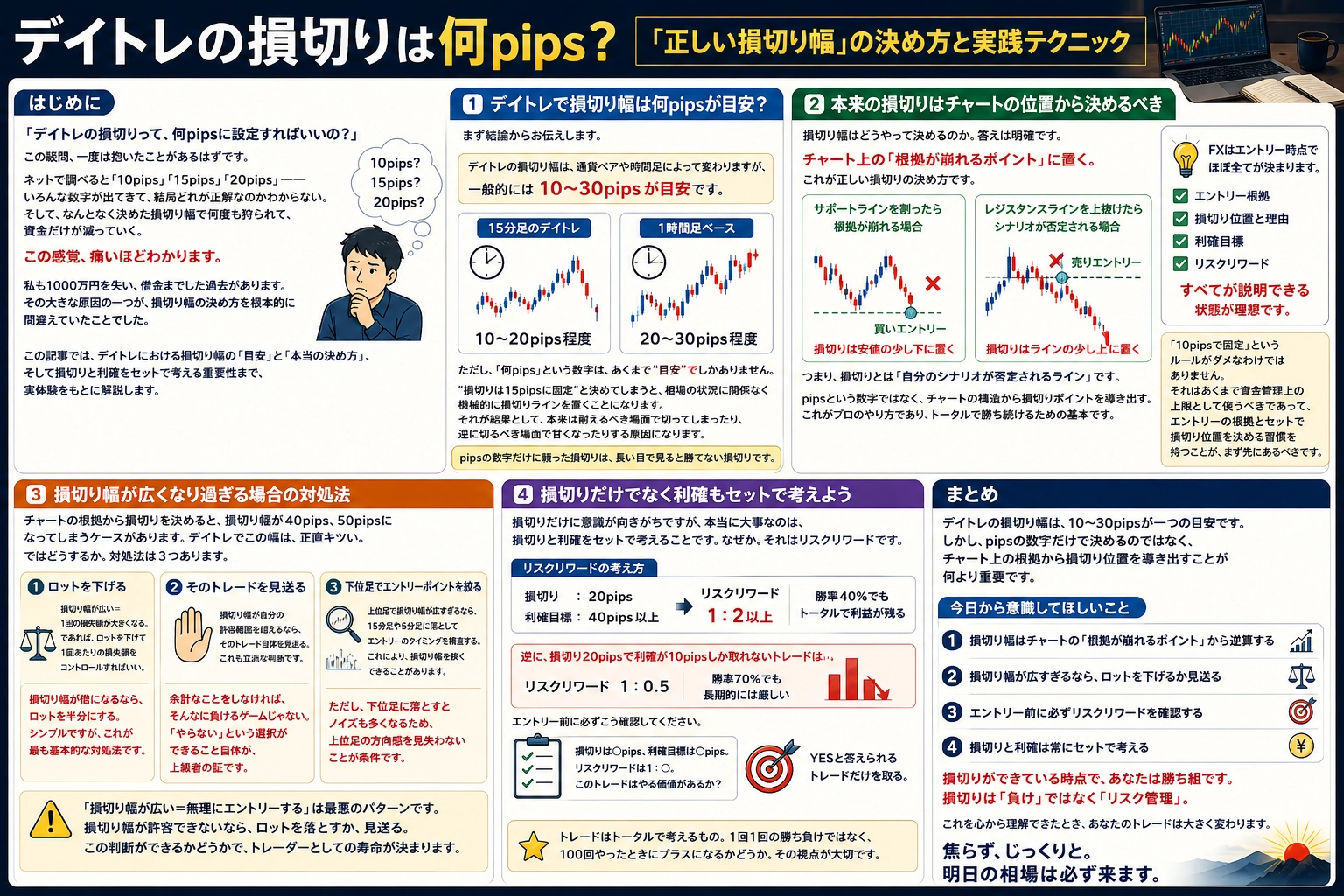
Today’s topic is “How many pips should you cut for day trading? How to determine the correct stop loss width and practical techniques.”
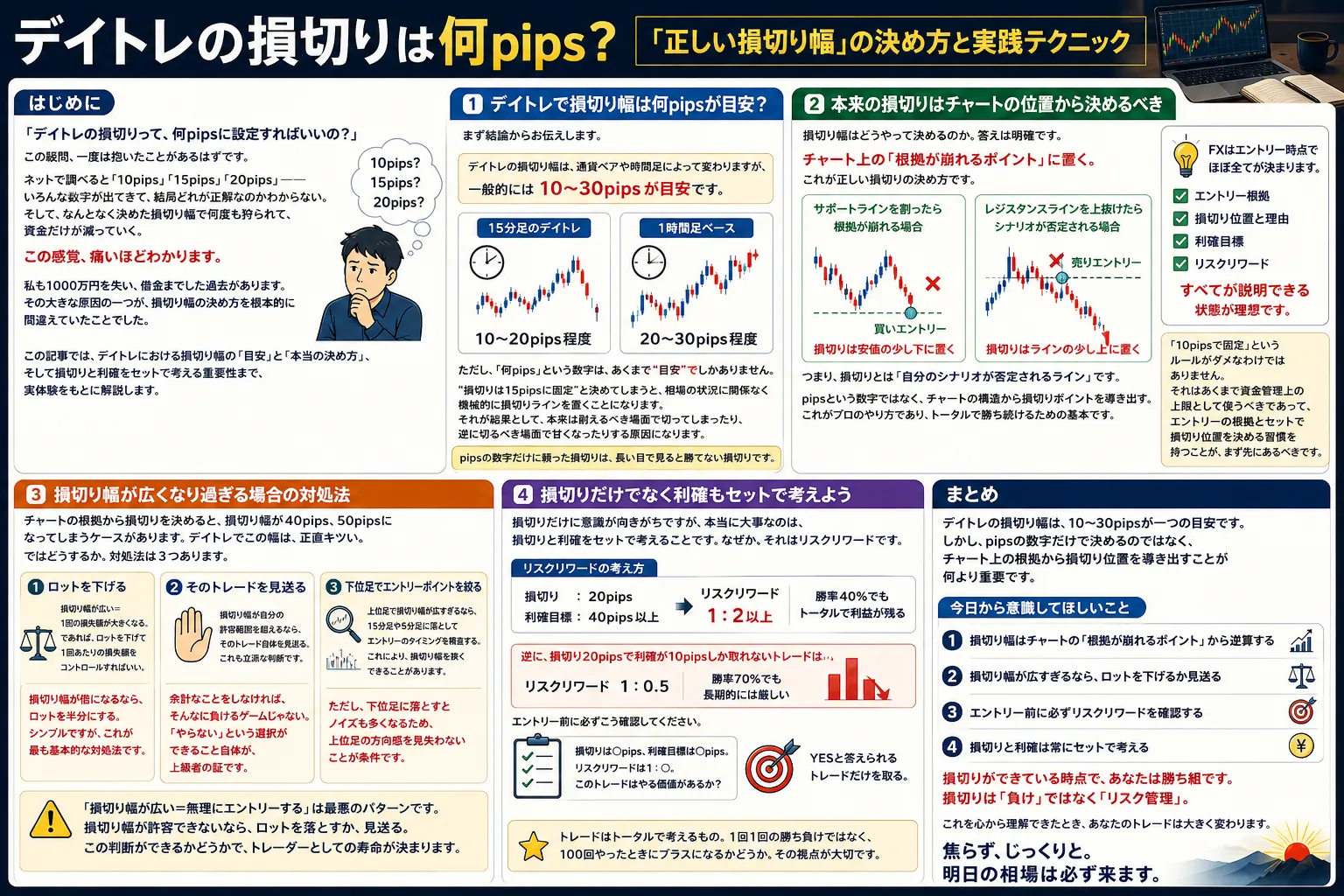
Introduction
“For day trading, what pips should I set for the stop loss?”
You’ve probably wondered this at least once.
When you search online, you’ll see numbers like “10 pips,” “15 pips,” “20 pips”—so which is correct remains unclear. Then you end up stopping out at fixed widths, draining your funds little by little.
I understand this feeling all too well.
I once lost 10 million yen and even ended up in debt. A major cause was fundamentally getting the stop-loss width wrong.
This article explains the “guide” for stop-loss width in day trading, the true method to decide it, and the importance of considering stop-loss and take-profit together, based on real experience.
◆ For day trading, what pips are a reasonable target for stop-loss?
First, the conclusion.
Stop-loss width for day trading varies by currency pair and time frame, but typically 10–30 pips is a common guideline.
For example, in 15-minute day trading, about 10–20 pips. On an hourly basis, 20–30 pips is a realistic line.
However, one important thing here.
The “number of pips” is only a guideline.
If you fix stop-loss at 15 pips, you’ll mechanically place the stop-loss line regardless of market conditions.
As a result, you may cut your losses in situations where you should endure, or be too lenient where you should cut, causing issues.
Relying only on the pip number leads to long-term unprofitable stop-losses.
◆ Proper stop-loss should be determined from the chart position
So how should you decide stop-loss width?
The answer is clear. Place it at the point where your rationale on the chart becomes invalid.
This is the correct way to decide stop-loss.
For example, if your entry rationale collapses when the recent low is broken, place the stop-loss a little below that low.
If your scenario is invalidated by a breakout above a resistance line, place the stop-loss a little above that line.
In other words, stop-loss is“the line where your own scenario is invalidated”.
Deriving the stop-loss point from the chart structure, not from a pip number. This is how professionals operate and the foundation for long-term success.
The rule “fix at 10 pips” isn’t bad in itself.
However, it should be used as a capital-management upper limit, and you should adopt the habit of setting the stop-loss position in conjunction with the entry justification first.
FX decisions are largely made at the time of entry.
Ideally, you can explain at the moment of entry, “Where to cut losses and why there.”
◆ What to do when stop-loss width becomes too wide
If you decide stop-loss from chart grounds, you may end up with a stop-loss of 40–50 pips.
This is tough for day trading. A single loss can wipe out a sizable amount of capital.
What to do? There are three ways.
① Lower your lot size
A wider stop-loss means a larger potential loss per trade.
If so, reduce the lot size to control the loss per trade.
If the stop-loss width doubles, halve the lot size.
Simple, but this is the most basic remedy.
② Skip that trade
If the stop-loss width exceeds your tolerance, skip the trade altogether.
This is also a valid judgment.
If you don’t overthink things, it’s not a losing game.
Being able to choose “not to trade” is a sign of a skilled trader.
③ Narrow entry points on lower time frames
If you’re looking at the hourly frame and the stop-loss width is too wide, move to 15-minute or 5-minute charts to refine your entry timing.
This can help narrow the stop-loss width.
However, lowering to lower time frames increases noise, so you must not lose sight of the direction on the higher time frame.
In any case, “wide stop-loss equals forcing an entry” is the worst pattern.
If the stop-loss width cannot be tolerated, reduce the lot or skip.
Whether you can make this judgment determines your trading lifespan.
◆ Think of take-profit as a set with stop-loss
When discussing stop-loss, many people focus only on “where to cut.”
But what’s truly important is to consider take-profit together with stop-loss.
Why? Becauserisk-reward ratio
For example, if stop-loss is 20 pips, your take-profit target should be at least 20 pips—ideally 40 pips or more.
If the risk-reward is 1:2, you can still be profitable with a 40% win rate.
Conversely, a trade with 20 pips stop-loss and only 10 pips take-profit is unsustainable long-term even with a 70% win rate.
Therefore, before entering, always check this:
“Stop-loss is ○ pips, take-profit goal is ○ pips. Risk-reward is 1:○. Is this trade worth taking?”
Only take trades where you answer “YES.”
This is the rule for long-term success.
Trading is about the total result.
Not win/lose on a single trade, but whether you are profitable after 100 trades.
With that perspective, your fear of stop-loss will shrink remarkably.
◆ Summary
For day trading, a stop-loss width of 10–30 pips is a guideline.
However, more important than the pip number is deriving the stop-loss position from chart-based rationale.
What you should start focusing on today:
・Calculate stop-loss width by working backward from the chart’s points where the rationale collapses
・If stop-loss width is too wide, reduce the lot or skip
・Always check risk-reward before entering
・Always consider stop-loss and take-profit together
If you can stop-loss effectively, you are already in the winning group.
Stop-loss is not “loss” but “risk management.”
When you truly understand this, your trading will change dramatically.
Don’t rush, take your time.
Tomorrow’s market will surely come.
◆ Who is Three-Resonance Wave FX ideal for?
・People with night shifts or irregular work schedules limiting trading time・People raising children who can’t stay glued to charts
・People doing FX as a side job・People who are not confident in complex analyses and want simple trading
・People tired of looking at dozens of indicators・People not confident in chart pattern judgments
・People who want to aim for large pips efficiently in little time・People who prefer swing trading to scalping
・People who get anxious watching price movements and get tired・People who hesitate on stop-loss levels and tend to hold positions too long
・People who become a collection of know-how and never use it・People who buy signal tools but can’t win

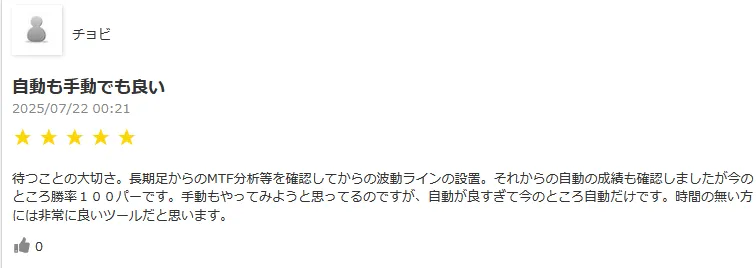
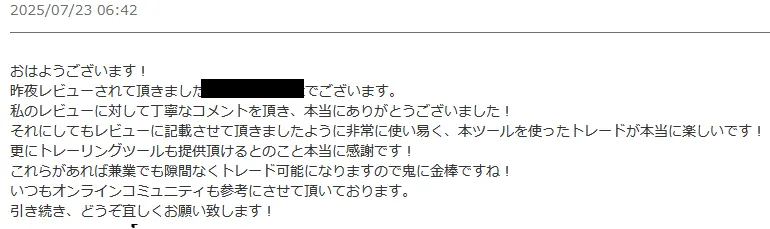
◆ Join Three-Resonance Wave FX here ↓ ↓ ↓
https://www.gogojungle.co.jp/tools/indicators/65204?via=users_products

◆ Join Three-Resonance Wave FX here ↓ ↓ ↓
https://www.gogojungle.co.jp/tools/indicators/65204?via=users_products