
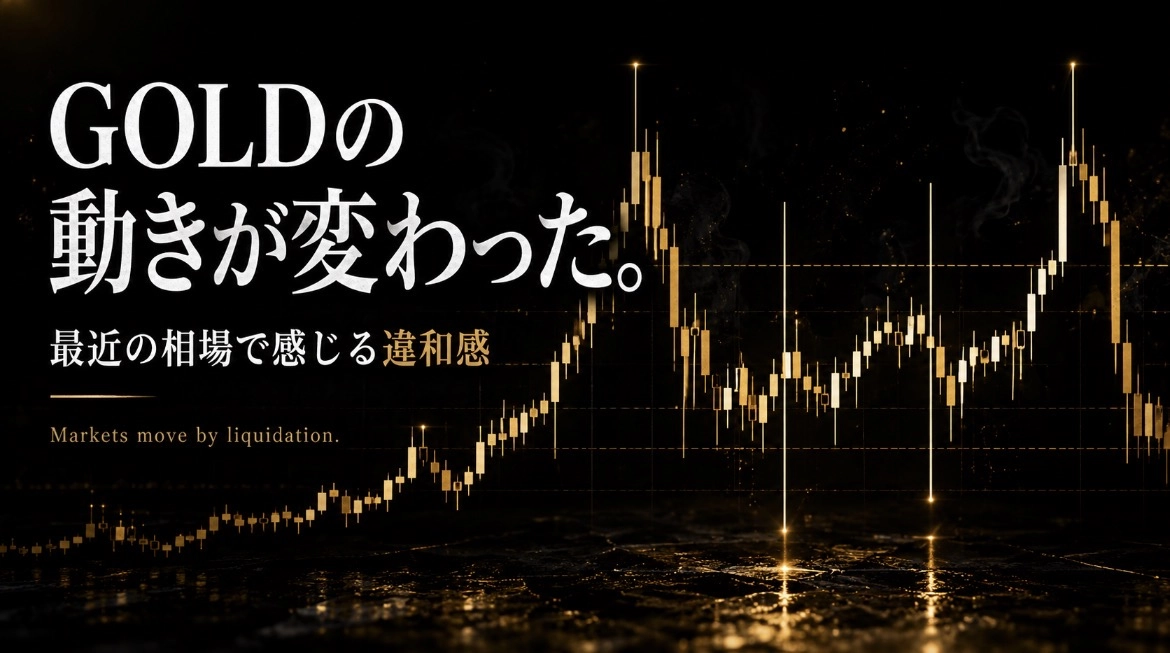
The movement of GOLD has changed. The recent market feels different.
The market moves on settle-outs. The day I felt it.
Gold until recently was relatively easy to understand.
From around 20:00 to 23:00, a sense of direction begins to emerge,
and after midnight another move is injected.
Then it grows rapidly,
and the trend continues.
In fact, I was able to extract stable profits from that “second-wave movement.”
But recently,
the movement has clearly changed.
After midnight,
it has become harder to see a sustained previous trend.
ATR suddenly jumps.
However,
what follows does not continue.
It runs for a moment and ends.
More often lately,
“a market that only hunts stops and ends”
that’s what it is.
If it breaks up, it reverses sharply.
If it moves down, it gets pulled back.
Long wicks,
doji candles,
sharp reversals.
Especially the daily chart two days ago was symbolic.
A doji with a long wick.
That day,
I think many traders were shaken out.
Those who bought on impulse.
Those who chased with selling.
Those who believed in a breakout.
Both sides got hunted.
Now, in Gold,
it’s less about “which direction it will extend” and more about
“where will the stop-loss take profit be executed.”
to understand its movement.
This is
in line with what I’ve long felt
that the market moves at settlement.
New orders alone are not enough to cause such rapid moves.
However, when losses cut and profits accumulate,
the market accelerates suddenly.
Gold right now is exactly that.
It’s not a market for holding for long periods,
but only at the moment a settlement occurs does it move rapidly.
And,
it stops quickly.
That’s why recent Gold has been difficult.
You need to wait.
But,
waiting too long ends it.
If you miss a few minutes of opportunity,
that day's market may end.
Even so,
forcing yourself to trade results in damage from low ATR.
So now,
more than ever
“where to enter”
than
“where the settlement will occur”
to be observed.
Now Gold is more a market where settlements are extracted than a market that follows trends,
perhaps approaching a market where
“the settlements are the movement.”