
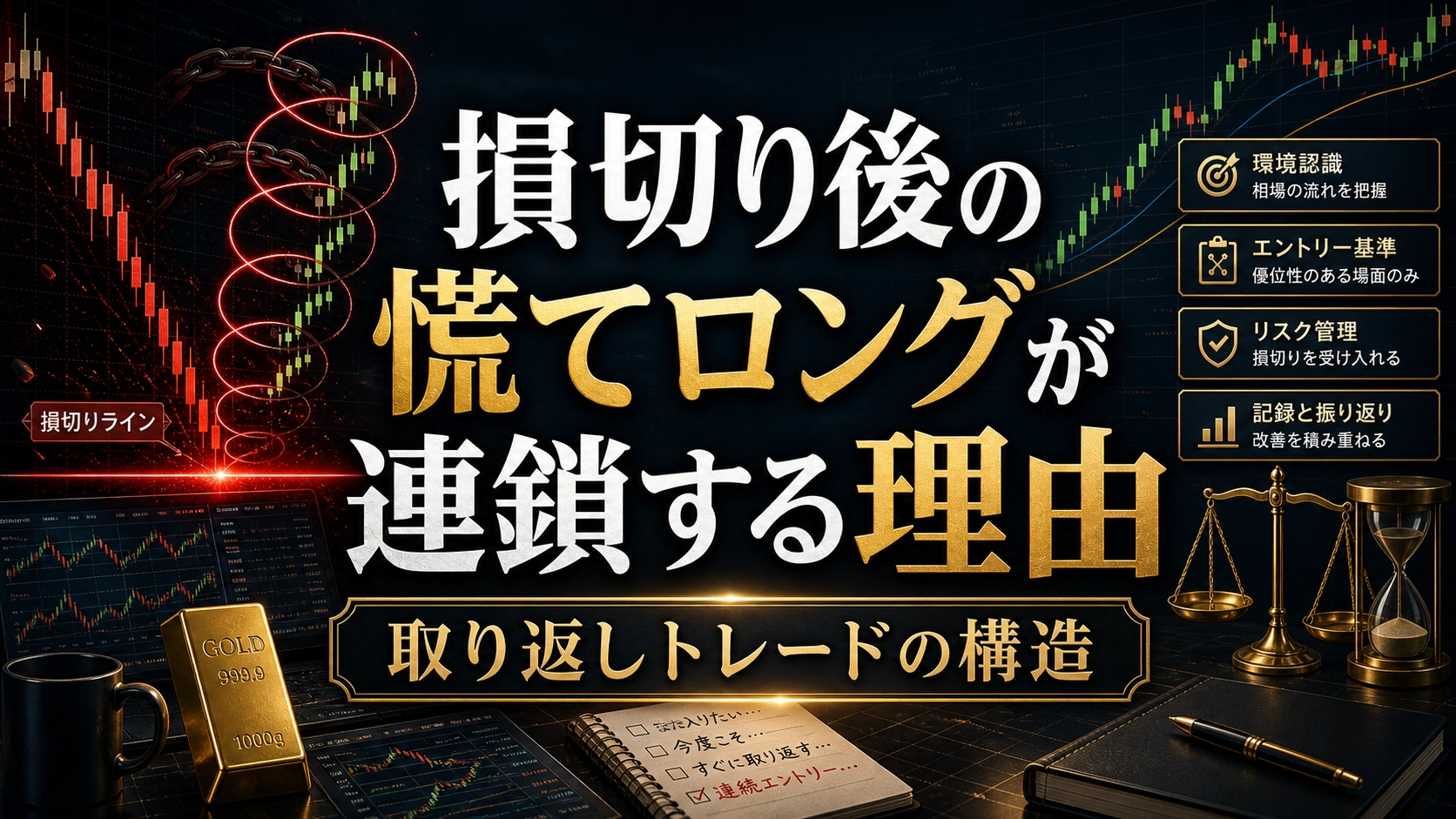
[The Structure of Catch-Out Trading] The Reason Why Panic Longs Cascade After a Stop-Loss
For those who can’t stop panic long after a stop-out in GOLD trading, this article explains the structural reason why “recovery trades” chain together and how to create decision points to cut them off.
Good evening!
This is Masashi^^
↓ A GOLD antidote feature has been organized^^
Please participate now while you can.
Today, I will write about the “structure of recovery trades.”
Right after you cut your losses, you’re already in the next position. I’ve experienced that moment of psychology to the point it makes me want to scream (;'∀')
? Why do panic longs after a stop-out chain? The structure of recovery trades
The moment you stop out, your mind goes white.
❌ “I endured so much to get in, only to be hit again”
❌ “Another loss”
❌ “I have to recover quickly”
Thinking that, you end up holding the next position without realizing it.
This is exactly the “recovery trade.”
Recovery trades don’t come from impulsiveness; they come from“a lack of understanding of the structure.”.
? In this article, I’ll explain at theSTRUCTURAL level why panic longs after a stop-out occur and why the chain won’t stop.
It isn’t that your mentality is weak. It isn’t that your willpower is lacking.
There are solid reasons and a proper exit.
❌ After a stop-out, you find yourself in again
Right after a stop-out, aren’t you doing these actions?
❌ You try to close the chart, but can’t
❌ You scroll and think, “It’s still moving.”
❌ You start calculating, “If it rises a bit from the stop-out price, I can bounce back.”
❌ You notice you’re pressing the buy button, thinking, “I can make it here.”
This isn’t just you.
I used to do exactly the same (;'∀')
The panic long after a stop-out, in other words“recovery trade”is what it’s called.
Once this starts, it’s hard to stop.
Suppose the first stop-out was -5,000 yen.
The recovery trade you enter to recoup becomes -5,000 yen again.
This time you feel you must recover 10,000 yen, so you enter again.
Have you experienced this chain?
? The reason recovery trades “chain” is that the first decision comes from emotion, so the second one does too.
The issue isn’t emotion alone; it lies deeper.
? Those who have experienced market reversals right after a stop-out are especially at risk.
When regrets of “I shouldn’t have stop-out there” pile up,the focus shifts toward “avoiding stop-outs.”.
That becomes the seed for the next “panic long.”
In other words, recovery trades are not about impulse but about“misinterpretation of accumulated experience.”that is what they’re born from.
? The feeling of “next time I’ll get in” while watching the chart may be
not evidence of learning, but a sign thatemotions are overwriting judgment.
? In the past week, how many times did you hold a position right after a stop-out?
The more times that number, the more this content matters to you going forward.
? What causes the chain: what is the “structural breakdown”
The real reason recovery trades won’t stop is“the decision-making axis keeps moving with its structure collapsed.”.
In normal trading, you first check the structure before entering.
? ・Which way is the market moving now
? ・Where is the wall, and which position is price currently in relative to that wall
? ・What stage is the wave in
Only when these three align can you judge whether it’s a situation to enter.
But when you enter recovery trades, almost no one does this check.
“It’s moving,” “I want to recover,” “This might be the entry point.”
These threeemotionsdrive the decision.
❌ Entering without structural checks is not trading; it’s the same as gambling.
There is a concept of a “wall.”
In a chart there are places where price has been bounced or halted many times.
Those places arethe “walls.”.
Entering near a wall versus entering from far away makes a huge difference in justification.
Whether there is a basis or not is completely different.
When you are executing recovery trades, you aren’t checking whether price is near a wall.
You are in a state of “enter because it’s moving.”
❌ Moreover, after a stop-out you are emotionally unsettled.
At that moment, trying to perform a structural check narrows your view, so even if you see a wall, you may read it optimistically as “it might move from here.”
? The wave state is the same.
Markets have phases of expansion and phases of stopping.
The panic entry usually happens in those “stopping” phases or already-extended places.
There isn’t just one way the structure can crumble.
“Ignore the wall,” “ignore the wave state,” “skip lower-timeframe and higher-timeframe checks.”
When these stack up,the accuracy of judgment drops to nearly zero.
The panic long after a stop-out is almost always a case where all of this collapses.
⚖️ What the winners do after a stop-out
After 18 years, I’ve learned one thing.
The difference between traders who keep winning and those who repeatedly fall into recovery trades lies in“actions after a stop-out.”.
To state one decisive difference
⚖️ The winners think the stop-out is over. The losers think the stop-out is the beginning.
Traders who end up in recovery trades view the stop-out as “a loss occurred.”
A loss happened. So they must recover. So they look for the next trade.
The stop-out becomes“an event demanding the next action.”.
Meanwhile, successful traders treat the stop-out as“an expected cost.”.
By the moment the stop-out occurs, that phase of the trade is finished and closed.
The next entry is not about “recovering” but about “once the next conditions align.”
? Saying this may look simple.
But actually doing it is quite difficult.
Why? Because most traders reach an emotional peak right after a stop-out.
Regret, urgency, self-denial
All of these occupy the mind, making it really hard to wait for the next conditions to align.
But the winners aren’t more emotional or more willpowered.
They simply have one rule: “Do nothing after a stop-out.”
✅ Another difference is“linguistic justification of the basis”.
Winners can always state in one line before entering why they enter.
“The wall is close.” “The wave stopped here.” “In agreement with the higher timeframe.”
That is why they enter.
If they can’t say it, they don’t enter.
When recovery trading, that one-line justification doesn’t come out.
There’s only “movement seems likely” or “I want to recover” (;'∀')
That difference, when accumulated, leads to big results differentials.
? How to create a decision axis using the structure
What you need to stop recovery trades is not guts or patience.
What you need isto build the decision axis on a structural basis.
Here, “structure” refers tothe walls, waves, and timeframes.
Having a decision axis that uses these means your “entry now” decisions are made bycriteria rather than by emotions.
? As long as you decide by emotion, you can’t stop panic longs after stop-outs.
Firstthe “wall”.
When you look at a chart, there are places where price has repeatedly bounced or paused. Those are the “walls.”
Entering from near the wall without other confirmations becomes weak.
Enter near the wall and when the wave state aligns.
That’s the basic approach.
?The “wave” tells you which phase the market is in now.
Is it in a growing phase, pausing, or about to reverse?
Being able to see this even roughly reduces “panic buying at the peak.”
Andthe use of the timeframe.
Many people get this wrong.
? Correct sequence of checks is this.
Firstthe lower timeframe, check “where the price is now.”
Thenthe higher timeframe, check “wall position and wave state.”
And return to the lower timeframe to decide “whether to enter here.”
This back-and-forth alone greatly reduces the habit of entering for no reason.
? Use the higher timeframe only for wall position/state checks.
Use the lower timeframe for current state checks and entry decisions.
Understanding this division of roles changes the meaning of the back-and-forth.
Whether you can follow this procedure right after a stop-out matters for your structure-based decision-making.
That’s the turning point for whether you’re trading by structure.
It’s not that your mentality is weak; it’s that you don’t have the structure visible.Realizing that will change your approach to recovery trades.
✅ Five steps to stop recovery trades starting tomorrow
To answer the question “I get it, but how do I change?”, I’ll answer it here directly.
? If your actions don’t change, your understanding doesn’t matter.
✅Step 1: Create a 15-minute rule right after a stop-out
After a stop-out, stay away from the chart for at least 15 minutes. Decide this first.
You can set an alarm too.
Use this 15 minutes as time to not think about the next trade.
It’s time for your brain to pass the peak of emotion.
✅Step 2: Before entry, write one line of justification
Write in one line why you are entering here in a text editor.
“Because the wall is close,” “the wave stopped here,” “it aligns with the higher timeframe.”
If you can’t write this, don’t enter.
If you can’t write it, you have no basis.
Entering without a basis is the same as a recovery trade.
✅Step 3: Check by alternating between lower and higher timeframes before deciding
Stop entering on a vague feeling that “it might move.”
Check the current state on the lower timeframe, check the wall and wave on the higher timeframe, then return to the lower to decide.
If you can’t do this back-and-forth, skip that day’s trade.
✅Step 4: Predefine daily loss limit
Decide in advance a maximum loss for the day, before you start trading.
If you hit that limit, your trading for the day ends.
The main reason recovery trades chain is that there is“no upper limit.”.
Setting a limit physically stops the chain.
?Step 5: Do not do post-trade reviews on the same day
Something I’ve always careful about is that if you review right after a loss, emotions contaminate the analysis of why you lost.
Review “why you lost” the next day in a calm state.
Trying to do it the same day invites the urge to immediately improve and recover (;'∀')
You don’t need to do all five at once.
First, try the“15-minute rule”and“write one line justification”from tomorrow.
? Conclusion: What I think after 18 years
Recovery trades are not about a weak mentality..
They occur because you move without confirming the structure after a stop-out, so the chain continues
That’s all there is to it.
✅
✅
✅
If you base your approach on these three, your judgments tomorrow will be different from today.
Don’t aim to erase emotions, but to have a system that allows you to judge with structure..
That is the only way to stop recovery trades.
? It may not be flashy, but it creates a framework you can rely on.
I’ve distilled the method I spent two years refining into“The Answer to Markets”.
If you’re curious, feel free to explore.
? The content this time is best understood if you have theGOLD antidote manual (or The Answer to Markets).
▼ The Answer to Markets
https://www.gogojungle.co.jp/tools/ebooks/77829
? A free AI tool for trade analysis
https://trade-ai-free.streamlit.app/