The reason you will never be able to win in FX
I am a Candlestick FX trader.
These days, many seem to be feeling worn out by the Iran situation.
・Soon to reach a final agreement!
・There will be a large attack soon!
Even a single statement from President Trump can cause the market to move up and down sharply,
and many traders seem to be being whipped around by it.
The Nikkei Stock Average also fell sharply yesterday,
with selling concentrated on semiconductors in particular,
but today it turned around, with SB G hitting a circuit break to the upside,
and semiconductors broadly bought.
Even though NVIDIA announced earnings early today,
including Kioxia, large caps hit the top, and
trading value on a single issue exceeded 1 trillion yen,
so recent markets have been characterized by high volatility.
The outlook for gold also had been falling due to rising government bond yields and a strong dollar,
but today it moved into risk-on mode and rose.
For those trading while trying to predict what will happen next,
I think the current market may be completely unpredictable.
Personally, I have stopped trying to predict,
and I trade by simply following market participants,
so I don’t really worry about anything in particular,
and I just trade calmly.
Now, today I’d like to write about the characteristics of people who are losing.
By knowing the traits of people who are losing,
paradoxically, you can learn what to do to start winning.
When I was losing,
I got caught in this trap.
When you acquire some logic,
everyone tends to think that, no matter the time, you can win with high probability and make lots of profits.
However, any logic has bad periods.
Your win rate can temporarily drop,
or you might not make much profit,
and results can differ from what you expected.
And honestly,
even my own logic sometimes performs poorly.
I want to say this clearly from the start.
No matter the time or the market, it is not the case that you always have a high win rate or that you always perform at your maximum.
During bad times,
when you miss opportunities,
your win rate can drop temporarily.
And the trait of losing traders is that,
when things go bad, they stop trading.
And then they go off on a journey to find another logic.
Successful traders,
even using the exact same logic
are able to continue because they understand the characteristics and essence of that logic,
and thus keep going.
Therefore, they eventually win in total.
In the stock market, this is similar to whether you can keep holding stock in KI OSS IA.
When NAND prices rise, it’s positive for Kioxia,
so Kioxia’s stock price rises.
If you fully understand this,
you won’t sell midway or hesitate before closing a position.
Although the Q1 guidance came out after earnings,
even calculating from that, P/E remains around seven times.
It is way too cheap.
If you understand this properly,
you can hold on to it for a long time.
On the other hand, if you’re just following the trend because it has recently risen,
everyone says Kioxia is good,
and you’re holding for that reason alone,
you might sell after a small rise,
and if it starts to fall, you’ll declare AI bubble collapse and
you’ll quickly sell in some awkward place.
And you’ll miss the upside on the earnings and the big rise today.
What’s the difference?
It’s whether you understand the essence of Kioxia, why you think the stock price will rise in the future,
and whether you’re buying with that understanding.
FX logic is the same:
what profit are you aiming for with this logic,
in what market does it work best,
and whether you’re using it with that understanding,
instead of just using it because past results were good,
or because it’s a popular tool and you think it must be good,
which makes a huge difference.
When you use it with an understanding of its essence,
even with some losses in a row,
you won’t be anxious, and
you won’t be drawn to other logics.
Because you can believe that someday it will return to its previous performance.
On the other hand, if you’re not understanding the essence,
even a short streak of losses makes you waver.
This is the difference between those who succeed with the same logic and those who don’t.
So, what exactly does this mean? I will explain using charts.
Here isthe "Ten-Tsui FX Logic"traded according to the rules.
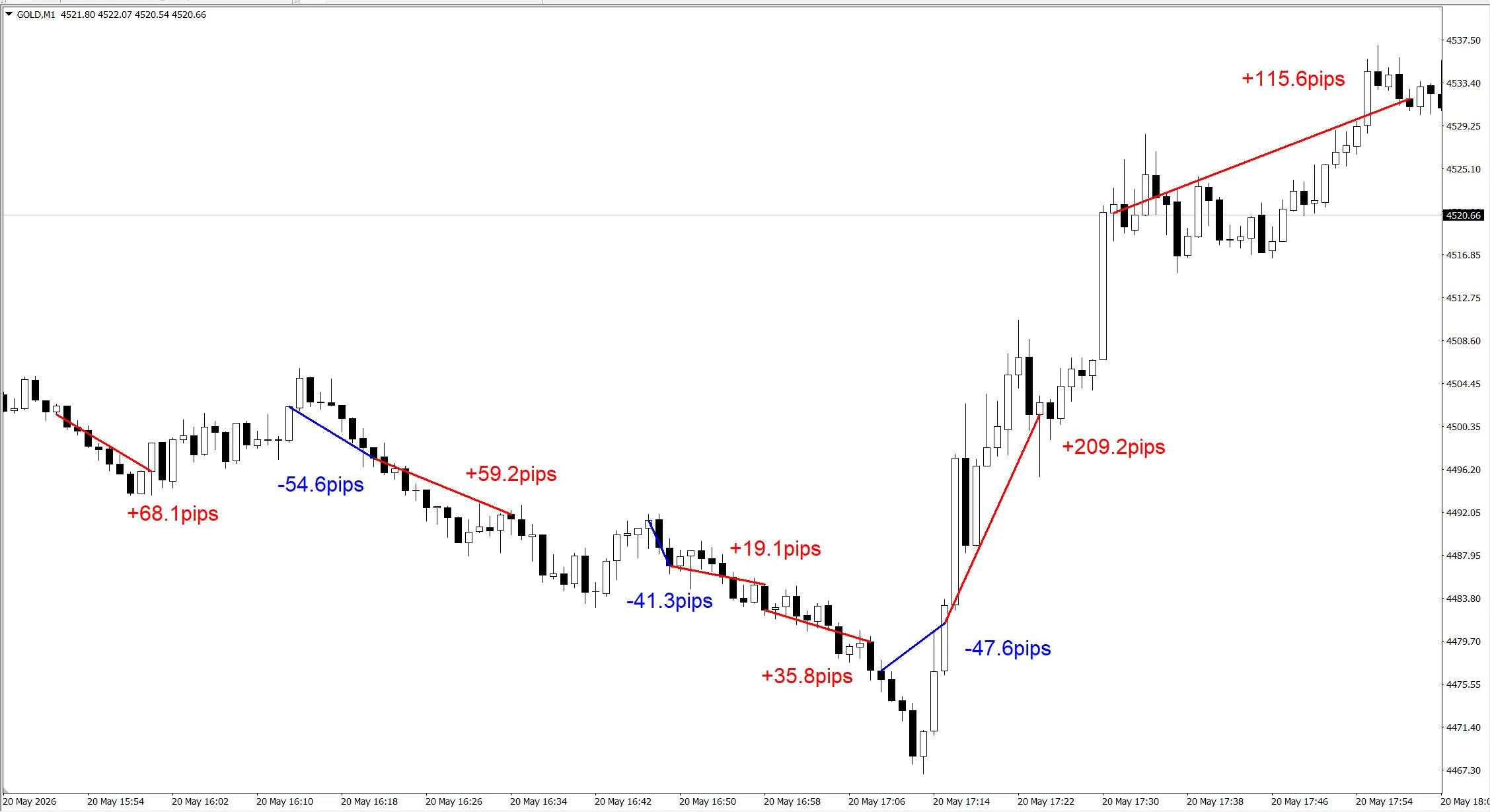
This time, I deliberately brought up the bad parts.
The win rate is 6 wins and 3 losses out of 9 trades.
Win rate is 67%.
The win rate is lower than usual.
And in total, the profit is+363.5 pips.
In the chart, the first half shows alternating wins and losses,
and the performance is flat.
Then a large trend emerges in the latter half,
allowing for large gains,
and the total ends up in the plus.
The total pips gained over time are as follows.
+68.1 pips
+13.5 pips
+72.7 pips
+31.4 pips
+50.5 pips
+86.3 pips
+38.7 pips
+247.9 pips
+363.5 pips
If you plot this on a graph, it looks like this.
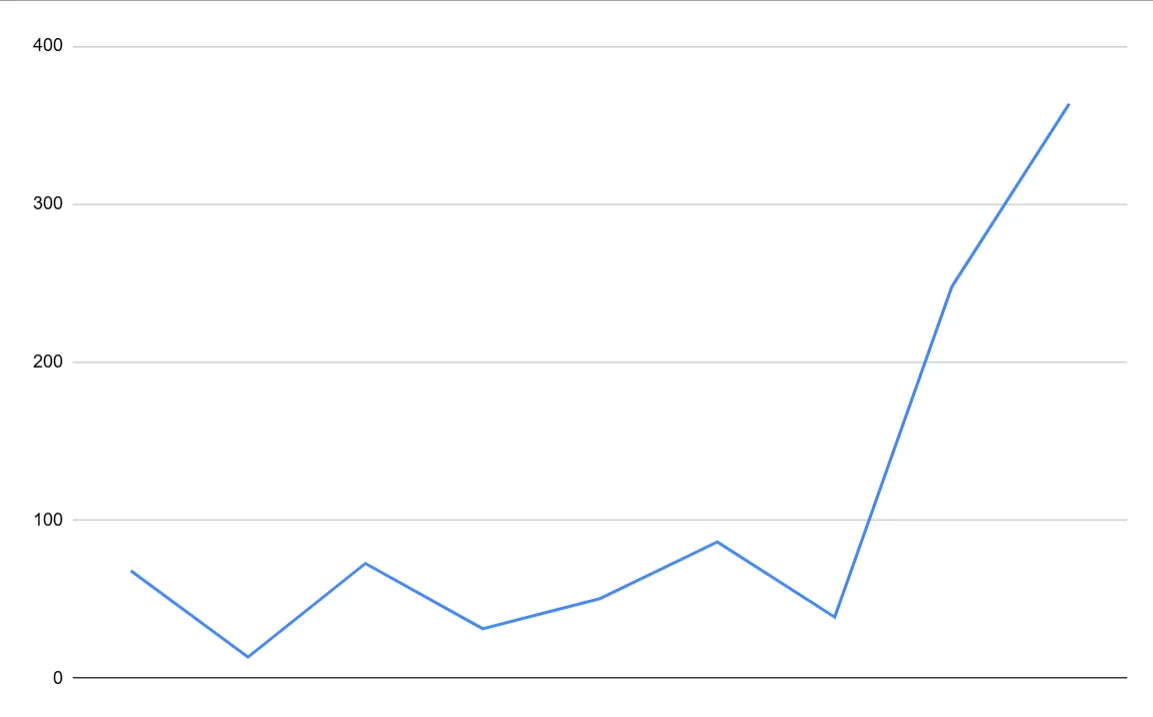
A graph makes it easier to understand.
In the first half, capital does not grow or shrink.
And in the latter half, capital grows rapidly.
Of course,the "Ten-Tsui FX Logic"does not forecast the future, so you don’t know when a big trend will appear.
Rather, I think no one can know.
Therefore, by simply following the rules calmly, you can achieve large profits like this.
And as a result, your funds will increase overall.
Now, for losers,
on the graph, they stop trading around the middle.
They think, after all this, they can’t win with this logic,
and go off to search for other logics.
And since no logic is always performing well,
when performance deteriorates they stop using the logic,
and again search for another logic.
There are people like this in the stock world as well, but
when tariffs shocks hit stocks in April last year and prices dropped sharply,
they sold off.
Of course, it’s hard to predict that tariffs shock would shock the market that much,
but at that time, it wasn’t the time to sell,
it was the time to buy more.
Even if you don’t buy more,
you should at least not sell.
And when prices go down, you sell,
and when everyone is excited and stock prices rise,
you buy when prices rise.
Buy when they rise,
sell when they fall.
This behavior of stopping trading when the logic is performing poorly is the same as this.
And I get the impression there are surprisingly many such people.
There are times when, precisely when leaving a bad phase, they stop trading.
This arises from not understanding the essence of the logic.
Understanding the essence of a logic does not mean simply memorizing its rules.
Why do you enter at certain times?
Why do you exit at certain times?
It’s about understanding the why.
And if you understand this,
the Ten-Tsui FX Logicwill continue to yield profits for a long time,
so even when times are tough, you can keep using it.
Andthe Ten-Tsui FX Logicalso provides a clear explanation of the “why,”
so you can understand the essence and keep using it.
In fact, we have received reviews like this.
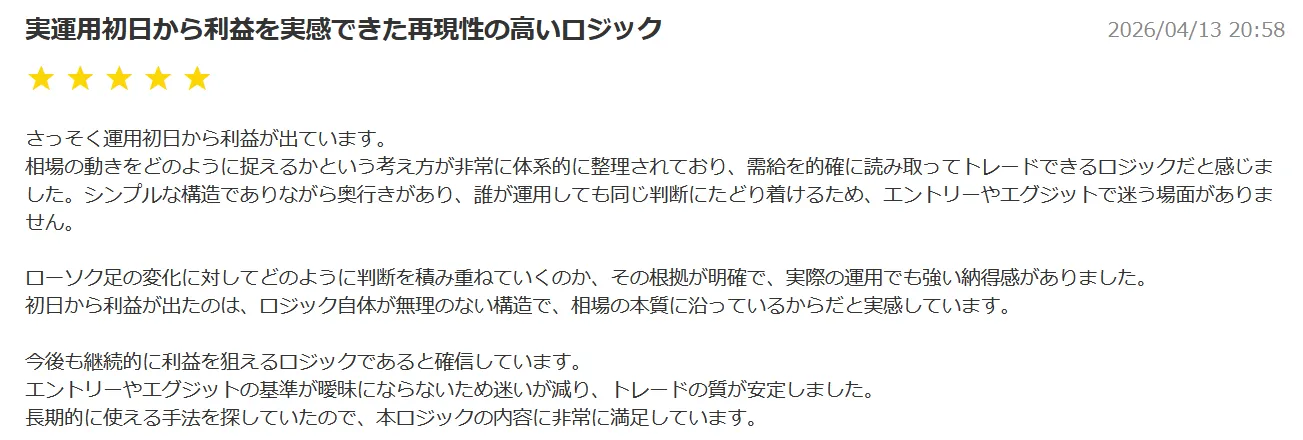
“How you judge and accumulate judgments against candlestick changes,
the reasoning is clear and the actual operation strongly convincing.
Profit on the first day occurred because the logic structure is not unrealistic and aligns with market essence.”
That’s exactly right.
Because you have confidence in the basis for your trades, you can trade with confidence.
No matter what tool you use, if you don’t understand the basis for its signals,
when you go on a small losing streak, you won’t be able to continue using it.
Understanding why this logic rule exists allows you to keep using it even when conditions are tough,
and ultimately, you can still secure profits overall.
So this time, I explained the difference between people who succeed and those who don’t despite using the same logic.
Currently, for a limited time here,we are offering the method to aim for the top for free.
How to aim for the top