

[Honest Opinion] People who are getting worn out by scalping with gold should switch to swing trading.
Stick to the daily chart every day, glare at the 5-minute chart, and try to grab a few pips.
I won. I lost. Then I won again. But after the spread, I ended up break-even. Before I knew it, three hours had passed. The profit was 2,000 yen. When converted to hourly wage, it’s less than 700 yen.
Haven’t you had experiences like this?
Scalping has the image of “making money in a short time.” But in reality, many people end up doing a task of “sitting in front of the chart for long hours, wearing out your mind, and earning small change.”
This time, for those drained by scalping, I’ll speak frankly about the option of swing trading.
What’s the problem with scalping
Scalping itself isn’t a bad method. It’s suitable for the right people.
But for many people, scalping is exhausting. Here are five reasons.
① The binding time is long
In M5 scalping, you have to stick to the chart waiting for signals. Wait an hour and no signal. Then as soon as you step away, it moves. You stick again.
In the end, you’re in front of the chart for 3–5 hours a day. If you make 10,000 yen in profit, that’s fine. Days with 5,000 yen or less are common.
② The number of decision points is too many
In M5 scalping, you may enter decisions more than 10 times a day.
If you repeat “to enter or not to enter” ten times, your judgment becomes dull. You get tired and start entering on a “kind of feel.” This is the scalping’s biggest trap.
③ You lose on spreads
Scalping involves many entry points. More entries mean paying more spreads.
If the gold spread is $0.3, and you enter 10 times a day, that’s $3. For 20 days a month, $60. Annual $720.
④ Mental strain is unsustainable
Scalping involves many wins and losses within a day. After three consecutive wins, two losses can nearly erase the profit. This mental fatigue accumulates.
⑤ Life gets wrecked
Gold moves the most from London to New York time. Japanese time is 16:00–2:00 the next day.
Sticking to the charts during this period means trading from evening to late night. You lose time with family. Sleep is sacrificed. Your main job is affected.
Even earning 100,000 yen a month from scalping is meaningless if your life is wrecked.
What’s good about swing trading
Swing trading is a style that trades on timeframes from M30 to H4.
What’s different from scalping?
① Significantly less time looking at charts
If you swing on H1, you only need to peek at the chart once an hour. On M30, every 30 minutes. On H4, every four hours.
Check in the morning. Check at noon. Check before bed. Three times a day, totaling 15 minutes. This is enough to operate.
It’s a different world from scalping’s “3–5 hours glued to the screen.”
② Fewer decision points
Swing entries are about 1–3 times a day. At most 5 times.
Fewer decisions mean you can focus on each one. “Feeling” entries are greatly reduced.
③ Higher profit per trade
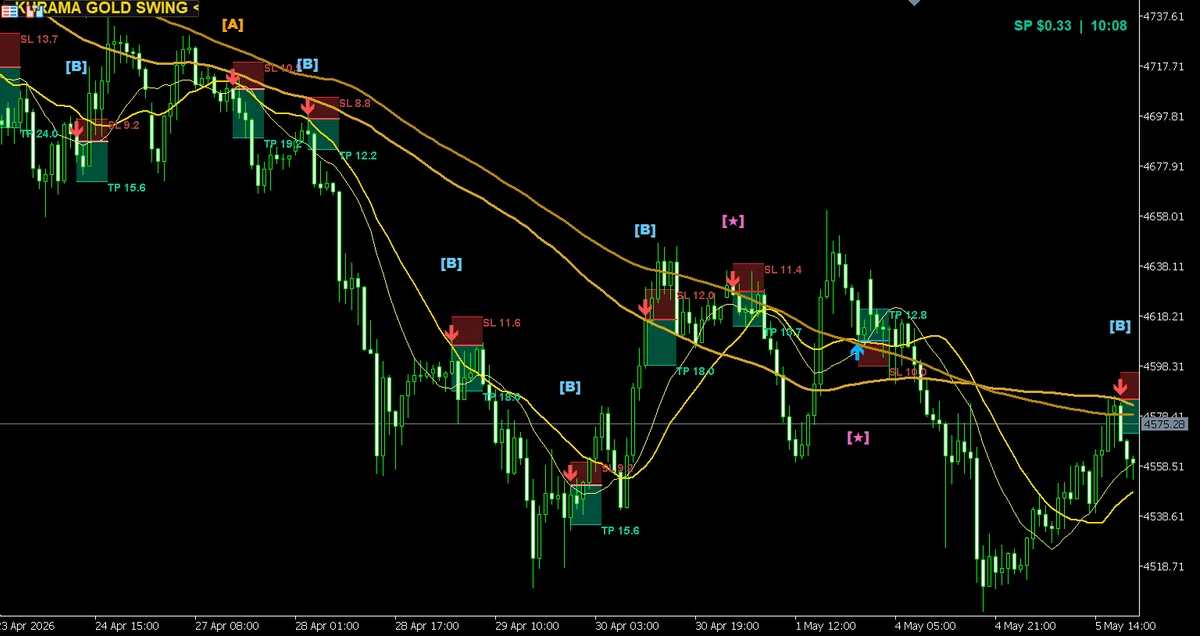
If scalping TP is $3–$5, swing TP is $15–$50. The range per trade is vastly different.
④ Smaller impact from spreads
A swing with TP $30 makes a $0.30 spread only 1% of total. A scalping TP $5 with $0.30 spread is 6% of total.
⑤ Compatible with life
This is the biggest advantage.
You can trade while working. You can trade while doing chores. You don’t have to cut back on sleep.
Trading is a means, not an end. It isn’t worth wrecking your life for it. With swing, you can profit while maintaining your life.
The misconception that “swinging is boring”
A common criticism of swing is this.
“Less entries and boring.” “Too long to wait.” “Time spent not doing anything is wasteful.”
This is all scalping-brain thinking.
The illusion that “time looking at charts = time working.” When you’re not looking at charts, you feel you’re slacking.
But in reality, the opposite is true.
Not watching the chart is correct. Trading isn’t a job where you earn more by doing more. The most profitable approach is “only do it in the right moments.”
Swing’s “idle time” isn’t wasted. It’s time waiting for opportunities.
Comparing monthly profits of scalping and swinging
Let’s compare with concrete numbers. Gold at 0.10 lots.
Scalping (M5):
・Entries per day: 8–10
・Average TP: $5 (about 785 yen)
・Win rate: 60%
・Daily expectation: 10 trades × 60% × 785 yen − 10 trades × 40% × 500 yen (SL) = about 2,710 yen
・Monthly (20 days): about 54,200 yen
・Binding time: 1 day 3–5 hours
Swing (H1):
・Entries per day: 1–2
・Average TP: $25 (about 3,925 yen)
・Win rate: 55%
・Daily expectation: 2 trades × 55% × 3,925 yen − 2 trades × 45% × 2,355 yen (SL) = about 2,196 yen
・Monthly (20 days): about 43,920 yen
・Binding time: 1 day 15–30 minutes
Monthly profit is almost the same. But binding time is only a tenth.
Hourly wage comparison: Scalping: 54,200 yen ÷ 80 hours =Hourly wage 678 yenSwing: 43,920 yen ÷ 10 hours =Hourly wage 4,392 yen
Which is smarter?
Important points when switching to swing
When switching from scalping to swing, there are common sticking points.
① The width of TP/SL changes
If you’re used to TP $5 on M5, a TP of $25 on H1 can feel “too far.” When you have $10 unrealized profit, you may feel the impulse to take profit early.
You have to widen TP/SL to fit the timeframe. It takes time to learn this by feel, not just by head.
② Holding drawdown for longer
Scalping resolves in minutes. Swing may hold positions for hours to days.
③ You need to get used to “doing nothing”
If no signal appears, do nothing. That’s swing’s basics. But those used to scalping may feel the urge to act.
The Kurama Gold Swing option
Want to switch to swing, but worry about the above cautions?
For those people, we created KURAMA GOLD SWING.
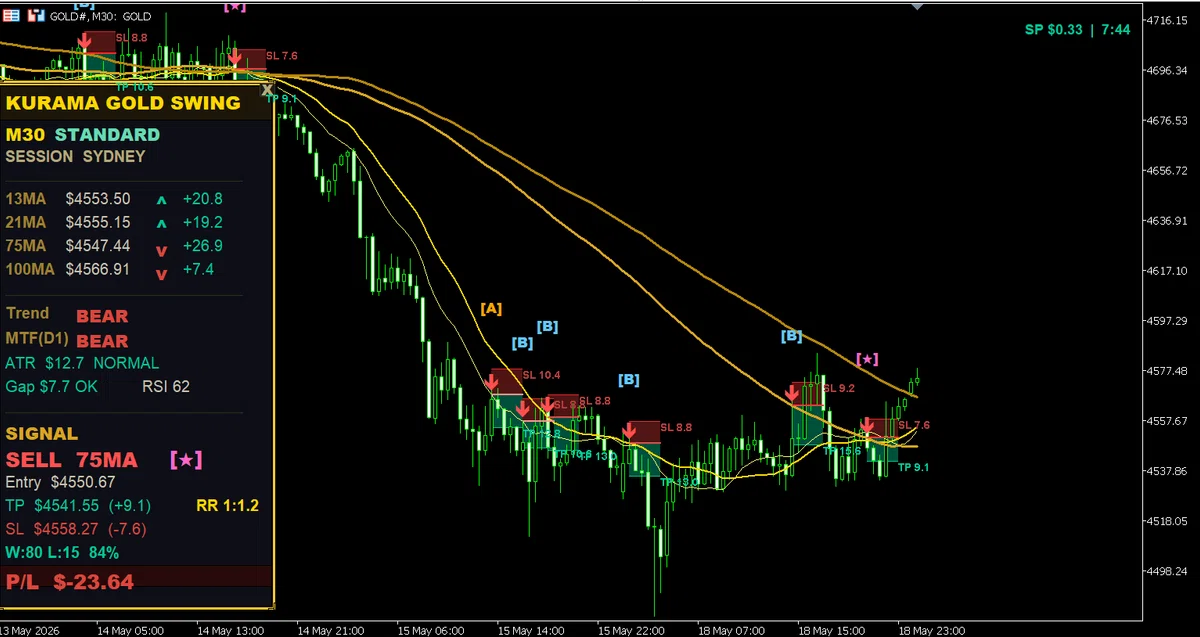
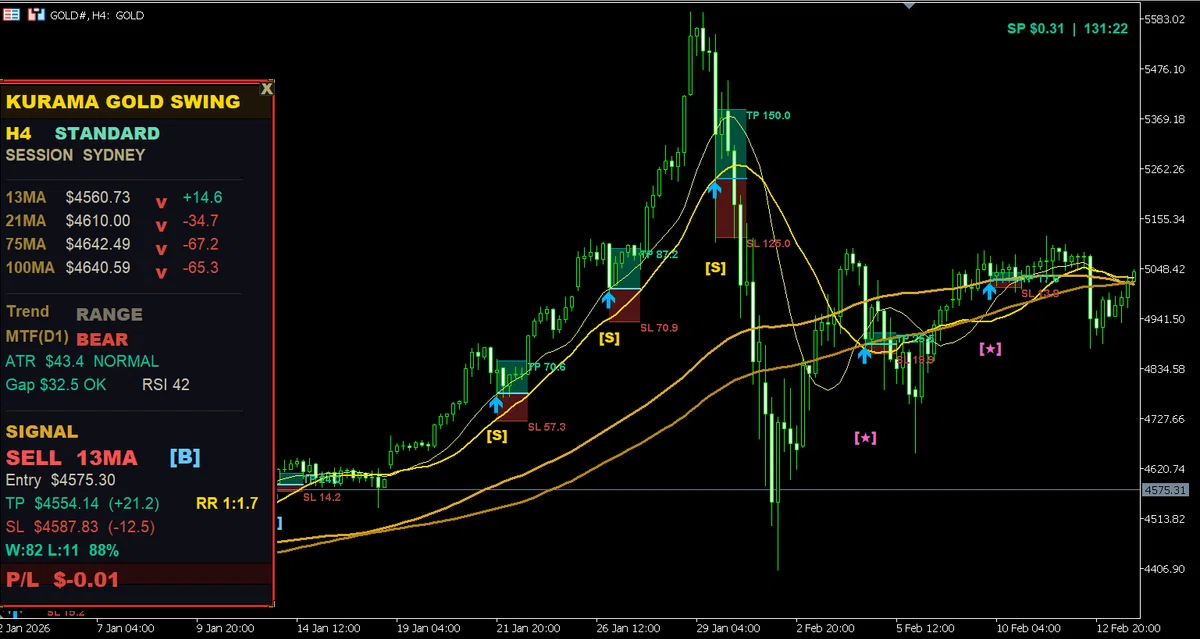
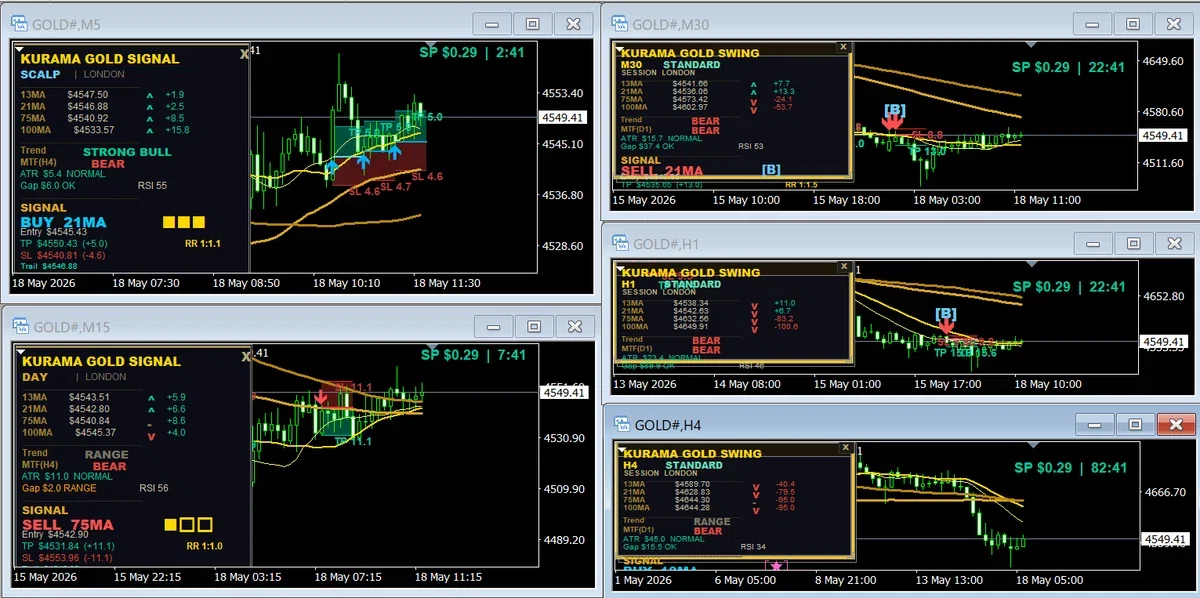
Designed with the same philosophy as KGS (Scalping/Day version), optimized for M30/H1/H4.
All concerns of swing beginners addressed:
・TP/SL automatically calculated based on ATR for the timeframe → no more worries about “too far” or “too near”
・Enter only when a signal appears → eliminates the urge of “must do something”
・Quality score ★〜★★★ → you won’t be uncertain about which signal to take
・Push notifications supported → you won’t miss signals even if you’re not glued to the chart
Push notifications are especially important. Signals arrive on your smartphone, so you can notice “a signal appeared” whether you’re at work or doing chores at home. Open the chart, place the order at the shown TP/SL, and close. That’s all.
Timeframe supported:M30 / H1 / H4Instruments supported:XAUUSD (Gold) onlyPlatform supported:MT4 / MT5
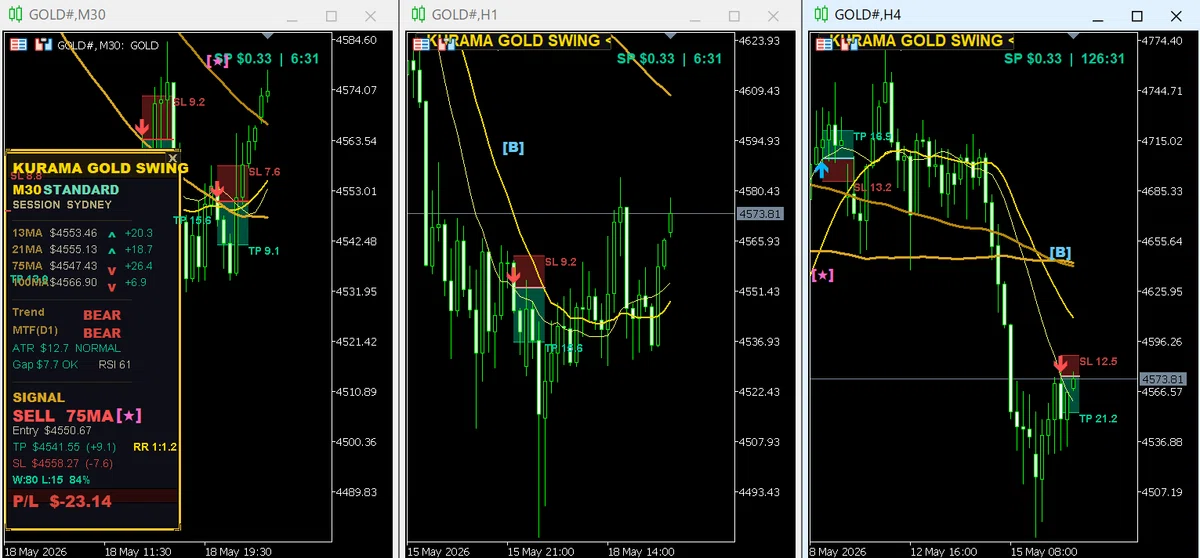
How to use KGS and GOLD SWING together
If you already own KGS (Scalping/Day version), this is the best way to use them.
・Days you sit in front of charts → KGS (M5/M15) for scalping/day trading
・Busy days → GOLD SWING (M30/H1/H4) for swing
If you own both, you won’t miss gold opportunities no matter your lifestyle.
Summary
・If you’re exhausted from scalping, consider swing
・Monthly profit is almost the same, but binding time is one-tenth
・In terms of hourly wage, swing is overwhelmingly favorable
・“Not sticking to the chart = you can’t win” is a misconception
・Check every 30 minutes to 4 hours, and you can operate
・Don’t miss signals with smartphone notifications
Trading is a part of life, not everything about life. Use swing to achieve a way of working that doesn’t bind you to charts.
KURAMA GOLD SWING?
https://www.gogojungle.co.jp/tools/indicators/79912?via=users_products

Is it OK?