
Foreign Exchange (Foreign Exchange)
1. Basic Structure: Exchange of Relative Value
The essence of foreign exchange is the “exchange rate” between one country’s currency and another country’s currency.
Concept of currency pairs: Currencies are always traded in pairs (e.g., USD/JPY). This is not merely a price; it indicates the relative value of how much of the right-hand currency (settlement currency / counter currency) is needed to buy one unit of the left-hand currency (base currency).
Zero-sum game:If the value of one currency rises, the other necessarily falls. In the market as a whole, this is fundamentally different from the stock market, where the overall market capitalization can increase.
2. Determinants of Exchange Rates (Backdrop of Supply and Demand)
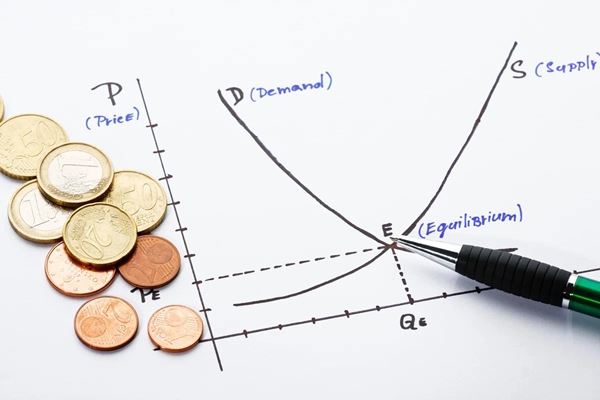
Exchange rates fluctuate based on the balance of demand and supply in the market. The main motivations are threefold.
Actual needs (trade and investment): settlements of imports/exports and investments in overseas assets (stocks, bonds).
Interest rate differentials (carry trades): selling currencies with low interest rates and buying those with high interest rates. Central bank monetary policy is the most watched factor.
Speculation: buying and selling based on predictions of future price increases or decreases. It is said to account for the majority of current currency market trading (about 90%).
3. Market Structure: Decentralized Network
The foreign exchange market does not have a single “exchange” like stock markets (such as TSE).
Interbank market (banking market):A market where major banks around the world trade directly via networks. The prices here form the basis of the exchange rate.
Over-the-counter (OTC) market:A market where banks and securities firms trade with individuals and corporations.
24-hour trading and OTC (Over-The-Counter):Trading is done directly between parties without going through an exchange. The global network operates in relay fashion across time zones, so trading never stops 24 hours a day, except on weekends.
4. Types of Exchange Rate Regimes
Different countries manage the value of their own currencies in different ways.
| System | Characteristics | Pros / Cons |
| Floating exchange rate | Left to market supply and demand (U.S., Japan, Europe, etc.) | Exchange rates absorb economic shocks; large exchange rate risk |
| Fixed exchange rate | Pegged to a specific currency | Promotes trade through currency stability; vulnerable to currency crises |
5. Summary
Foreign exchange can be described as a system in which the balance of economic strength, interest rate differentials, and expectations between two countries is continuously adjusted in real time by a vast network of banks around the world, 24 hours a day.
※The above text was created using AI.