
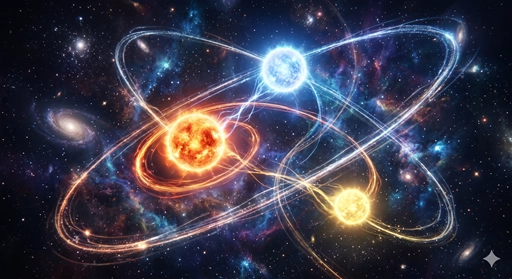
Three-Body Problem (Three-Body Problem)
"The Three-Body Problem" is the title of a modern science fiction landmark by Cixin Liu (Liu Cixin). The original title is "The Three-Body Problem" (The Three-Body Problem) and it is the first volume in the Remembrance of Earth's Past trilogy.
What is the physics "three-body problem"?
In physics, the three-body problem refers to the classical difficulty where three bodies (for example, stars or planets) influence each other through gravity, and their motions cannot be solved analytically in general. In Newtonian mechanics, the two-body problem can be solved easily, but with three bodies it tends to be chaotic and unpredictable.
In the novel, this is deftly incorporated as the harsh environment of the planet "Three-Body" with its three suns, whose inhabitants (the Trisolarans) endure unstable climates (stable periods and chaotic eras). Their civilization repeatedly faces extinction and seeks help from Earth, which forms the basis of the story.
1. Meaning of the Three-Body Problem
The three-body problem is the classical mechanics question of what trajectories three bodies, mutually influencing each other by gravity, will follow in the future.
Difference from the two-body problem: The interaction between two bodies (e.g., Earth and Moon) can be completely solved by Newtonian mechanics, and the orbits are nice ellipses or parabolas (Kepler's laws).
The barrier of the three-body problem: As soon as three bodies interact, the mutual influences entangle in such a way that a general solution (an equation valid for all cases) cannot be derived, which has been mathematically proven.
2. Structure and mathematical background
The reasons this problem is so difficult are its structural features outlined below.
Non-integrability (unsolvable structure)
In the late 19th century, Henri Poincaré proved that the three-body problem does not possess an algebraic general solution (a solution using constants of integration). In the differential equations describing celestial motion, the number of conserved quantities (energy, momentum, etc.) is insufficient relative to the number of variables needed to solve the equations.
Chaos (unpredictable structure)
The three-body problem is also the origin of chaos theory.
Sensitivity to initial conditions: If the initial positions or velocities are even slightly off, the resulting trajectories diverge dramatically over time.
Therefore, you cannot predict the future exactly with equations, and only numerical simulations (approximate calculations) on computers can track the orbits.
3. Special "solutions"
While there is no general solution, several stable "special solutions" have been found under certain conditions.
Lagrange points: five points where a small third body can remain stationary while maintaining relative positions to two larger bodies.
Figure-eight solution: three bodies with equal masses chase each other in a figure-eight orbit (discovered in the late 20th century).
Restricted three-body problem: a model that simplifies computation by assuming one body's mass is negligible.
Lagrange points: five points where a small third body can remain stationary while maintaining relative positions to two larger bodies.
Figure-eight solution: three bodies with equal masses chase each other in a figure-eight orbit (discovered in the late 20th century).
Restricted three-body problem: a model that simplifies computation by assuming one body's mass is negligible.