
Cryptocurrency Market Analysis [May 19]
Market Overview and Trends in Major Crypto assets (cryptocurrencies)
The current financial markets appear to be swayed by the Trump administration’s unpredictable and fractious remarks on social media regarding the Iran situation, leaving observers perplexed. While geopolitical risks are still smoldering, there has been little concrete progress, so markets at the start of the week lacked clear direction.
In the U.S. stock market, S&P 500 rose by 0.3% and the Nasdaq 100 rose by 0.2%, finishing Monday's trading with a modest gain. Meanwhile, the crypto asset sector broadly lacked vigor, remaining largely flat or soft.
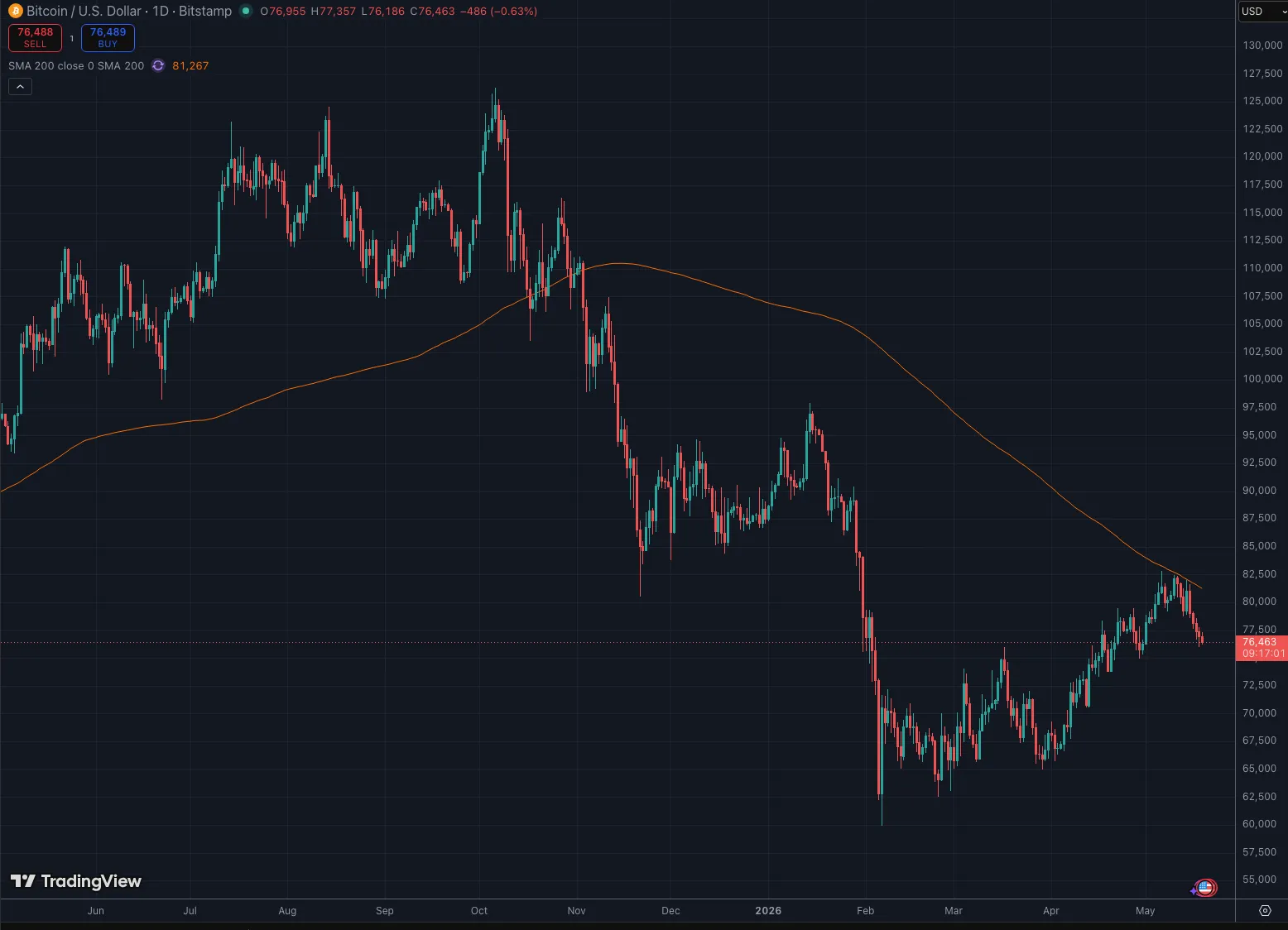
TheDownward trend that began last Friday continues to weigh on the market as a whole. The king of crypto assets, Bitcoin (BTC), extended its losses on Monday and broke below the psychological level of 70,000 dollars.
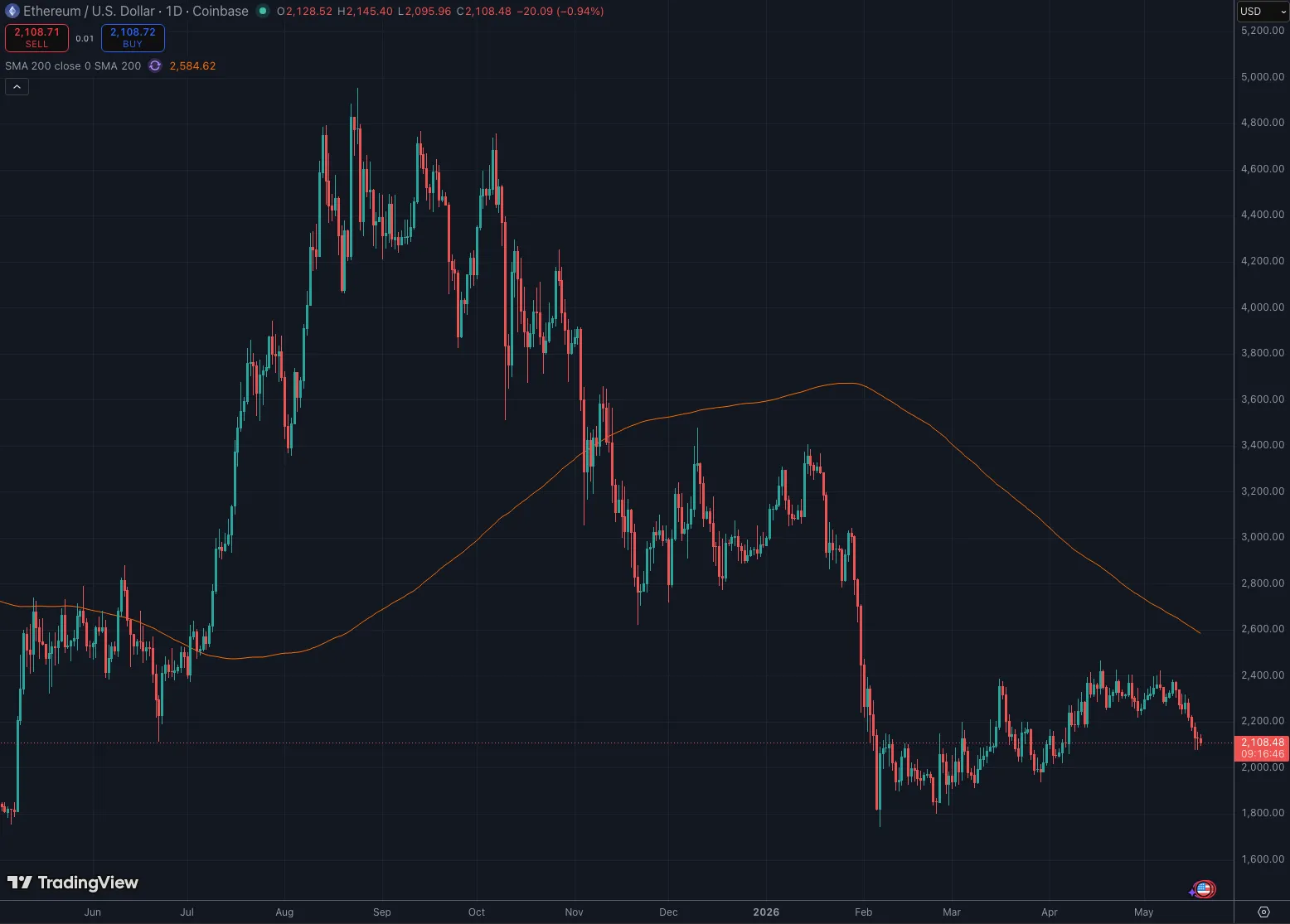
Ethereum daily chart
In the traditional finance (TradFi) space, there were important regulatory moves advancing the industry. Digital asset leader Galaxy Digital received the long-awaited “BitLicense” from the New York State Department of Financial Services (NYDFS), allowing the company to operate a crypto asset business legally in the tightly regulated state of New York.
Additionally, there is active movement around the rollout of spot ETFs. Asset management giants VanEck and Grayscale have each submitted new amendments to the SEC regarding their SPOT-BNB ETF applications. In particular, VanEck's amendment submission marks its fifth submission, revealing behind-the-scenes constructive and proactive dialogue with the SEC.
In the DeFi space, a breakthrough innovation emerged. On the Hyperliquid decentralized exchange (DEX), Trade.xyz opened the first ever “pre-IPO (unlisted stock) perpetual futures market” targeting SpaceX. In this market, SpaceX’s standard valuation is set at $1.78 trillion (about ¥260 quadrillion).
This surprising news sparked a surge, and the governance token of Hyperliquid, “HYPE,” jumped as much as 7% at one point. Treating unlisted IPO stocks as on-chain derivatives is moving beyond a temporary craze toward establishing a genuine major product category in the market.
Moreover, the DeFi sector overall (up 3.1%) showed particular strength on this day, with the driving force largely led by Ondo Finance (ONDO), a leader in real-world asset (RWA) tokenization.
ONDO closed with a gain of around 11%. Intraday, there was a surge of intense buying in the final four hours, decisively separating it from other major DeFi tokens with a dominant rally.
The immediate trigger for this surge was Bloomberg’s report on positive coverage of tokenization markets by the SEC. Ondo has already secured a significant share in tokenized asset and stock markets and early on submitted a “no-action letter” to the SEC in April, seeking to avoid enforcement actions.
Furthermore, the roadmap ahead is very strong. In July, with major global institutions such as BlackRock and Goldman Sachs, and within the DTCC consortium, it has been revealed that actual operational transactions are planned to commence within this ecosystem.
Bitcoin-related key topics
■ Signs of a domestic crypto asset boom in Japan by 2028
Within Japan’s traditional major financial institutions, seismic shifts are underway. Securities firms are actively considering whether to publicly offer crypto asset investment products, including U.S.-approved and heavily funded Bitcoin ETFs and Ethereum ETFs.
Companies that have already begun steering toward actual sales or shown strong positive posture include the following.
Actual sales/handling:
SBI Securities, Rakuten Securities
Currently under serious consideration for introduction:
Nomura Securities, Daiwa Securities, SMBC Nikko Securities, Mizuho Securities, Mitsubishi UFJ Morgan Stanley Securities, Matsui Securities, Monex Securities, Mitsubishi UFJ Morgan Stanley Securities, UFJ Smart Securities, Okasan Securities, Tokai Tokyo Securities, Iwai Cosmo Securities
Historically cautious toward crypto assets, Japan’s financial industry’s current comprehensive consideration by major face-to-face and online brokerages strongly hints at a future surge in Japanese investment activity several years from now.
■ The history of Bitcoins Pizza Day:1万BTC buys two pizzas for 2枚
A few years ago, programmer Laszlo Hanyecz paid 10,000 BTC for two pizzas (Papa John’s). Over time, those 10,000 BTC would be worth an enormous amount—roughly $767 million in value today—illustrating Bitcoin’s explosive growth and becoming the most famous anecdote about crypto’s potential.
■ Arthur Hayes lowers his long-term Bitcoin price target from $500k to $125k
Arthur Hayes, co-founder of the crypto exchange BitMEX and a prominent investor, has revised his bitcoin price target from a bullish $500k to $125k. The rationale is as follows:
- The speed of AI evolution and productivity gains is far outpacing market expectations and is very strong.
- As a result, even if central banks around the world print money aggressively, AI-driven supply expansion could offset inflation, potentially keeping inflation from rising as much as feared.
- In other words, the very inflation that would have driven BTC to $500k is less likely, so the target price was reset to $125k.
This does not imply a pessimistic view of Bitcoin’s future, but rather a realistic revision considering AI as a new macroeconomic variable.
■ Michael Saylor’s claim that “Bitcoin is the best form of capital humanity has ever had”
Michael Saylor, chairman of MicroStrategy and one of the world’s largest Bitcoin holders, reaffirmed his unwavering belief in Bitcoin.
According to him, historically gold served as the world’s most portable capital, but in today’s fast-paced digital global economy, gold’s movement and storage costs are too high and slow. Bitcoin, he argues, is the digital-era gold of the 21st century—an unparalleled infrastructure that can move hundreds of billions, even trillions, across borders instantaneously and most efficiently.
Recently, he issued a strong message to the market: “If you’re going to sell assets, buy Bitcoin.” He has demonstrated this not just verbally but through action, publicly announcing an additional purchase of 535 BTC (about $4.34 million ≈ ¥600 million) on the market.
■ Iran's sanctions evasion breakthrough via a BTC-enabled, maritime insurance platform “Hormuz Safe”
Amid ongoing geopolitical tensions, the Iranian government launched an innovative maritime insurance platform “Hormuz Safe” that uses Bitcoin for settlements for ships passing through the strategic Hormuz Strait, a key artery for international trade.
With this platform, global maritime insurers and ship operators can underwrite insurance and settle claims in Bitcoin. This represents a major example of crypto assets being used in real-world settlements for risk management of a vital global oil transit corridor.
However, this advanced initiative faces significant headwinds and barriers. The biggest issue is uncertainty over how widely this would be recognized and accepted internationally.
A more definitive risk is that because this platform facilitates financial transactions with Iran, it could become a target of U.S. secondary sanctions against entities dealing with Iran. Still, the launch signals Iran’s strategic intent to integrate crypto assets into state-level economic infrastructure despite sanctions.
()