

Can I get close to Buffett? Tracing the twists and turns of investment methods (Part 1)
The investment approach I am aiming for now is“Wait for high-quality, flawless stocks to drop in price, and buy during market-wide corrections.”This is the method.
I think I’m gradually getting closer to Buffett’s method, but there were many twists and turns to get here.
Is it better to hold onto good companies for a long time?
At first, as Buffett said, I thought, “Just buy good companies and hold them for a long time.” The target company I focused on wasNippon Oil & Gas Exploration Corp. (1963).
It possessed world-leading LNG plant construction technology and was rapidly expanding its profits. One reason was my impression from Chairman Hisashi Echikawa’s speech at the time.
However, soona sharp drop in resource pricesarrived. Initially I didn’t think deeply about it, but oil and LNG plant construction are greatly influenced by resource prices. Nippon Oil & Gas Exploration’s performance and stock price were not spared.
The stock price plummeted rapidly, resulting in a significant deviation from my expectations.
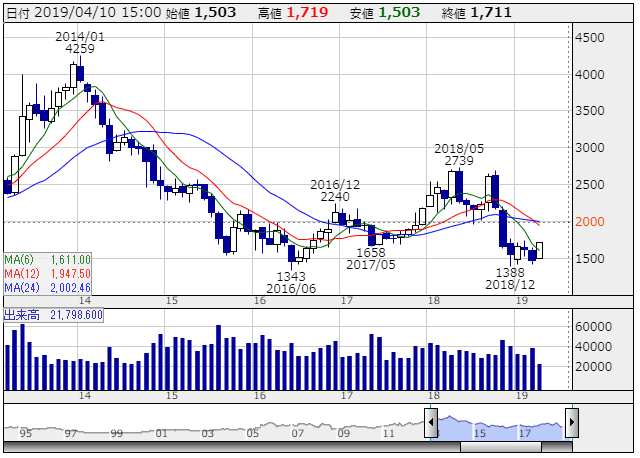
From this experience I learned thatyou must recognize risks that have a large impact on the businessand buy at price levels that reflect those risks. Nippon Oil & Gas Exploration happened to be something I noticed due to my own subjectivity and limited experience.
Buying low-PER stocks with small risks guarantees profits?
After that, I began to read the“Risks of the business”section of annual securities reports in depth. Reading this helps you roughly understand the factors that affect performance.
If you can buy low-risk businesses at cheap prices, you can at least limit downside risk, and if fortune smiles, you might rise. Around this time, I began tohunt for low-PER stocks.
There were investments that paid off well.JX Holdings (5020) and Daido Steel (4577) are representative examples.


On the other hand,this alone wasn’t enoughand there were times when I felt unsatisfied. This method reduces downside risk, but does not yield large gains even when prices rise.
Also, it takes time for low-PER stocks to unwind; you must wait for market trends.It takes a lot of time with little in the way of tangible results, which is boring. I began to want bigger rises in a shorter period.
Success with PC Depot’s rebound. Could this be the境地 I was aiming for?
Then a successful example wasPC Depot (7618)investment.
The company faced issues with expensive services for the elderly and the stock price fell sharply due to the controversy. However, from its disclosed materials, earnings remained solid and business risks were small.
Believing the controversy would subside and the stock would recover, I recommended buying. As expectedit rose more than 50% in just under a year.

By that time my ability to read annual securities reports had improved, giving me considerable confidence. With this as my weapon, I believed I coulddistinguish risky stocks from safe ones.
Then, I began to target stocks like PC Depot that were “in the middle of a flare-up” but whose business activities, as judged from disclosed materials, had no fundamental problems,and that could rebound were very attractive. The more they flared up and the stock price fell, the more attractive they became.
This approach,a strength in analytical capability, began to look like my own境地. A famous value investor, John Templeton, also said the following.
To achieve high performance, you must do something different from the majority of people.
However, this approach would later lead to a major pitfall.
(To be continued)