

【Conclusion】Gold EA vs Sign Tool, which is better? | The answer after 12 years of trading
I want to automate trading with gold.
I completely understand this feeling. I don’t have time to stare at charts all day. Trading with emotions leads to losses. So I want to leave it to a machine.
So there are two main options.
EA (automatic trading) or a signal tool (discretionary aid).
Many people think, “Wouldn’t completely automatic EA be easier?” I’ve traded gold for 12 years, and ultimately I chose a signal tool.
This time I’ll explain the reasons by listing the advantages and disadvantages of EA honestly.
Advantages of EA
First, acknowledge the good points of EA.
① Fully automatic
It trades automatically while you’re asleep or at work. You don’t even need to look at the charts. This is a major benefit.
② No emotions involved
You don’t hesitate to cut losses. You don’t take profits prematurely. It moves monotonically as programmed. Human weaknesses don’t interfere.
③ Backtesting capability
You can verify it with historical data. Numbers show how it would have performed over the past decade with this method.
Hearing this, you might think, “Then EA is the only option.”
But reality isn’t so sweet.
Fatal weaknesses of EA
① It dies when market conditions change
EA is optimized for past markets. Even if backtests show superb results, that’s about “the past market.”
Gold has behaved very differently in 2024 and 2026. Volatility levels, how trends appear, session-by-session price action—all have changed.
There’s no guarantee that an EA optimized for past markets will function the same way in the present market. In fact, there are many EA that peak in backtests and then suffer big losses in real trading.
② Becomes a black box
Most people don’t understand what the EA is actually doing. “Why did it buy here?” “Why did it cut here?” are unknown.
You leave it to it without understanding. It’s fine while it’s working. But when losses begin, you can’t decide whether to stop or continue because you don’t understand the logic.
In the end, you can’t make the most important judgments yourself.
③ Struggles to handle sudden market shocks
Trump's remarks, geopolitical risks, interventions—gold can move $50–$100 on such shocks.
EA isn’t prepared for this. A normally optimized logic can move and cause huge losses in the middle of a sudden crash.
④ VPS and maintenance costs
To run EA 24 hours a day you need a VPS (virtual private server). It costs about 2,000–5,000 yen per month. Annually that’s 24,000–60,000 yen in running costs.
There’s no guarantee of profit from the EA itself plus VPS costs. The cost structure is heavy.
⑤ Few gold-specific EAs
Looking at content markets, there are many EAs claiming to handle gold. But most are generic “all currency pairs” tools.
Very few EAs are truly optimized for gold’s volatility, spread dynamics, and session characteristics.
Advantages of a signal tool
① You keep the final decision
Signals appear, but you decide whether to enter or not.
“Skip because of upcoming data,” “withdraw due to abnormally high volatility,” “stop because the quality score is low.”
Keeping this human decision is the biggest strength of signal tools.
EA lacks this flexibility.
② Can adapt to market changes
A signal tool provides “decision-making material.” The final decision is made by the human. Therefore, even as market conditions change, you can respond: “Right now this signal should be skipped.”
EA will keep moving according to the program regardless of market changes. Humans are more adaptable.
③ Improves trading skills
If you rely completely on EA, your trading skills won’t improve at all. When EA breaks, you’re left with nothing.
Trading with signals makes you think about why a signal appeared here. Over time, you gain the ability to read the market.
You grow with the tool, not just rely on it.
④ No VPS required
Signal tools only operate when you have the chart open. No VPS needed. Zero ongoing cost.
⑤ Fewer troubles
EA often suffers from technical issues like “order didn’t go through,” “VPS went down,” or broker server delays typing the trade. Signal tools just display signals, so they’re not affected by such issues.
Honest look at the weaknesses of signal tools
To be fair, let’s note the downsides.
① You must enter orders yourself
Even when a signal appears, you need to place the order. You may miss signals when you’re not watching the chart. It can’t be used while you’re sleeping.
② Emotion can still enter
“You can decide yourself whether to enter” also means emotions can distort the decision. You might be scared to enter a signal, or want to enter when there isn’t a signal.
However, this can be greatly mitigated by quality scores and filters. If you set rules like “only enter signals with 2 stars or higher,” emotional involvement becomes much smaller.
Conclusion: For gold, signal tools win in the long run
EA is suited for people who want to leave everything to automation or who aren’t interested in trading skills.
But considering the characteristics of gold, I firmly believe signal tools win in the long run.
Reason is simple.Gold changes too rapidly.
Volatility varies day by day. A single word from Trump can move $50. Interventions happen. Indicators surge.
Only signal tools that preserve human judgment can adapt to these changes. EA cannot adapt to this change and will eventually fail.
KURAMA GOLD SIGNAL PRO
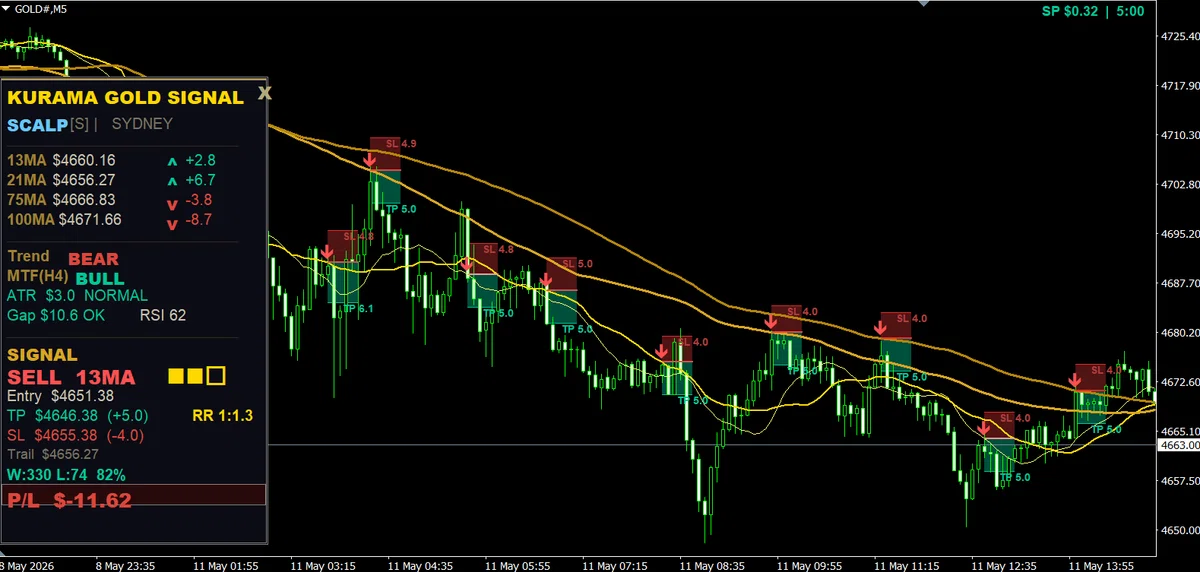
KURAMA GOLD SIGNAL PRO (KGS) I created is a “signal tool that incorporates the good points of EA.”
Elements adopted from EA:
・TP/SL automatic calculation → no emotion-driven settlements
・7-layer filter for automatic judgment → avoids useless signals
・Quality score automatically evaluates reliability → reduces indecision
Elements retained as a signal tool:
・Final judgment by humans → can respond to sudden events
・Trade while watching the chart → improves skills
・No VPS required → zero running cost
EA’s “automation” and the signal tool’s “flexibility” have been combined in this design.
In practice, user Jose Casas achieved 57 entries in 9 days, 55 wins, 2 losses. Win rate 96.49%, net profit $8,923. Following the signals while choosing sessions oneself and trading only high-quality signals led to this result.
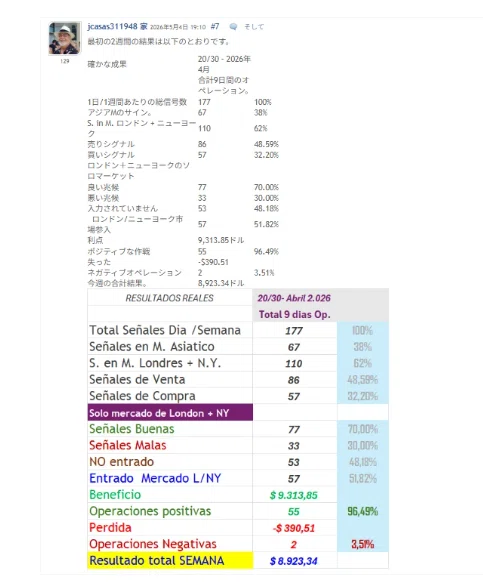
These numbers can’t be achieved with EA. It’s because human judgment remains in place that this performance is possible.
Summary
・EA is fully automatic but weak to changing markets, a black box, and rarely gold-specific
・Signal tools allow final human judgment, making them better suited for volatile gold
・For highly volatile assets like gold, signal tools that preserve human judgment win in the long run
・KGS combines EA automation with signal-tool flexibility
・Improve trading skills while increasing win rate with the tool’s support
If you want to win even more
Even just following KGS signals can change your results.
But if you understand why a signal appears at a certain point, entry accuracy rises further.
・Enter with confidence when a signal appears
・Understand logically why a signal has a certain quality score
・Learn to discern when to skip a setup with your own judgment
A trader who relies solely on tools and a trader who understands the tool’s logic will have completely different decision quality when looking at the same signal.
This is the material I’ve compiled to systematicize my moving average method. It includes the core reasoning behind KGS’s logic.
? MA method material here →

? Details of KURAMA GOLD SIGNAL PRO here
Would a set be a good deal?
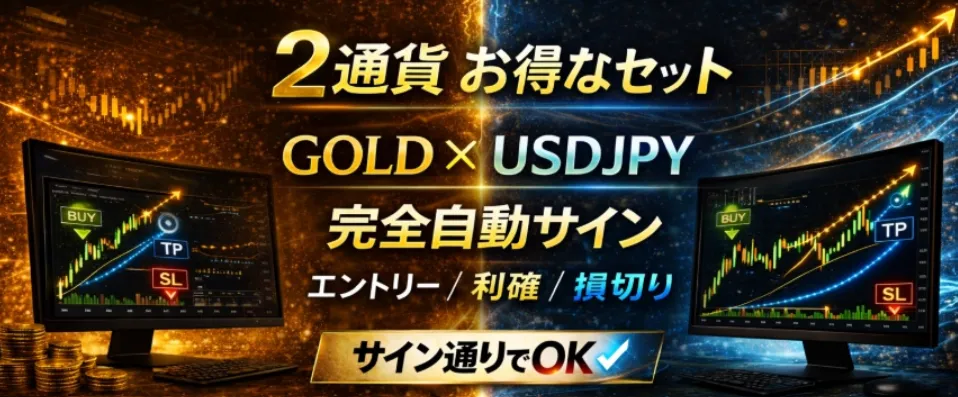
KGS (gold-specific) and KUS (USD/JPY-specific) are available as a set at a discount.
KGS alone ……… ¥24,800
KUS alone ……… ¥19,800
Total for the two ……… ¥44,600 ★
Set price … ¥39,800 (¥4,800 OFF)
? Set products here →https://www.gogojungle.co.jp/tools/ebooks/77857?via=users_products
![]()
KGS (gold-specific) and KUS (USD/JPY-specific) are available as a set at a discount.
KGS alone ……… ¥24,800
KUS alone ……… ¥19,800
Total for the two ……… ¥44,600 ★
Set price … ¥39,800 (¥4,800 OFF)
? Set products here →https://www.gogojungle.co.jp/tools/ebooks/77857?via=users_products

Is it OK?