

Thoughts on whether AI can create contrarian signals in the AI×GOLD system
0
This post is a development log for reproducing in AI the idea behind the popular GoGoJunction product “AI Scalper GOLD” on its own terms.
There is no aim to criticize any particular product, and the reproduction is completely different from the original. This is written as a project to expose the process of “creating a sign tool with AI.”
As someone who sells the “Pro-grade FX Sign Tool Mass Production AI System,” there has been a企画 I’ve wanted to do for a long time.
“Take a popular sign tool on GoGoJunction, analyze it with AI on my own, and try to make it myself on my own accord.”That’s the idea.
One per week, a three-article series to reach completion. This week's topic is this.
“AI Scalper GOLD | a learning AI with memory of losses, a Gold-only scalping indicator”
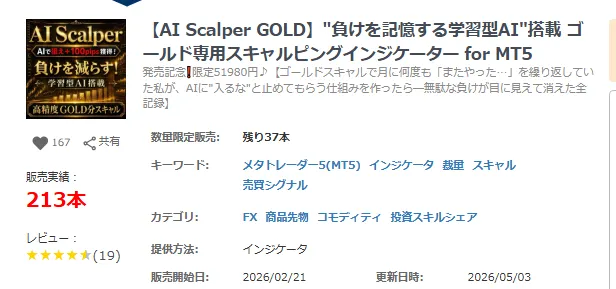
A popular tool that ranks high on GoGoJunction. The product page is crafted so intricately that honestly, I thought, “This looks strong.”
First, entrust the product page entirely to AI
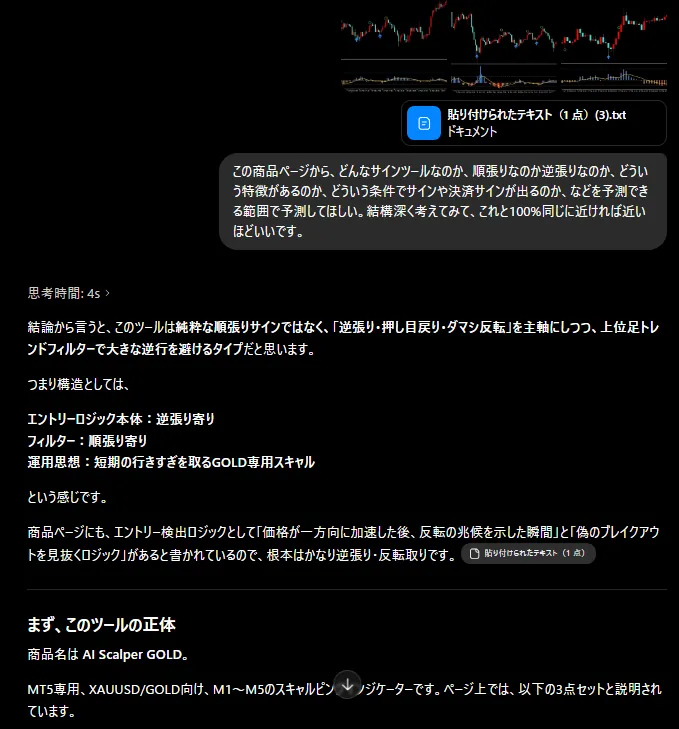
The first thing I did was this.
I fed the AI all the text and sample images from the product page and asked it this:
“From this product page, what kind of sign tool is it, is it a trend-following or counter-trend, under what conditions would signals appear, think deeply within the range you can predict.”
The answer it gave was incredibly long.
“Counter-trend biased, almost certain.”
“Exhaustion Index might be a deviation indicator normalized by ATR.”
“AI feature is probably a similarity judgment by k-nearest neighbors.”
“Upper-timeframe trend filter + volume filter + multi-stage cooldown structure”…
…yeah, too complex.
If I had it do all of this in one go, it would surely have bugs.
But there was value
However, while reading the AI’s analysis, one important aspect became visible.
The sentence written on the product page: “When price accelerates in one direction and then shows signs of reversal at the moment of turning.”
This is not how you’d describe a trend-following tool, right?
It would be phrased like “captures strong breakouts” or “initial move of the trend.”
In other words, this tool is the type that goes after the extension from the opposite side, confirming it.
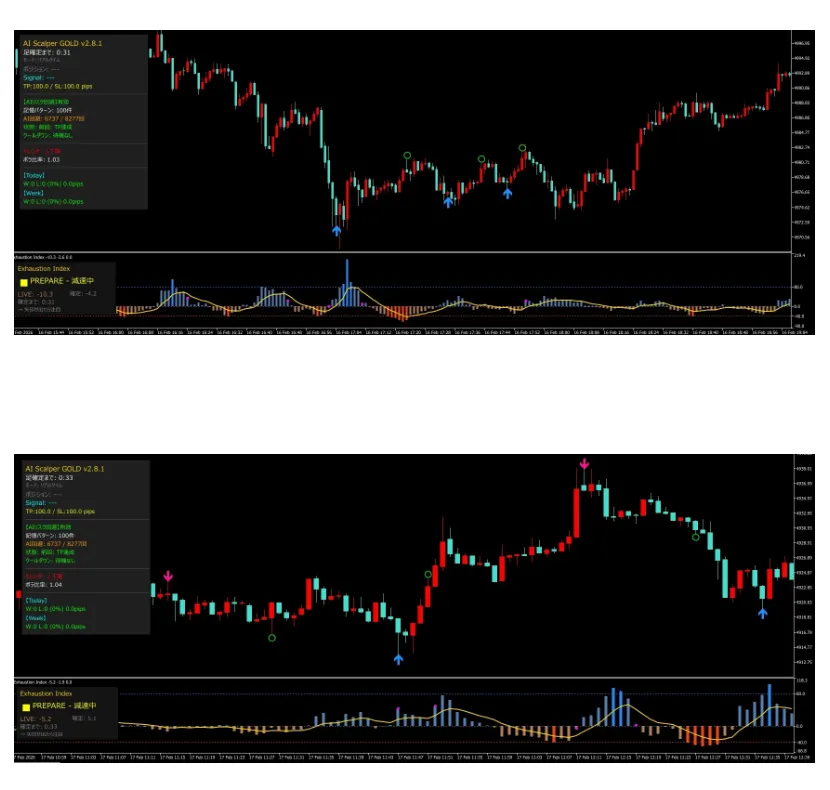
I also checked with sample images for verification.The blue arrows were in the “downward trend continuing in the lower price range,” and the pink arrows were in the “uptrend’s extended high-range,”as shown.
The oscillator at the bottom called the “Exhaustion Index” literally means Exhaustion = “fatigue” or “depletion,” so the name mirrors the philosophy.
With this much understood, the core is clear: “When price has run too far, aim for the moment of return.”
Throw AI at it again, this time to create a specification
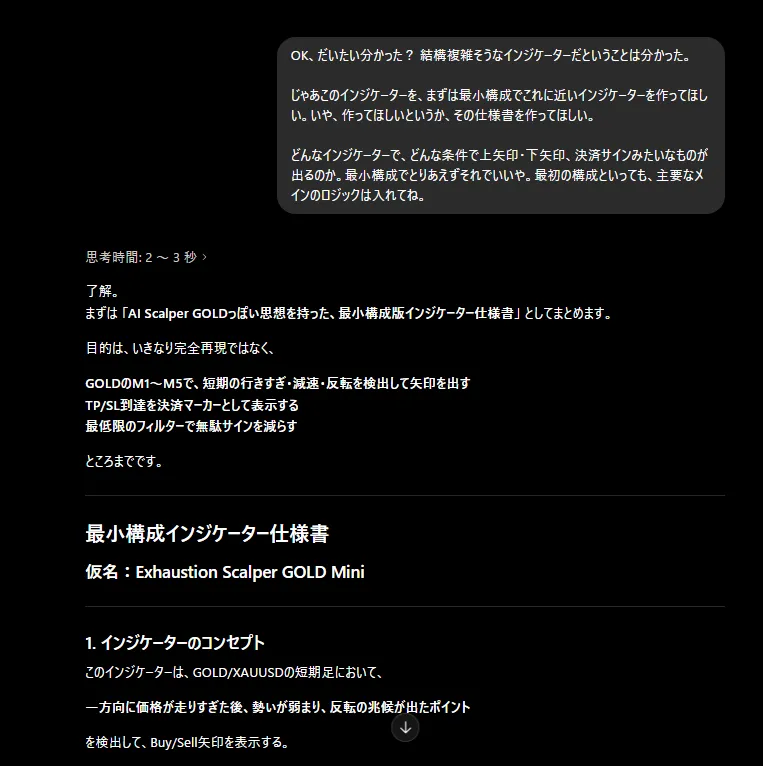
With the direction clear, the next instruction was this.
“I want to build a near-minimal indicator. Create a specification.”
The specification that came back was again long.
“Lower-interval oscillator display.”
“Upper-timeframe trend filter.”
“Volume filter.”
“AI loss-pattern memory.”
“Nerf/martingale management feature.”
“Win-rate panel.”
…too many.
Even that cannot be built in one go. So I asked again.
“Simple is good. No panel needed, and keep the logic a little simpler.”
This trimmed things down fairly well. The final minimal approach is the following simple concept.
Specification for this week’s creation
Buy signal: When price is far below the moving average and then begins to rebound with a bullish candle. Specifically, look for signs of reversal such as “the lower wick shows up” and “the close is higher than the previous bar.”

Sell signal: When price is far above the moving average and then begins to retract with a bearish candle. The opposite of Buy.

Take-profit and stop-loss: Automatically set according to current volatility. Since GOLD’s volatility varies daily, fixed “30 pips” would be fatal. On volatile days, widen; on calm days, narrow it, and adjust automatically.

Result marker: Draw a green circle when profit is reached, and a red cross when stopped out.

Prevention of consecutive signals: After a signal appears, don’t emit the next signal until the result is known.
That’s all.
What about the “AI that remembers losses”?
The main feature of the original product, “AI that remembers losses,” how should we handle this?
Asked AI, it replied, “Probably a similarity judgment using k-nearest neighbors.”
…
Let’s set that aside for now lol
If you include it from the start, it will definitely cause bugs somewhere.
In Phase 1, do not include AI memory features. Prioritize something that works over perfect reproduction.
AI features, higher-timeframe filters, and time-of-day filters will be added gradually later.
What I realized this time
After doing this, I realized:If you ask AI to “make Everything in one go,” you will surely fail.
The original full specification had about 20 items. If you pass that as-is, it would probably collapse partway through.
By reducing to “minimal configuration,” “simpler,” and “exclude this time,” and trimming multiple times, you end up with something that can be created in one shot.
Also, the way a product page is written is fascinating becausethe designer’s intention leaks through quite clearly, which is another interesting finding.
Just by reading “what they are emphasizing,” you can mostly infer the internal logic. It’s educational from the vendor’s viewpoint as well.
Next issue teaser
Next: “Coding and Operation Check.” We’ll feed this specification to AI and actually have it create a MT4 indicator.
There will surely be bugs somewhere. We’ll show how to fix them all.
In the end, I’ll distribute the complete version for free.
See you again.
? About the development methods used in this article
The workflow for letting AI create a sign tool that I’m presenting in this series
is based on the“Pro-grade FX Sign Tool Mass Production AI System”that is currently on sale.
From the product page and ideas for the method, AI creates the specification,
and the indicator’s code can be generated in a seamless flow.

× ![]()

Is it OK?