

Cryptocurrency Market Analysis [May 12]
1. Overall Trend in the Crypto Asset Market and Decline of Major Coins
On Tuesday, the crypto asset (cryptocurrency) market moved broadly lower, dragged by declines in Wall Street (the US stock market), with the major coin Bitcoin (BTC) dropping toward the $80,000 level. As a result of this decline, the total market capitalization of crypto assets decreased by 1.6% over the past 24 hours, shrinking to about $2.76 trillion.
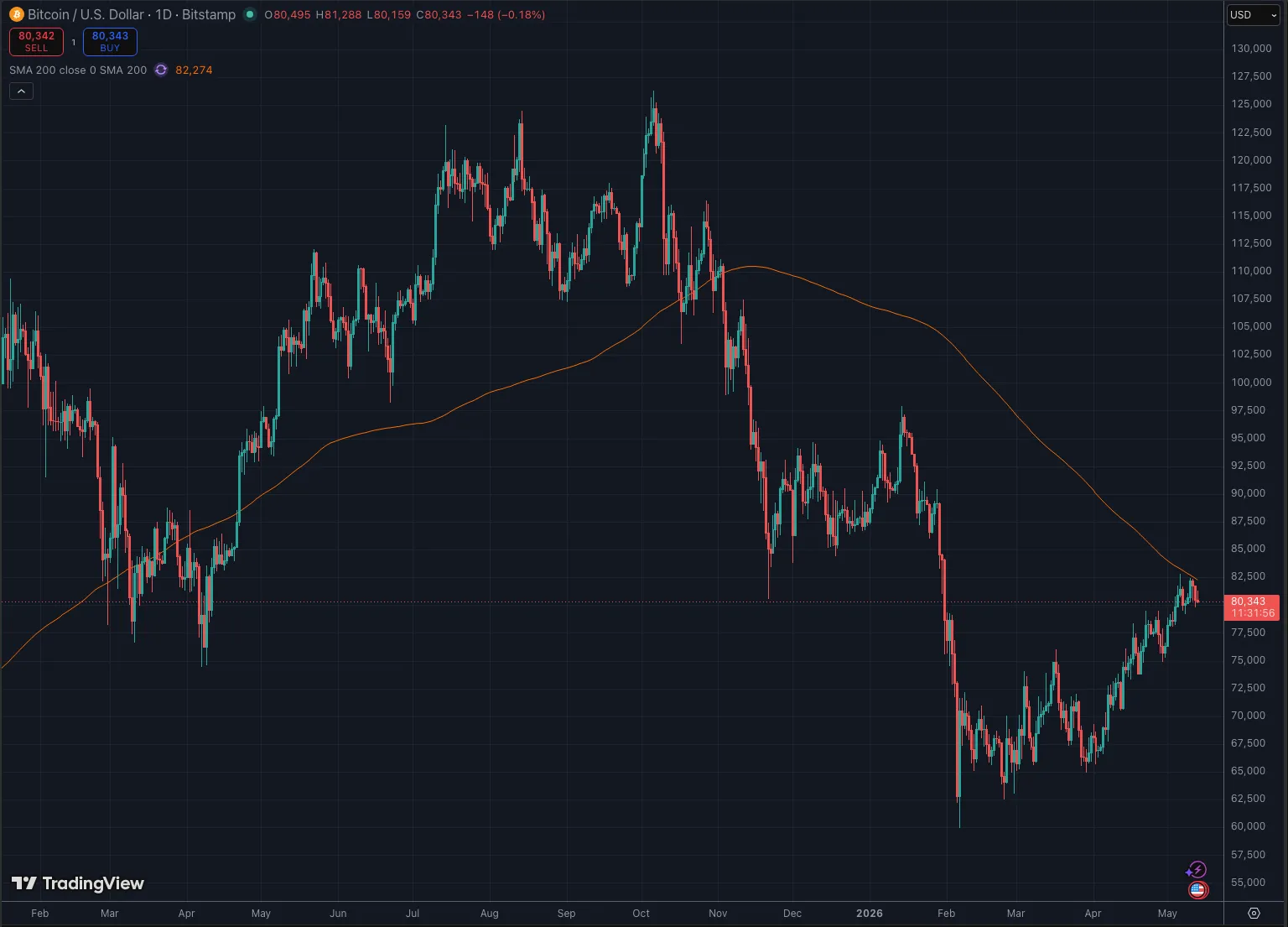
Bitcoin Daily Chart
Meanwhile, the Bitcoin Fear & Greed Index, which reflects investor sentiment in the market, is at 42, indicating a neutral state—not overly pessimistic nor optimistic.
According to the cryptocurrency data site CoinGecko, as of writing this article, Bitcoin is trading at $80,262. This is down 1.7% from the previous day and down 1.3% from the prior week.
Ethereum (ETH), ranked No. 2 by market capitalization, fell more than Bitcoin, dropping 2.8% from the previous day to $2,265. This pushed the weekly decline to 4.7%.
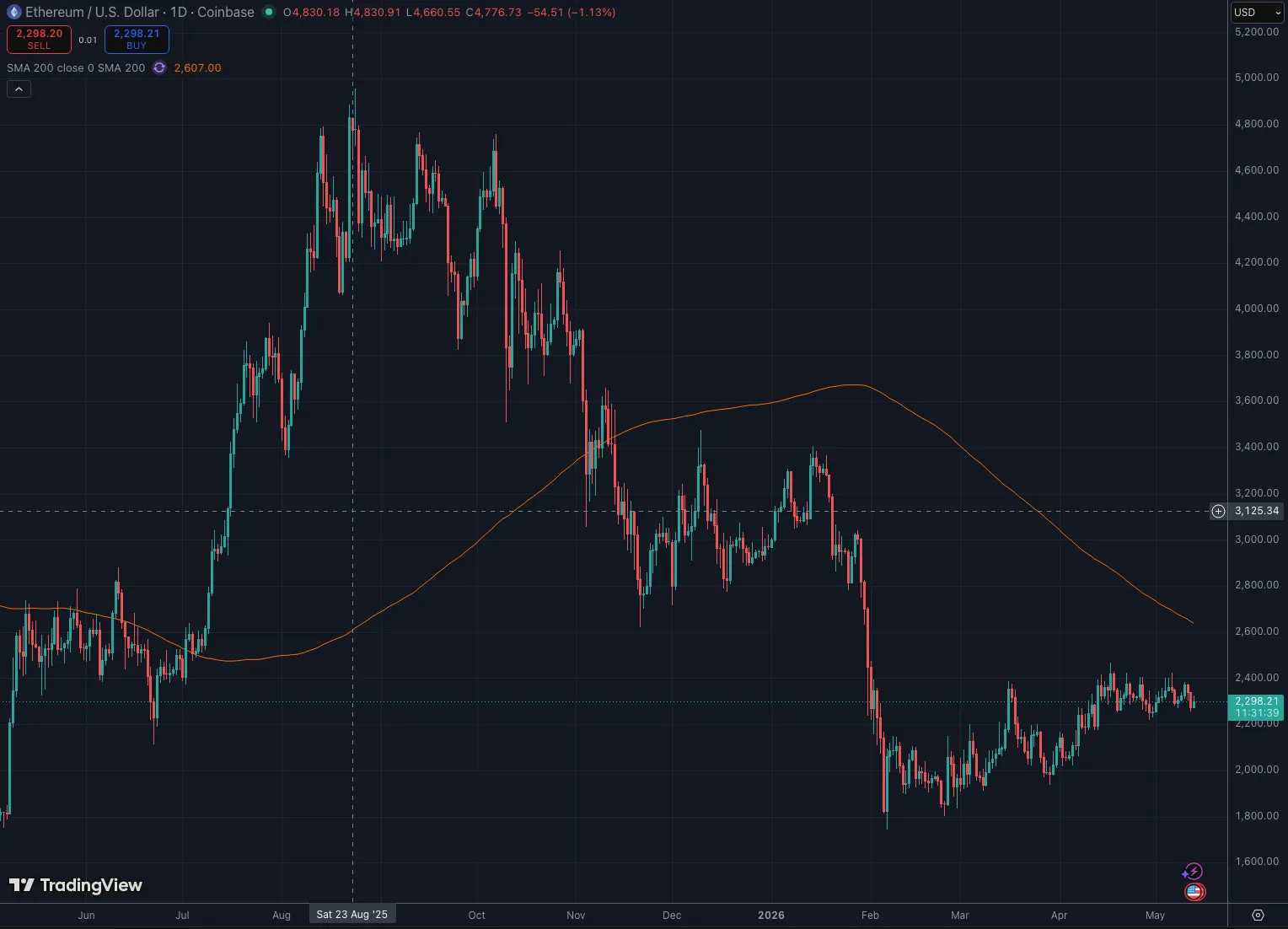
Ethereum Daily Chart
Most major tokens within the top 20 by market cap also moved lower together. Details of their movements are as follows.
Solana (SOL) fell 3.7% from the previous day and hovered around $94. However, it has gained 10% over the past week. Cardano (ADA) declined 4.2% from the previous day. The hyperliquid HYPE token dropped 3.5% to $40.32, recording an 8.5% weekly decline. Ripple (XRP) fell 3.5% to $1.43. Binance Coin (BNB) declined 1.1% to $653. Dogecoin (DOGE) dropped 2.4% from the previous day.
2. Impact of US Macro Indicators (CPI)
The background to this market decline is heavily influenced by the April Consumer Price Index (CPI) reported by the U.S. Bureau of Labor Statistics.
The report shows that US CPI rose 0.6% month over month in April, and 3.8% year over year. The 3.8% annual increase is the highest since May 2023, and slightly exceeded the market consensus of 3.7% compiled by Dow Jones in advance. Moreover, the core CPI, which excludes food and energy due to their volatility, rose 0.4% month over month and 2.8% year over year, also beating market expectations and indicating stubborn inflation.
The main driver of this persistent inflation is energy prices. Energy prices rose 3.8% month over month in April, accounting for more than 40% of the total rise in CPI.
In particular, geopolitical risks such as the Middle East's Red Sea shipping route and potential closures have contributed to a 28.4% surge in the gasoline index over the past 12 months. Rent and housing costs also rose by 0.6%. Meanwhile, wage growth has not kept up with price increases, real average hourly earnings have fallen year over year for the first time since April 2023, and concerns about consumer spending have grown.
3. Bitcoin ETF Inflows/Outflows and Shift from Gold
According to analysis by JPMorgan, investors are increasingly using Bitcoin as a hedge against the devaluation of currency (inflation reducing the purchasing power of cash), moving away from traditional gold as the default hedge. Evidence shows that physical Bitcoin ETFs have seen inflows for three consecutive months, while gold ETFs have faced notable outflows and struggled.
SoSoValue’s on-chain data statistics show that the 11 physically backed Bitcoin ETFs listed in the US market recorded $275.5 million in redemptions on Thursday and $146.6 million on Friday. However, on Monday the funds saw a net inflow of $27.29 million, ending a two-day downtrend.
Currently, the total net assets of these 11 ETF products amount to about $109.08 billion, which corresponds to roughly 6.78% of Bitcoin’s total market capitalization.
4. Bitcoin (BTC) Related Individual News
Economization of Computing Resources and Reassessment of the PoW Core
The “structure” Bitcoin has realized as a system for over a decade is now drawing renewed attention as a concept of a currency.
Recent major deals by SpaceX and xAI (Elon Musk-led AI company) have demonstrated that “computational power can function as money” in practice. Thus, the hypothesis that computing resources can have monetary functions is not unfounded. In the future, society may transact using units of computation (tokens) rather than existing fiat currencies.
Bitcoin, from its inception, has already implemented and proven this idea worldwide through the consensus algorithm Proof of Work (PoW). The key points are as follows.
Miners perform vast calculations (hash computations) and consume enormous electrical energy to create blocks, thereby protecting the Bitcoin network. As a reward for these computations, new bitcoins are issued, linking computing resources directly to monetary value. Some suggest using this computing power for meaningful external tasks like AI training, but doing so would distort mining competition and reduce network security. By keeping Bitcoin focused on computations that only decrypt Bitcoin, Bitcoin maintains the most robust system in human history, unaffected by external political or economic factors. In other words, the cutting-edge concept of “computing resources as money” that’s currently popular due to SpaceX and xAI is exactly what Bitcoin has been running for over a decade. This discussion is gaining strong relevance in the context of the AI boom’s enormous demand for computing power, re-evaluating the essential value of PoW.
Potential Tokyo Stock Exchange Listing by Japan Exchange Group (JPX)
On May 6, JPX's CEO told Bloomberg in an interview that there is a possibility that a physical ETF for crypto assets including Bitcoin could be listed on the Tokyo Stock Exchange (TSE) as early as 2027.
In the US, a leading example, the assets under management (AUM) of physical Bitcoin ETFs surpassed $100 billion for the first time in April 2026, becoming a successful model for institutional adoption. If JPX achieves domestic listing, Japanese individual investors’ money could flow into the crypto market via NISA accounts for the first time. It would also create a path for Japanese institutional investors to invest in and hold Bitcoin safely within a strong domestic regulatory framework, marking a major historical turning point.
CZ on the Futures of AI Agents and Crypto
Changpeng Zhao (CZ), founder of the world's largest cryptocurrency exchange Binance, in a dialogue with Cathy Wood of ARK Invest, stated that “future AI agents will use cryptocurrency for settlements rather than Visa cards.”
AI agents will make autonomous decisions and execute trades at ultra-fast speeds, potentially generating enormous volumes of transactions—10x to 1,000x those of humans. In such a world, using Bitcoin ($BTC) for cross-border payments, which offers 24/7 real-time settlement and higher compatibility with programs than the current Swift/Visa networks, would be far more natural.
Ray Dalio’s Assertion: “Bitcoin Is Not Yet a Safe Asset”
Ray Dalio, founder of Bridgewater Associates, the world's largest hedge fund, contends that Bitcoin is not yet a true safe asset due to its characteristics (transparent on the blockchain, limited privacy, etc.). He notes that Bitcoin still tends to move with tech stocks and tends to be sold first in market downturns as a risk-off asset.
On the other hand, regarding traditional safe-haven assets like gold, Dalio emphasizes that gold has thousands of years of history and immense trust as a core asset in the global financial system, and concludes that the world still places the highest trust in gold with solid historical backing.
Wall Street Institutions Expanding Crypto Talent Hiring
Bloomberg reports that major Wall Street institutions are significantly expanding hiring of professionals in Bitcoin and crypto-related areas.
Specifically, JPMorgan, Morgan Stanley, and BlackRock are extensively recruiting for advanced positions such as engineers and directors in their digital assets divisions, signaling a deeper fusion of traditional finance and crypto.
[Paid Subscription Notice]
In the paid subscriber area, we offer even deeper, high-value analysis of individual assets.
“I want to invest in the next big winner beyond Bitcoin and Ethereum,”
“I want to grasp the fundamental flows and future of the crypto market and ride that wave reliably.”
If this describes you, please consider subscribing. Ongoing high-quality research is the key to great success.
(This report has been delivering market-leading insights since its 2016 launch)