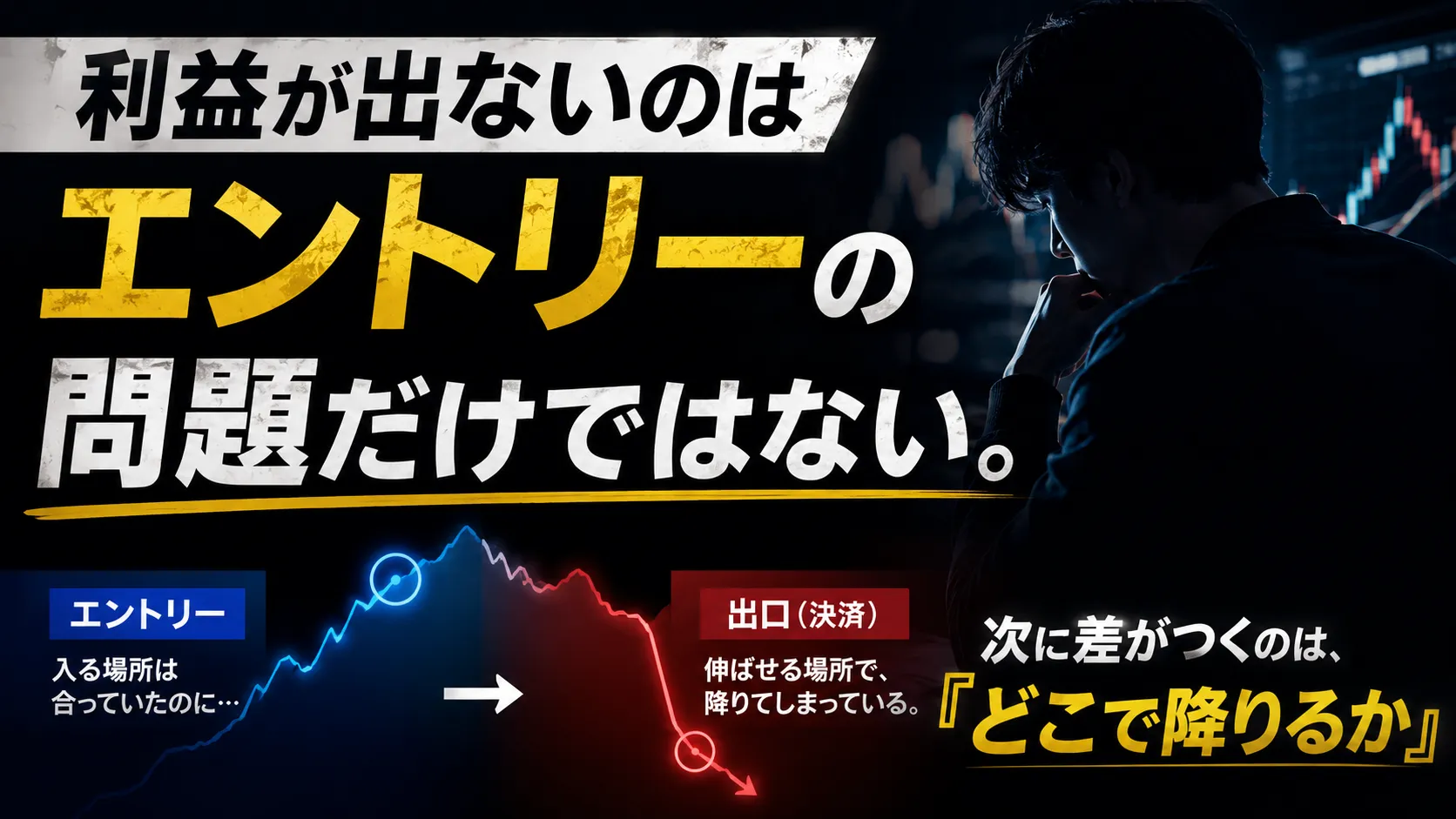

Chapter 3: If 「●●」 Changes, Trading Becomes a Different Thing
Chapter 3:
When "●●" changes, trading becomes a different animal
Why, even with the same entry,
the results can change this much?
Last time,
how easily the number called “win rate” can be created.
And what really matters is what you should truly look at,
- how far it extended
- where it was stopped
- how it progressed afterward
that is, the discussion we had.
This time is a continuation of that.
And from here,
we will enter the common points among traders who are still unnoticed,
“People who keep profits”
■ Why does the difference arise even when entering at the same place?
As you continue trading,
have you ever experienced this?
Same direction.
Same kind of entry.
You should have been looking at the same chart, but
somehow the results are completely different.
One person +300 pips.
Another person +30 pips.
One person exits break-even.
Another person cuts loss midway.
Why does such a gap occur?
The answer is simple.
Because the "exit" is different.
■ Trading is not about the “entry game”
Many people in trading think of it as
“where you enter”
a game of entry.
entries are important.
But in the real market,
long-term edge is not built by entry accuracy alone.
Because,
“profits are only realized at exit”
therefore.
For example,
- someone who takes profit at 1:1 every time
- someone who lets it run to 1:3
- someone who can hold near the end of the wave
These three people, even with the same win rate, have completely different final profits.
In other words,
even with the same logic,
it becomes a different trade depending on the exit strategy.
This is the reality.
■ Many people exit during an expanding market
In actual trading,
more than losing,
you miss profits that could have been earned
in overwhelming numbers.
A wave that could have extended 300 pips
- exit at +40
- get anxious at +60
- close after a small pullback
I think everyone has had experiences like this.
So why does this happen?
The reason is simple.
Because you cannot see “the next move.”
■ People cannot sustain “unseen profits”
The difficult part in trading is not the entry.
It is the holding.
When unrealized gains accumulate,
fear of “what if they disappear” arises.
Then people
- take profits too early
- escape with tiny profits
- fail to extend gains
This is less about lack of skill and more about a lack of evidence to support decisions.
In other words,
there is no visualization showing that the move has more to go.
Thus, it becomes anxious.
■ As soon as you incorporate a certain analysis, the perspective changes
Here is an interesting claim.
Even looking at the same chart,
some people unusually extend profits far more than others.
Moreover, those people do not have special entries.
They are actually quite simple.
So, what makes the difference?
They look at
“how reachable it is”
They don’t only consider direction.
- where liquidity is accumulating
- where it tends to stall
- which wave tends to extend
- which price ranges tend to attract bids
They watch those factors.
In other words,
they are not “predicting the future,” but
they are looking at a structure that makes trends likely to extend.
■ Here, many people misunderstand
When people hear about AI or analytic tools,
they imagine tools that will make you win automatically.
But the truly powerful use is the opposite.
The best tools do not erase the human.
Rather, they
support human judgment.
- your own market perception
- your own entries
- your own patterns of strength
While utilizing these, they complement only the parts where humans struggle.
That is why you truly become strong.
■ What matters is not replacement but coexistence
Understanding this changes your perspective on tool selection.
For example,
- price action
- ICT
- Dow Theory
- correlation analysis
- order blocks
- macro analysis
These all have different roles.
In other words,
not “which is strongest?”
but
“how to stack them together”
is what matters.
■ Competitive edge increases the more it overlaps
For example,
there is a type of entry you excel at.
There,
an analysis is added.
Then,
what used to be intuitive
“around here?”
begins to appear as
- an area where it tends to extend
- a price range that is easy to reach
- dangerous reversal points
as visible.
Then, what happens?
unnecessary profits decrease.
you stop hanging on in places where it won’t extend.
As a result,
the RR itself begins to change.
This is very significant.
Because,
what truly changes the equity curve is not the
“win rate,” but the“average profit.”
■ Therefore, strong traders spend time on exits
Beginners,
instead, chase entries.
However,
those who stay longer are actually studying
where to exit.
Because,
trading is
not a game of predicting the future.
By selecting only situations with edge and
remaining in the place where it grows
and leaving with solid profits.
That accumulation is what matters.
There is analysis that is already changing the precision of exits.
Still, only some traders are using it.
But once you learn this perspective,
you will realize how much of your previous profit-taking was based on feeling.
■ Next time preview
Then,
what makes a “rising market”
and a “falling market”
different?
Why, even with similar shapes,
one explodes while
the other stalls midway?
Next time,
we will dive into the “places where prices are drawn to”
and so on.
From here on, this is not mere technicals.
We will move toward the underlying,
the essence of liquidity.