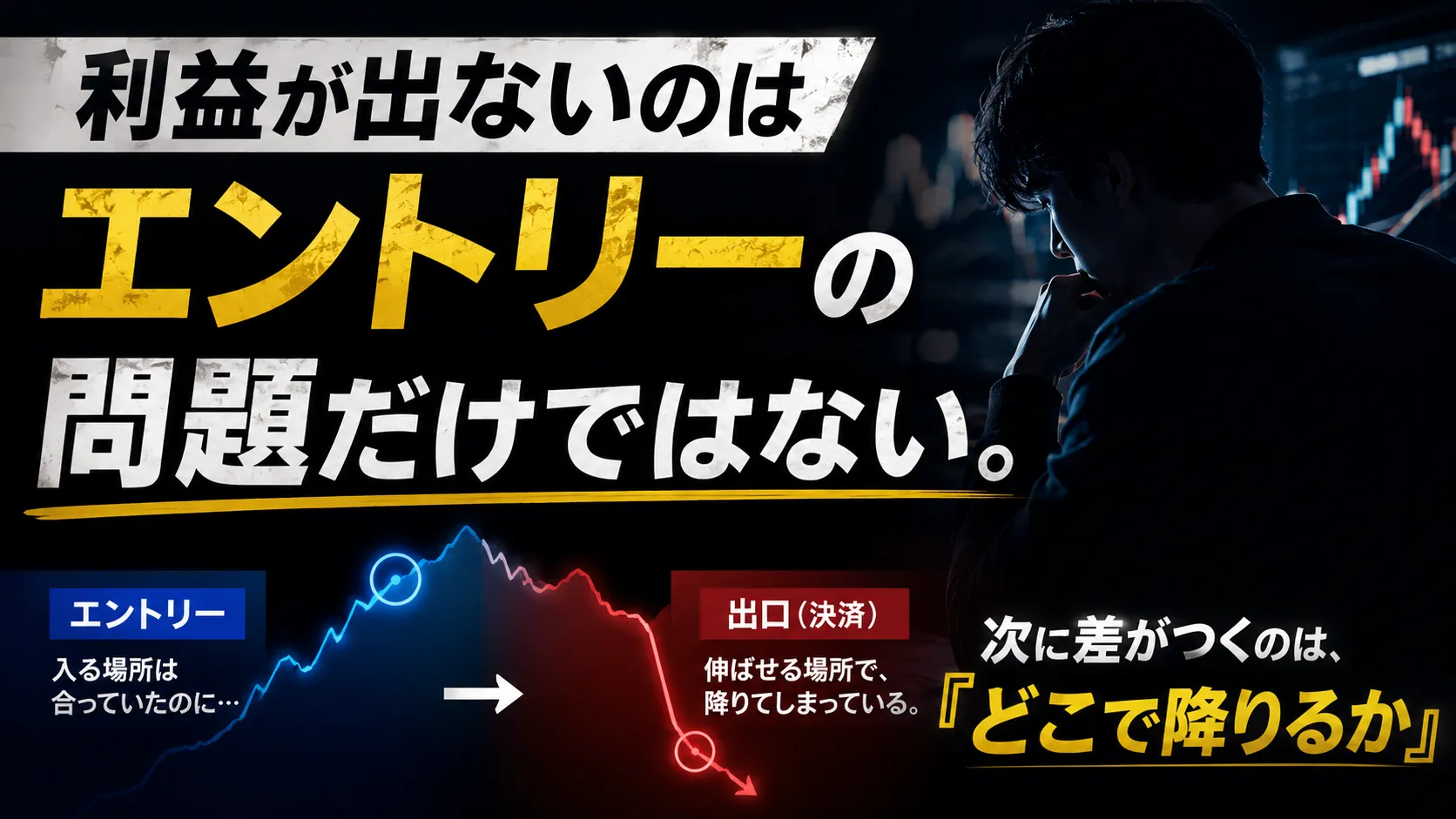

Episode 3: If 「●●」 changes, the trade becomes a different thing
Episode 3:
When "●●" changes, trading becomes a different thing
Why, even with the same entry,
the results can change this much?
Last time,
I talked about how easily a number like the win rate can be manufactured.
And what really matters is
- how far the price moves
- where it gets halted
- and how it progresses afterward
That is what I discussed.
This time is a continuation of that.
And from here,
we will enter the common traits of those who still have profits left that many traders have not yet noticed.
“People who keep profits”
■ Why are there differences even when entering at the same place?
As you continue trading,
have you ever had experiences like this?
The same direction.
The same type of entry.
You should have been looking at the same chart,
but somehow the results are completely different.
Some people gain +300 pips.
Some people gain +30 pips.
Some people exit at breakeven.
Some people cut losses midway.
Why does this kind of gap occur?
The answer is simple.
Because the exit is different.
■ Trading is not an “entry game”
Many people think trading is
“where to enter”
a game.
entry is important.
However, in the real market,
long-term edge cannot be achieved by entry accuracy alone.
Because,
“profits are only realized at exit”
therefore.
For example,
- someone who takes profits at 1:1 each time
- someone who can let it run to 1:3
- someone who can hold close to the end of the wave
These three people,
even with the same win rate, end up with completely different final profits.
In other words,
Even with the same logic,
it becomes a different trade due to the exit strategy.
This is reality.
■ Most people exit during a market that can extend more
In actual trading,
more often than losing,
“missing out on profits that could have extended”
happens far more than losses.
A wave that could have extended 300 pips
- escape at +40
- get nervous at +60
- close after a small pullback
I think everyone has had this experience.
So, why does this happen?
The reason is simple.
Because you haven’t seen what lies ahead.
■ People cannot sustain “unseen profits”
The difficulty in trading is not the entry.
It is the holding.
When unrealized gains arise,
fear arises of “what if it disappears.”
That fear leads people to
- take profits too quickly
- exit with minor profits
- be unable to extend profits
This is less about technique and more about a lack of decision-making data.
In other words,
the basis that “there is still a high chance to rise” is not visualized.
That causes anxiety.
■ Once you adopt a certain analysis, the perception changes
Here is an interesting point.
You can see the same chart, but some people unusually extend their profits.
Moreover, these people are not entering in a special way.
Rather, it is simple.
Then, what is the difference?
They look at
“how far it tends to reach”
not just direction.
- where liquidity tends to accumulate
- where it tends to stall
- which wave tends to extend
- which price ranges tend to attract
there.
In other words,
they are not “predicting the future,”
they are looking at a “structure that tends to extend.”
■ Here, many people are misunderstanding
When people talk about AI or analytic tools,
some think they are
“things that win automatically.”
However, the truly powerful use is the opposite.
The best tools do not erase humans.
Rather,
they complement human judgment.
- your own market perception
- your own entries
- your own strong patterns
Using these, and supplementing only the parts where humans struggle,
you become truly strong.
So, the key is not replacement but coexistence.
■ The important thing is not replacement but coexistence
If you understand this,
your perspective on tool selection changes.
For example,
- price action
- ICT
- Dow Theory
- correlation analysis
- order blocks
- macro analysis
these all have different roles.
In other words,
“which is the strongest?”
is less important than“how to layer them”together.■ Advantage grows the more it overlapsFor example,you have a favored entry type.Then, you add some analysis.Then,what was once a gut feelinglike “this area maybe?”begins to appear asan area likely to extenda price range easy to reacha dangerous reversal pointas visible.Then what happens?unnecessary take-profits decrease.you stop hanging around in spots where it won’t extend.As a result,the RR itself begins to change.This is huge.Because,what truly changes capital curves is not the win rate, but the“average profit.”■ Therefore, stronger traders spend more time on exitsBeginners,tend to chase entries more.But,those who stay longer are actually studyingwhere to exit.They are researching it.Because,trading is not a game of“guessing right.”Choose only the favorable situations,in places where it grows,and leave with real profits.That is the accumulation.There is some analysis that is beginning to significantly change the precision of exits.Yet,only a portion of traders are using it.However,once you know this perspective,you will realize how much your previous exits were based on feel.■ Preview of next timeNow,what is the difference between a “rising market”and a “non-rising market”?Why, even with similar shapes,one explodes while the other stalls midway?Next time,we will dive into the place where prices are drawn toand how it works.From here on, this is not merely technical analysis.We will move toward the essence of liquidity behind the market.
“how to layer them”
together.
■ Advantage grows the more it overlaps
For example,
you have a favored entry type.
Then, you add some analysis.
Then,
what was once a gut feeling
like “this area maybe?”
begins to appear as
- an area likely to extend
- a price range easy to reach
- a dangerous reversal point
as visible.
Then what happens?
unnecessary take-profits decrease.
you stop hanging around in spots where it won’t extend.
As a result,
the RR itself begins to change.
This is huge.
Because,
what truly changes capital curves is not the win rate, but the
“average profit.”
■ Therefore, stronger traders spend more time on exits
Beginners,
tend to chase entries more.
But,
those who stay longer are actually studying
where to exit.
They are researching it.
Because,
trading is not a game of
“guessing right.”
Choose only the favorable situations,
in places where it grows,
and leave with real profits.
That is the accumulation.
There is some analysis that is beginning to significantly change the precision of exits.
Yet,
only a portion of traders are using it.
However,
once you know this perspective,
you will realize how much your previous exits were based on feel.
■ Preview of next time
Now,
what is the difference between a “rising market”
and a “non-rising market”?
Why, even with similar shapes,
one explodes while the other stalls midway?
Next time,
we will dive into the place where prices are drawn to
and how it works.
From here on, this is not merely technical analysis.
We will move toward the essence of liquidity behind the market.