
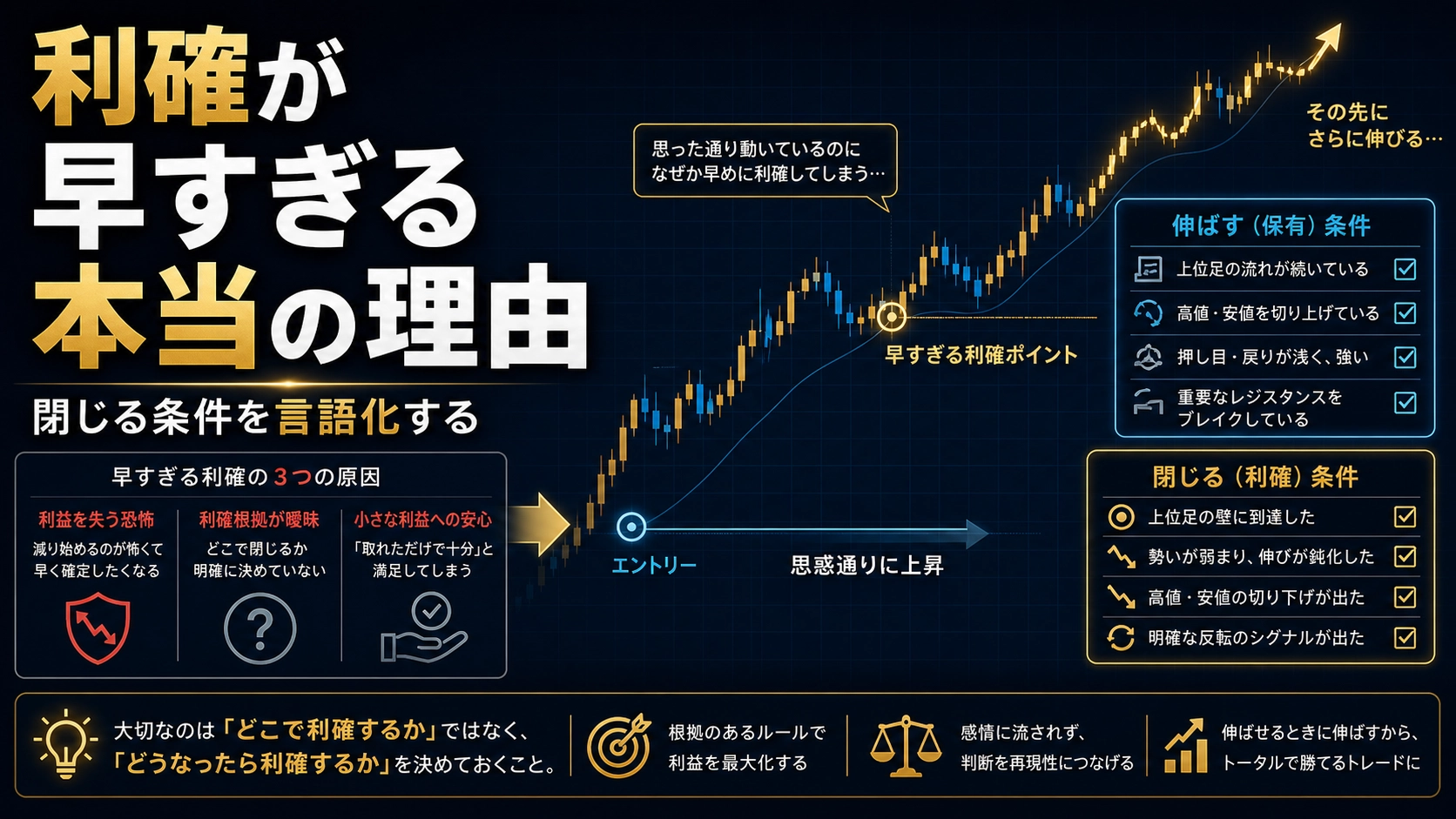
[The Real Reason Why Profit-taking Is Too Early] Explanation by an 18-Year Trader
The reason the market continues to climb after you take profit isn’t that your mental state is weak. Today I’ll talk about the real reason behind it.
Good evening!
I’m Masashi.
After trading for 18 years, what I’ve noticed is that the biggest difference between people who win and those who don’t is the way they decide to take profits.
↓ A feature has been organized around GOLD’s antidote^^
Please join while there’s still time.
The Real Reason Profits Are Taken Too Early|Explained by an 18-Year Trader
Entry, and it moved as you expected.
But somehow you take profits early.
After that, the market keeps rising rapidly…
I think this isn’t a rare experience for anyone.
❌ “What a waste,” “Why did I cut it?”
Feeling that, you do the same thing in the next trade.
This isn’t a matter of technique.
Taking profits too early isn’t a mental weakness—it’s caused by薄薄い justification—the lack of a solid reason.
In this article, I’ll explain the real structure that leads to early profit-taking, and the mindset to change it.
✨ The sense of “I just cut it because it felt early” will gradually become clearer^^
1. Aren’t you like this? The Reality of “Too-Early Profits”
First, honestly: when you entered and the price moved in your favor, how do you feel?
❌ “What if it comes back later?”
❌ “Isn’t this much enough?”
Don’t these thoughts arise?
From the moment you take a position, you’re already thinking about “where to exit.”
Rather than the potential for growth, the fear of it coming back grows biggerin your mind.
Then what happens is…
When there’s a few dozen pips of unrealized gain, you exit with “it’s enough.”
After that, when you look at the chart, it’s already gone up another 100 pips or 200 pips.
If this happened once, you could dismiss it as a matter of feeling.
But if it happens every time,something is wrong, don’t you think?
? The issue isn’t that you cut early—it’s that you can’t explain why you cut at that moment with your own words.
? The justification for “I’ll cut here” didn’t even exist in the first place
There was a reason to enter.
But there was no clear reason to take profits.
Thisasymmetry
When trading, people often think about where to place stop losses.
But where to take profits is often left vague at entry.
⚠ “Well, if it runs, I’ll take as much as it runs”
⚠ “Let’s judge as the situation unfolds”
This thinking may look flexible, but in reality it’sthe same as not deciding
Because you haven’t decided, your emotions take over.
Because emotions are in control, as soon as unrealized profits grow a little, you think “this is enough.”
? After 18 years, what’s common among people who struggle with too-early profits is“the entry justification and the take-profit justification are scattered in different places”—a state that makes it hard to align decisions.
Sticking with this scattered state and trying to “train your mental state” or “hold positions” won’t work.
It’s not a matter of training; it’s astructuralissue^^
2. The Real Cause of Early Take-Profit: A Structural Issue of Thin Foundations
People often say, “Early take-profits come from mental weakness.”
But I’ve felt a sense of mismatch with this explanation for 18 years.
? Because even if you try to fix it with mental talk, the same problem recurs.
“I’ll change myself to stop taking profits early,” yet you end up doing the same thing again.
This isn’t a matter of mental strength; it happens because the foundation is structurally broken.
Let me be具体.
? When entering, many people do so with the intuition, “it looks like it will move, so I’ll enter.”
You entered because the candlestick looked like a favorable pattern, or because it crossed the moving average, “this looks like a good entry.”
But“There’s no basis for how far it will move”.
? No basis for how far it will move means there’s no basis for where to take profits
Because there’s no basis for take profits, emotions make the judgments instead.
This is the true structure.
? In charts, there are places that act as a barrier to stop market moves.“Walls”.
Price action tends to bounce between these walls.
If you understand where the walls are, you gain a basis for the next move up to the next wall.
Conversely, if you enter without knowing wall positions, you’ll be holding a position with no sense of how far it will move.
? Because you don’t know how far it will move, when it moves a little you think“this might be enough”.
? More importantly, not only the walls but“which stage of the current wave you are in” is crucial.
If the wave is still in early stages, profits to be taken will be later.
If the wave is near the end, pulling too long can lead to a reversal.
If you enter without grasping this “wave state,” you’ll lose track of the time frame you can hold.Not knowing which time frame you can hold leads to the urge to exit as soon as profits appear.
❌ Not grasping wall positions
❌ Not reading the current wave state
These two factors often overlap.
Before trying to change your mental state, it’s better to change this structure first.
3. The Decisive Difference with the Winners: Exposing the “Vague” Root
Successful traders vs. those who aren’t.
? If you had to sum up the difference in one word, it’s“whether there is a basis for taking profits.”.
But just hearing that phrase isn’t enough, so I’ll go into more concrete detail.
❌Common behavior patterns of unsuccessful tradersare as follows.
“Good pattern appears → enter → unrealized profit grows → a bit of anxiety arises → I worry and take profits → later it would have extended”
When you ask why you decided to take profits in this flow, the person often answers“I just felt scared for some reason.”.
So, what exactly is the cause of this vague fear?
?“I don’t know what comes next” is causing the fear.
The reason you don’t know what comes next is because you don’t understand the meaning of your current position.
Whether the current price is near a wall or far from it.
Whether the current wave has room to grow or is about to stop.
? Meanwhile,What do the winners do?
? Before entering, they have a hypothesis: “this position can move to the next wall.”
And they also check, from the wave state, that there is still room to grow.
Therefore, even if unrealized profits increase slightly, they conclude“the basis is still alive” and continue to hold the position.
Take profits when“the basis collapses” or “we approach the next wall”.
Because this is clear, you’re less likely to be swayed by emotions.
? The losers take profits based on emotions; the winners take profits based on the state of the basis
? In summary:
❌Losers: no basis for take profits, emotions decide:
?Winners: there is a basis for take profits, decide based on the state of the basis.
The essence of the basis isn’t complicated.
“Wall position” and “wave state”
But as long as you trade without focusing on these two, the habit of taking profits vaguely early won’t change.
Just understanding the vague root will show you what to learn next^^
4. Changing Your Thinking: The Reversal Between Walls, Waves, and Time Frames
So, concretely, how should you change your thinking?
? This part isn’t about “techniques.”
Even changing entry conditions or indicator settings won’t change the root cause.
What should change isthe very idea of“what you base your position on.”.
First, organize the order in which you view the chart.
❌ Many people look at the chart to find a good pattern.
This leads to reacting to visible moves and not truly understanding the current market state.
? The important thing is to confirm the current state, not just look for a pattern.This order matters.
Specifically:
⚖️ First, check the current price movement on a lower time frame.
⚖️ Then switch to a higher time frame and check the wall positions and wave states.
⚖️ Then go back to the lower time frame to make the entry decision.
This“alternating lower and higher time frames” is the basic movement to establish a basis.
⚖️ The higher time frame is used only to check wall positions and wave states
? “What direction is the current flow?”
? “How much room for growth does the wave have?”
? “Where is the price likely to stop next?”
By checking these on the higher time frame, you form a hypothesis thatthe price may move up to this point.
? Following this flow yieldsa basis for take profits.
If you decide “there’s still distance to the next wall” or “there’s still room to grow from the wave state,” you’ll cut emotionally less when profits appear slightly.
Conversely, if “the next wall is right there” or “the wave is already stretched,” you can opt to skip entering altogether.
Many early-profit issues arise because you enter without this hypothesis..
? To acquire this mindset, you don’t need special tools.
A chart is enough^^
However, unless you clearly define how to identify walls and how to judge the wave state, you won’t be able to judge even when you do see it.
That’s where many people stumble.
5. What You Can Do Tomorrow: Five Steps to Create Take-Profit Basis
Finally, here are concrete steps you can start right away tomorrow.
?It’s not about where you cut, but about whether you have a reason for cutting there.
✅Step 1: Decide the take-profit hypothesis before entering
Before entering, confirm on a higher time frame where price is likely to stop next.
This is the take-profit hypothesis.
Just stopping the habit of entering without a hypothesis will reduce emotional take-profits.
✅Step 2: Develop the habit of alternating lower and higher time frames
Check current movement on the lower frame, then switch to the higher frame to verify the wall and wave state.
Then return to the lower frame.
Make this alternation a pre-entry “ritual” every time.
At first it may take time, but with practice you’ll do it in 2–3 minutes.
✅Step 3: Even if unrealized profits appear, just confirm whether the basis is alive
If you feel like cutting the moment profits appear, stop and check.
“Is the set hypothesis still alive?” “Has the wave state changed?”
That’s enough.
If the basis is alive, you don’t need to cut.
If the basis collapses, that’s the take-profit moment.
✅Step 4: Record whether your decision was correct after taking profits
Note the price at which you took profits and how far it moved afterward.
If you cut too early, write a brief note about your mental state at that time.
When you can see the reasons like “the wall wasn’t confirmed” or “I didn’t check the wave state,” you can use it next time.
✅Step 5: Don’t deny the urge to cut early
The urge to cut early is linked to risk sensitivity.
Instead of denying it,use it as a signal to confirm the basis
✍️ You don’t have to do everything at once. Steps 1 and 2 can start tomorrow
“Decide the take-profit hypothesis before entering”—even this alone will change how you hold positions^^
Summary
✨ The problem of profits being taken too early comes fromthe lack of foundation, not the mind.
? Even if you have a basis for entry, if there’s no basis for take profits, emotions take over.
? The habit of alternating between lower and higher time frames to check wall positions and wave states builds that basis.
? The crucial point isnot “where you cut” but “why you cut there” in your own words.
? Positions with a basis can be judged by structure, not emotion
Let’s build this calmly, step by step.
? If you want to deepen your understanding of how to read walls and wavesfor taking profits, here’s more.
What I narrowed down over two years, summarized in video and AI tools, is“The Answer to the Market”.
It’s not flashy. But it gives you a framework you can judge for yourself^^
? Learn more here
https://www.gogojungle.co.jp/tools/ebooks/77829
? We also created a free AI tool for trade analysis. Feel free to try it
https://trade-ai-free.streamlit.app/
【Classic techniques to aim for big profits】
▼ GOLD’s antidote manual
https://www.gogojungle.co.jp/tools/ebooks/50406
? Free gift|Partial manual公開
https://www.gogojungle.co.jp/info/22533