
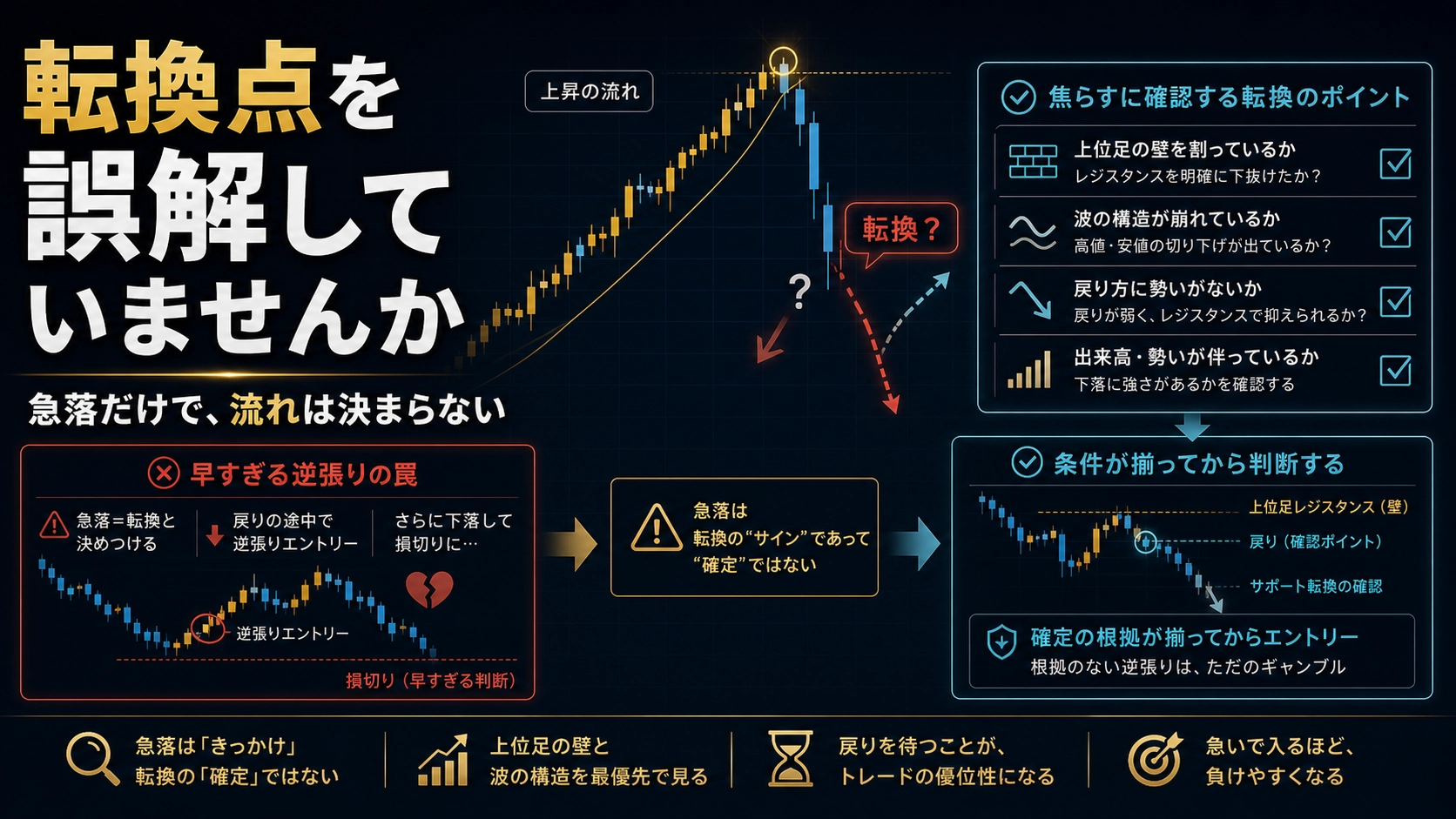
[Traders Misunderstanding the Turning Point] 18 Years of Honest Feelings
If you’re being pushed around trying to pinpoint the turning point, the problem isn’t how you discern it. Today I’ll talk about the root of it.
Good evening!
I’m Masashi.
After trading for 18 years, I’ve realized the biggest difference between those who win and those who don’t is how they move at the moment the trend changes.
↓ A feature article with GOLD special medicine ^^
Please join in while you can.
To Traders Misunderstanding the Turning Point|18 Years of Honest Talk
“It was rising a moment ago, and suddenly it’s dropped.”
In moments like this, how do you act?
❌ People who decide it’s a reversal and go short.
❌ People who think it’s still a pullback and add to their position.
❌ People who don’t know which way it will move and can’t take a position.
? The moment when the direction of the market changes is the moment when traders behave most differently.It’s where traders’ actions diverge the most..
? If you think the turning point is something the chart tells you, you’ll be moved around forever
In this article, I’ll explain, based on 18 years of trading experience, the misunderstandings many traders fall into at the moment when the flow changes.
The turning point“how to discern it”versus, the turning point“fundamental way of thinking”—I’ll organize it from the ground up, so please read to the end ^^
1. At the turning point, what kind of action are you taking?
? How do you discern a turning point?
That kind of question is leading you astray.
A turning-point-related failure isn’t simply “late judgment” or “entered the opposite direction.”
There’s a deeper root problem, and many traders keep making the same mistakes without realizing it.
For example, have you ever experienced this?
❌ The trend is rising and you think it will go further, so you hold a long position.
But immediately after, the price slides downward.
If you think it’s a pullback and don’t cut losses, you end up large negative without realizing it.
Then when you cut losses, it reverses and goes back up (;'∀')
I used to do this a lot in the past.
Or another pattern:
❌ The market moves sharply.
You judge this is a turning point and enter in the opposite direction.
But it’s actually just a temporary pullback, and it returns to its original direction.
You cut losses and feel frustrated at why this happens.
? Both failures share a common issue.
That is trying to judge “whether this is a turning point or a pullback” based only on the chart’s appearance.
? Humans’ eyes are strongly drawn by the immediate movement just before.
When it drops a lot, we feel it might be a turning point.
When it recovers a little, we think it might still go further.
If you act according to this sense, you’ll be tossed around by market fluctuations every time.
? As long as you judge turning points by the magnitude of movement, your accuracy won’t improve
So what should you base your judgment on?
Before touching that, firstorganize the structure of why this happens.
If you don’t understand that, no matter what solution you hear, it’ll end up as “somehow”.
2. The chart’s traps: confusing “turning” with “pullback”
Misreading turning points isn’t a matter of talent or experience.
?Structural problem.
A chart is made by overlapping multiple movements to form a single line.
Within a larger trend, there are small shakes.
Within those small shakes, even finer movements exist.
This is anested structure, but many traders try to view the chart from only one perspective.For example, if you look only at lower time frames, you may see a “plunge,” but on higher frames it may look like a small pullback within a big rise.
Conversely, on lower frames it may look like only a small retrace, while on higher frames it’s the start of a genuine directional change.
? This “perspective misalignment” is the root cause of confusing turning points with pullbacks
So why do many traders misunderstand this?Because they think turning point = big movement.
? In reality, whether a turning point occurs isn’t decided by movement size, but by how the market’s structure—where “walls” and “waves” change—evolves within it..
?Wallis the price range where the market repeatedly reacts.
?Waveis the direction of highs and lows and their continuity.
?Turning point means the continuity of the wave is broken and the movement that has crossed the wall has become established.
Instead of looking for answers in the movement itself, confirm what changed within the market’s structure..
This mental shift is the first step to reducing misreading turning points ^^
But even if you understand the structure, there’s another barrier to cross in the next section: the differences in thinking between winners and losers.
That’s the topic of the next section“Differences in thinking between successful and unsuccessful traders”.
3. Winning traders don’t try to hit the turning point
There’s a fundamental difference in thinking between losing traders and winning traders regarding turning points.
Both groups think differently about turning points..
❌ Firstthe mindset of losing traders.
They set up a forecast that “this will turn here,” and invest energy into whether that forecast will come true.
When the forecast fails, they blame the chart, saying, “Why didn’t it turn?”
Or they cling to “it might still turn,” expanding the losses.
“If this chart pattern appears, it will turn,” “If RSI hits this level, it will turn.”
There was a time I tried to “prophecy” turning points using various indicators.
? Thenwhat do winning traders think?.
? Turningsare treated not as something to predict, but as something to confirm.
Specifically, the order is to “act after confirming whether a turning has occurred.”
“Enter because you think it’s turning” isn’t the idea; “Enter because there is structurally sound evidence of a turning” is.
? Traders who predict and enter are risking the market. Those who enter after confirmation follow the market
The former holds a position on the premise that its forecast is correct.
The latter holds a position waiting for the market to give permission to move.
? As a result, the former tends to enter early and get shaken out just before a turning point.
? The latter enters slightly later but is easier to hold because it’s aligned with the market’s structure.
Moving on a feeling like “I vaguely sense a turning point” is actually the former mindset.
The essence of “vague sense” is reacting to movement size or speed, not confirming the structure.
✍️ Rather than sharpening your intuition, clarify the structure you should verify..
Focusing there will yield faster results ^^
4. A way to read turning points through structure
So far I’ve been saying turning points aren’t judged by feelings or movement size, but confirmed by structural changes.
Then how should you actually approach the market conceptually?
Let’s organize it at a conceptual level.
? First, it’s important to have a habit of timeframes “checking back and forth.”“Verify by going back and forth”.
⚖️ Check the current price action on the lower timeframe.
⚖️ Then check the walls’ positions and wave state on the higher timeframe.
⚖️ And then go back to the lower timeframe to make a judgment.
This back-and-forth matters because each timeframe has its own“role”.
?Lower timeframe role: to observe what is happening right now
?Higher timeframe role: to determine where walls are, what state the waves are in, and whether you are in a position to trade at all
⚖️ Timeframe repetition exists because each is answering a different question
? Next, about how to use “walls.”“Walls”are places where turning is more likely to occur.
Walls do not guarantee turning simply because they’re reached.
? The important thing is when you reach a wall, you should look at“how the wave has changed”.
? If you reach a wall and the wave continuity is broken, a structural basis for turning has formed.
? If you reach a wall and the wave continuity remains, there’s still a chance of a pullback.
?“Don’t hurry to confirm the turning”.
Turning points can be confirmed a little later without issue.
Hurrying to enter means you’ll enter before the turning and get shaken out before it completes.
Over 18 years I arrived at the mindset“It’s okay to be a bit late. Enter where there is a solid basis.”.
Even if you miss the first move, there’s still ample return once the structure is confirmed.
The losses from rushing in and getting shaken out are worse than missing the later gain.
5. Starting tomorrow: How to face turning points in 3 steps
So what exactly should you do starting tomorrow?
I’ve organized it into three steps.
It’s not difficult, but continuing will gradually change your perspective.
?If you want to change something, first change your “way of seeing”.
✅Step 1: Stop deciding turns based on movement size
When prices move significantly and you think “it might be turning,” pause a moment.
Movement size and turning aren’t the same thing.
Practice shifting the criterion from “how big the move is” to “whether the wave’s continuity has broken.”
✅Step 2: Go back and forth between lower and higher timeframes and verbalize what each timeframe is indicating
Don’t stop at “I vaguely feel a turning.” Put it into words (or write it down) and say things like
“Right now, upper timeframe has reached the wall. The wave’s highs are being lowered. Therefore there is a basis for turning.”
Being able to verbalize it keeps entries from being mere feel-based decisions.
Entries that you can’t verbalize are feel-based and not reproducible.
✅
Step 3: Instead of entering when you decide a turning has occurred, set a rule to enter only after the turning’s structure is in place
“Entering because you think it’s turning” is prediction.
“Entering because the basis for turning is in place” is confirmation.
Please formalize this rule in your own system.
Decide that entering before the basis is in place is against the rule.
At first it may feel rigid, but this becomes the foundation for stability.
? The core of what I learned in 18 years is “stop predicting and commit to confirmation”
It’s simple to see, but few people can actually do it.
Because they can’t do it, they make the same mistakes at the same turning points repeatedly.
Starting tomorrow, just become aware of it.
You don’t have to do it perfectly right away.
Just keep these three in mind when you view charts, and your view of turning points will gradually change ^^
Summary
Failing to identify turning points isn’t a matter of talent or lack of experience.The root is the belief that you judge turning points by movement size.
?The fundamental misunderstanding is trying to judge turning points by movement size.
? Confirming the wave’s continuity and the wall’s position structurally.
? The day you stop trying to hit turning points may be the first day you start to beat the market
? The article touches on“how to use walls,” “how to read waves,” “concrete methods for time-frame back-and-forth”—these are explained in detail in my two-year compilation of materials“The Answer of the Market”.
? More details here
https://www.gogojungle.co.jp/tools/ebooks/77829
? I also created a free AI tool for trade analysis. Please try it
https://trade-ai-free.streamlit.app/
【Proven Techniques for Big Profits】
▼ GOLD Special Medicine Manual
https://www.gogojungle.co.jp/tools/ebooks/50406
? Free gift|Partial manual released
https://www.gogojungle.co.jp/info/22533